
24/7 全天候客户支持

免费退货

当日/次日达

品质保障

开启新人专享福利: 全场免邮 | 低至 2 折 | 免费试用 30 天 JoyPlus 会员
下载 Joybuy
Converting direct current from a 12V leisure or vehicle battery into alternating current allows you to run everyday household electronics away from the domestic mains network. Whether you are charging a laptop during a motorway rest stop, running camping equipment in the Highlands, or setting up emergency backup power at home, having a dependable power inverter eliminates the boundary between vehicle power and domestic appliances. Selecting the right model ensures that sensitive devices receive smooth, stable electrical current without overheating or buzzing.
Modern electronic devices, including modern smart devices, medical kit, and power tools, require clean electrical output to operate reliably. Pure sine wave units replicate domestic alternating current, protecting sensitive microprocessors from electrical harmonics and voltage spikes. By evaluating steady output requirements, connection methods, and thermal management, you can pinpoint the exact inverter configuration to keep your gear powered safely on the road.
Electrical appliances fall into resistive loads that consume steady power and inductive loads that demand a brief surge upon start-up. Always match your inverter selection against the continuous rated wattage rather than peak surge figures to prevent premature thermal shutdown.
Modified sine wave inverters produce choppy, stepped power that can cause audio hum, excessive operating heat, and erratic performance in sophisticated electronics. Pure sine wave technology produces smooth sinusoidal curves identical to standard UK grid electricity.
Standard 12V vehicle cigarette lighter sockets are fused to handle up to 150 watts of direct current draw. Demanding greater continuous wattage requires direct connection to the battery terminals using dedicated heavy-gauge cabling.
These featured models offer clean sinusoidal power conversion across compact vehicle travel and high-output off-grid setups.
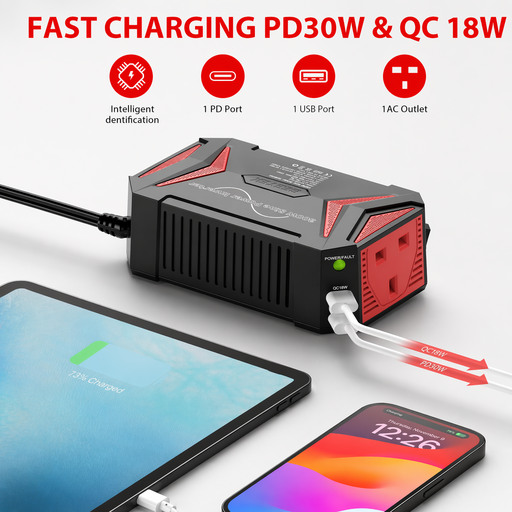
Why It Stands Out: This compact unit changes 12V battery power into 230V or 240V alternating current while offering modern fast-charging standards. It integrates a dedicated PD30W Type-C socket alongside a QC3.0 USB connection, letting you fast-charge smartphones and compatible tablets without occupying the main AC socket. It serves as a neat travel companion for road trips and passenger vehicle workspaces.
Pros:
Who is it for? Drivers, mobile workers, and road trippers needing to power a laptop and fast-charge handheld smart devices directly from a 12V vehicle cabin.
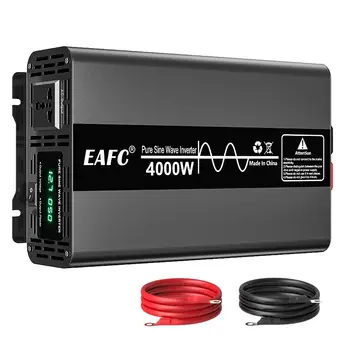
Why It Stands Out: Engineered for serious power demands, the EAFC NBF4000 delivers 2000W of continuous power alongside an impressive 4000W peak surge output. Built with amorphous silicon technology and an integrated multi-protection system, it reliably manages substantial electrical draws. Dual turbine cooling fans maintain optimal internal operating temperatures during heavy work sessions in campervans or emergency setups.
Pros:
Who is it for? Campervan owners, tradespeople, and rural homeowners requiring high-wattage continuous electricity to operate power tools, larger domestic appliances, and backup systems.
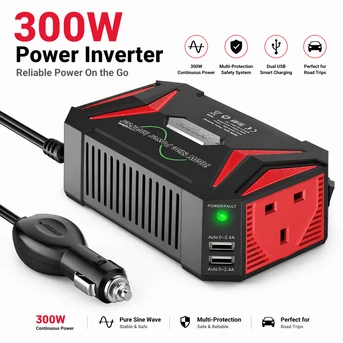
Why It Stands Out: Supplying reliable 300W continuous output, this 12V to 220V-240V pure sine wave inverter features a dedicated household AC socket paired with two standard USB ports providing up to 4.8A combined. When operating above 150W in 12V vehicles, direct connection via battery clamps ensures safe, stable current delivery without stressing in-cabin wiring.
Pros:
Who is it for? Families and touring travellers wanting a dependable in-car adapter to run mains equipment alongside dual USB accessories during UK camping breaks and holidays.
If your specific setup requires higher direct-current battery banks, alternative wattage thresholds, or specialist marine housings, browse the wider catalogue to compare different mounting styles and power configurations. View the complete power inverter range
Vehicle accessory sockets and cigarette lighter ports are typically fused between 10A and 15A, limiting safe prolonged power draw to around 150 watts. Attempting to draw higher continuous loads through an in-cabin socket will blow the interior fuse. For power draws exceeding 150W, always connect the inverter directly to the 12V battery terminals using dedicated heavy-gauge leads.
Pure sine wave inverters produce a smooth, consistent electrical wave identical to the alternating current supplied by national grid mains wall outlets. This clean waveform prevents overheating, operational buzzing, and internal component damage in delicate electronics, modern laptop power supplies, and variable-speed appliance motors.
Running high-draw electrical equipment while a vehicle engine is switched off draws power solely from the starter battery, which can deplete it quickly. To avoid a flat battery, operate heavy electrical appliances only while the engine is running, or connect your inverter to a dedicated secondary deep-cycle leisure battery designed for sustained cyclic discharge.