
24/7 Customer Support

Free returns

Same-day & Next-day Delivery

Quality Guaranteed

Unlock Your Welcome Offers: FREE Delivery | Up to 80% OFF | Free 30-day JoyPlus trial
Download the APP
Navigating the world of pushchairs can feel overwhelming. With so many types, features and styles available, finding the right one for your family's needs is a significant decision. Whether you're a new parent preparing for your first arrival or looking to upgrade for a growing family, the goal is the same: to find a safe, comfortable and convenient way to get around with your little one.
This guide is designed to cut through the clutter. We'll walk you through key considerations for choosing a pushchair and highlight a couple of standout options that balance practicality with comfort, helping you make a confident choice for the journeys ahead.
Before diving into specific models, let's consider a few factors that will influence your decision. Thinking about these points will help you narrow down the features that matter most to you.
Your daily routine is a major factor. If you live in a city and rely on public transport, a lightweight stroller with a compact folding pushchair mechanism will be a priority. Look for models that are easy to collapse with one hand and light enough to carry up a flight of stairs. Conversely, if you enjoy walks in the park or on country paths, a buggy with more robust wheels and good suspension will provide a smoother, more comfortable ride for your child.
For a newborn, it is essential to have a pushchair from birth that offers a fully reclining or lie-flat seat. This position supports their spinal development and ensures their airways remain open. Many pushchairs are designed to adapt as your child grows, offering a long-term solution from birth to toddlerhood. If you're expecting a second child or have two young children close in age, a double pushchair is a practical investment. These come in two main configurations: tandem (one seat behind the other) or side-by-side.
In the UK, all pushchairs must comply with specific safety standards. Look for models that meet the EN 1888 standard, which ensures the product has passed rigorous checks for stability, durability and structural integrity. Features like a secure 5-point safety harness, responsive brakes and lockable swivel wheels are non-negotiable for keeping your child safe on the move.
Based on functionality, user-focused design and adherence to safety standards, here are our recommendations for parents in the UK.
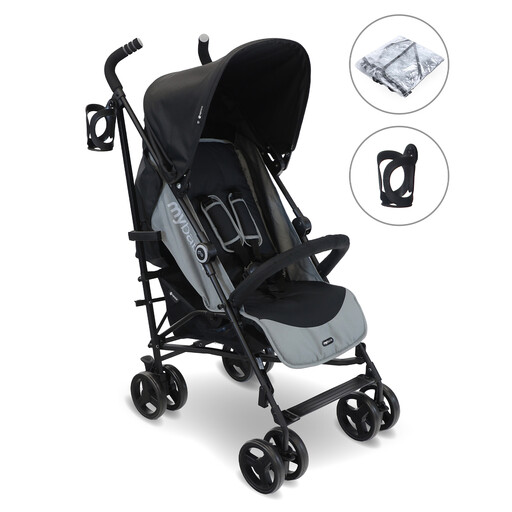
Why It Stands Out This model is a versatile all-rounder, designed to cater to the needs of modern parents from day one. Its key strength lies in its combination of a lightweight frame and suitability from birth. The multi-position, fully reclining seat makes it a practical pushchair from birth, while the simple umbrella fold and carry handle make it an excellent lightweight stroller for travel and daily errands.
Pros
Who is it for? This is an ideal choice for parents seeking a single, adaptable buggy for use from birth up to approximately four years (22kg). It is particularly well-suited for urban families who value portability and ease of storage without compromising on comfort or safety.
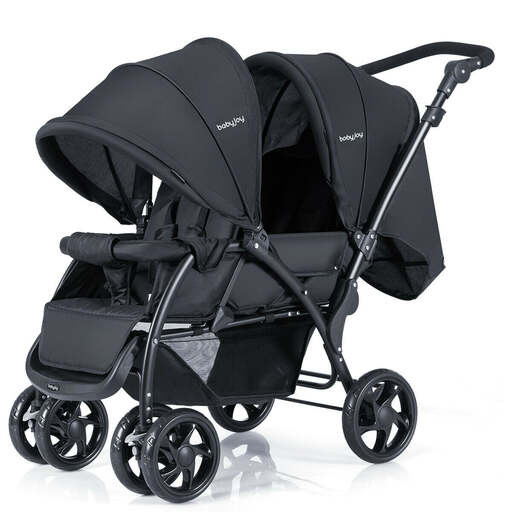
Why It Stands Out Designed specifically for growing families, this tandem pushchair offers a practical solution for transporting two children. Its clever design accommodates children of different ages, with a rear seat suitable from birth and a front seat for children from six months. The adjustable features ensure that both children and the parent remain comfortable during outings.
Pros
Who is it for? This double pushchair is built for parents of two young children, such as a newborn and a toddler. Its tandem design is often easier to manoeuvre through standard doorways than side-by-side models, making it a practical choice for daily use.
Our recommendations cover two highly practical scenarios, but every family's needs are unique. If you're looking for a different configuration, colour or feature set, there are many other models to consider.
To see a wider variety of options, we invite you to explore our full collection of prams and strollers.
1. What is the difference between a pushchair, a stroller and a buggy? In the UK, these terms are often used interchangeably to describe a wheeled chair for a child. However, some people use "stroller" or "buggy" to refer to a more lightweight stroller or a simpler, umbrella-fold model, while "pushchair" might be used for a sturdier system that is often suitable from birth.
2. Do I really need a pushchair with a lie-flat seat for a newborn? Yes, a lie-flat position is crucial for newborns. Babies under six months have not yet developed the muscle strength to support their heads, and a seated position can cause their head to flop forward, potentially restricting their breathing. A lie-flat surface supports their developing spine and ensures their airway remains clear, which is why it is the recommended position for them when in a pushchair.
3. How do I choose between a tandem and a side-by-side double pushchair? The choice depends on your priorities. A tandem pushchair, like the one recommended above, is the same width as a single pushchair, making it easier to navigate through doorways and narrow shop aisles. A side-by-side model allows both children to have a similar view but is wider, which can be a challenge in some environments. Consider where you will be using the pushchair most often before deciding.