
24/7 Customer Support

Free returns

Same-day & Next-day Delivery

Quality Guaranteed

Unlock Your Welcome Offers: FREE Delivery | Up to 80% OFF | Free 30-day JoyPlus trial
Download the APP
Whether you're an automotive mechanic working in a cramped engine bay or a dedicated DIY enthusiast tackling a home project, the right tool can make all the difference. A quality ratchet set is a cornerstone of any serious toolkit, but choosing one can be confusing with all the different sizes, tooth counts and features available. This guide is designed to cut through the clutter, helping you understand the key specifications so you can select a tool that offers both performance and value for your specific tasks.
Before you make a purchase, it's important to understand what makes a ratchet suitable for your needs. Focusing on a few key characteristics will ensure you get a tool that works efficiently and reliably.
The "drive size" refers to the square drive lug that connects the ratchet to the socket. The three most common sizes each have their own ideal applications.
The mechanism inside a ratchet head contains a gear with a specific number of teeth. This determines the "arc swing"—the minimum angle you need to move the handle to engage the next tooth and turn the fastener.
A fine tooth ratchet, such as one with 72 or 90 teeth, requires a much smaller arc swing than a standard ratchet. For example, a 72-tooth ratchet has an arc swing of 5 degrees, while a 90-tooth model has an even smaller swing of just 4 degrees. This is a critical feature when working in confined spaces where handle movement is restricted, as it allows you to continue tightening or loosening a bolt with minimal clearance.
Modern ratchets come with features designed to make your work faster and easier. A reversible ratchet has a small lever on the head that allows you to instantly switch between tightening and loosening without removing the socket. Another valuable feature is the quick release ratchet mechanism. A button on the back of the ratchet head allows you to securely lock sockets in place and release them with a simple press, enabling fast, one-handed changes.
Based on features that offer practical benefits for both professionals and hobbyists, here are our recommendations.
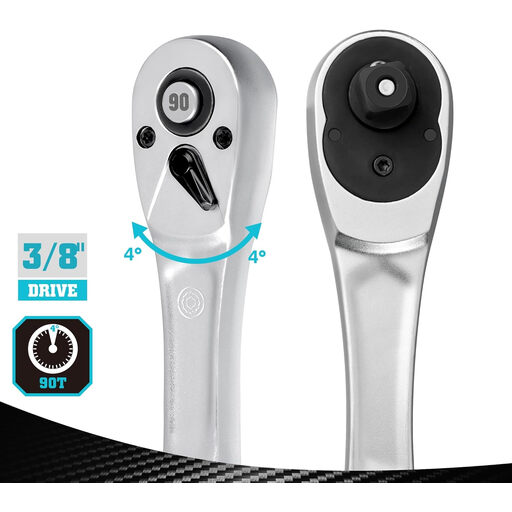
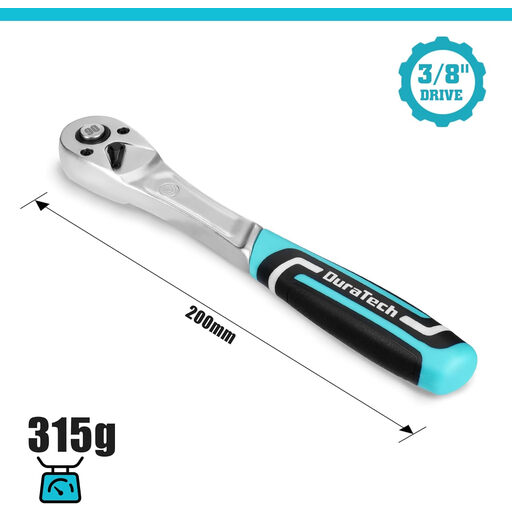
Why It Stands Out: This ratchet's main advantage is its 90-tooth mechanism, which provides a very narrow 4-degree arc swing. This makes it exceptionally useful for working in tight quarters where other ratchets simply can't get a grip. The construction from chrome vanadium steel adds to its durability and resistance to corrosion.
Pros:
Who is it for?: Automotive mechanics, engineers and serious DIYers who frequently encounter fasteners in restricted spaces and need a reliable, versatile 3/8 inch ratchet.
Why It Stands Out: Taking the benefits of a fine-tooth mechanism into an even smaller form factor, this 1/4 inch ratchet is built for precision. It shares the same 90-tooth gear and 4-degree swing as its larger counterpart, making it a powerful tool for intricate jobs where space is at an absolute premium.
Pros:
Who is it for?: Technicians and hobbyists working on electronics, vehicle dashboards or small machinery where a standard-sized tool is too cumbersome.
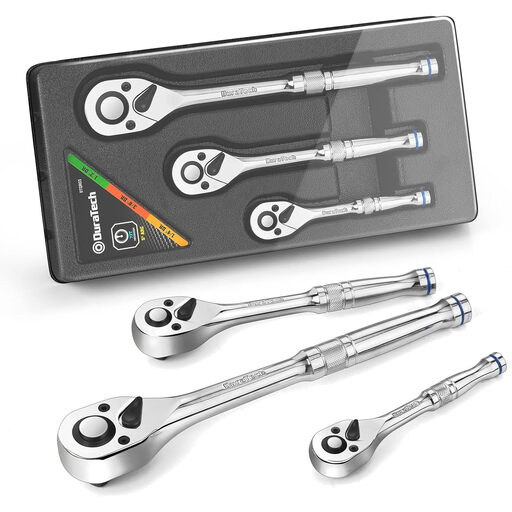
Why It Stands Out: This set offers a complete solution by providing all three common drive sizes (1/4", 3/8" and 1/2") in one package. Each ratchet features a reliable 72-tooth mechanism with a 5-degree arc swing, offering a great balance of precision and strength. The included storage case keeps the tools organised and protected.
Pros:
Who is it for?: Anyone looking to build a complete mechanics tool set or upgrade their existing collection. It's an excellent starting point for apprentices or a versatile addition for any professional workshop or home garage.
If you're building out your toolkit and need more than just a socket wrench set, it's worth exploring a wider selection of hand tools. Browse our collection of chrome handles and other workshop essentials to find exactly what you need for your next project.
The primary difference is the arc swing. A 72-tooth ratchet requires 5 degrees of handle movement to turn a fastener, while a 90-tooth ratchet only needs 4 degrees. This makes a 90-tooth model more effective in very tight spaces where you can't move the handle very far.
The three most common drive sizes are 1/4-inch, 3/8-inch and 1/2-inch. The 1/4-inch is for light-duty, precision work; the 3/8-inch is a versatile all-purpose size; and the 1/2-inch is for heavy-duty, high-torque applications.
A quick-release mechanism features a button on the ratchet head that, when pressed, releases the socket. This allows for rapid, often one-handed, socket changes, which improves workflow and efficiency, especially when you need to switch between different socket sizes frequently.