
24/7 Customer Support

Free returns

Same-day & Next-day Delivery

Quality Guaranteed

Unlock Your Welcome Offers: FREE Delivery | Up to 80% OFF | Free 30-day JoyPlus trial
Download the APP
Whether you're a professional mechanic working in a busy garage or a dedicated DIY enthusiast tackling a weekend project, you know the frustration of a stubborn bolt in a tight space. A standard spanner requires constant removal and repositioning, turning a five-minute job into a thirty-minute ordeal. This is where a quality ratchet spanner set becomes an indispensable part of your toolkit.
A ratchet spanner combines the grip of a ring spanner with the speed of a ratchet, allowing you to tighten or loosen fasteners quickly without lifting the tool. This guide is designed to help you understand the key features to look for and to highlight some practical options available for your workshop or home garage.
Selecting the right set can feel overwhelming with all the different features available. Focusing on a few key aspects will help you find a tool that meets your needs for efficiency and durability.
The internal mechanism of a ratchet spanner is defined by its tooth count. A higher tooth count results in a smaller swing arc, which is the minimum angle you need to move the handle to engage the next tooth.
Your choice between a fixed or flexible head depends on the type of work you do most often.
The material of your spanners determines their lifespan and performance under stress. Chrome vanadium spanners are the industry standard for a reason. This steel alloy is heat-treated for high strength and hardness, ensuring it can withstand high torque without deforming. The finish is also important; a mirror-polished chrome finish offers excellent corrosion resistance and is easy to clean, while a matte finish can provide a better grip in oily conditions.
Here are a few carefully selected options that cater to different needs, from professional technicians to home mechanics.
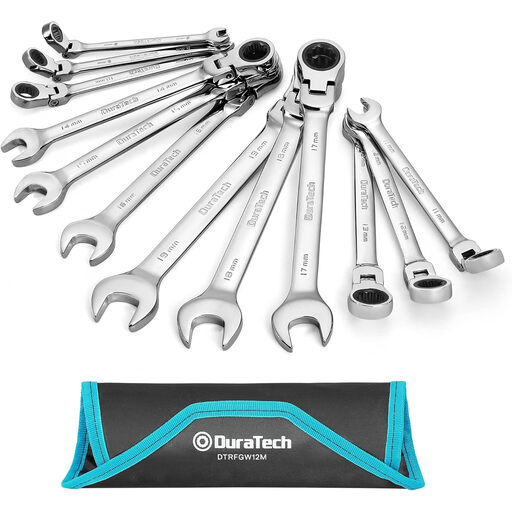
Why It Stands Out: This set combines versatility with performance. The 180-degree flex head provides excellent access around obstructions, while the 72-tooth ratchet mechanism ensures efficient work with a tight 5-degree swing arc. The comprehensive range of common metric sizes makes it a highly practical choice.
Pros:
Who is it for? This is an ideal mechanics tool set for professional automotive technicians and serious DIYers who frequently encounter hard-to-reach bolts in engine bays and chassis work.
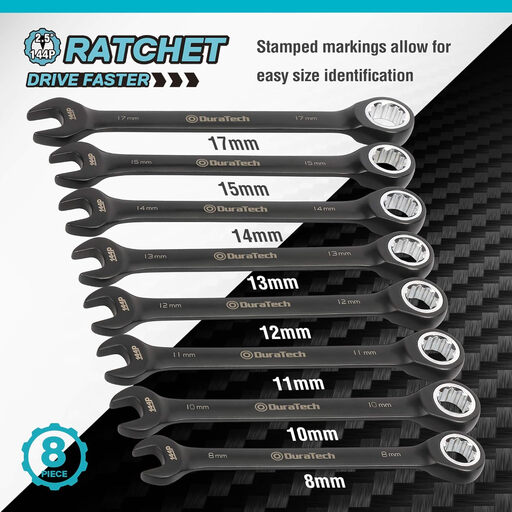
Why It Stands Out: The standout feature here is the advanced 144-tooth ratchet mechanism. Requiring just a 2.5-degree swing arc, it is designed for precision work in the most cramped quarters where other spanners simply cannot operate. The black chrome finish adds an extra layer of corrosion resistance.
Pros:
Who is it for? This set is aimed at professional mechanics and industrial users who demand the highest level of precision and accessibility for working in tight, complex machinery or modern, compact engine bays.
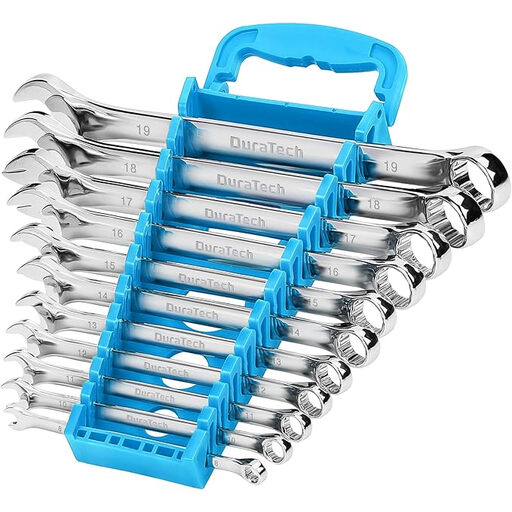
Why It Stands Out: For those who prioritise strength and simplicity, this traditional combination spanner set is an excellent choice. While it doesn't have a ratchet mechanism, its robust, single-piece construction is perfect for applying high torque. The ring end is offset by 15 degrees to provide clearance for your fingers, and the 12-point design grips fasteners securely to prevent rounding.
Pros:
Who is it for? This is a foundational metric spanner set for home DIYers, apprentices and anyone needing a reliable, no-fuss set of spanners for general maintenance, assembly and repair tasks.
A great spanner set is a cornerstone of any toolkit, but sometimes a project requires more. If you are building your collection from the ground up or need a comprehensive solution for your vehicle, you might want to consider a pre-assembled kit.
Explore our range of complete tool bag with tools to find everything you need for your next project, all organised in one convenient package.
The primary advantage is speed. The ratcheting mechanism allows you to turn a fastener continuously without having to lift and reposition the tool after each turn. This dramatically speeds up work, especially in areas with limited access where repositioning a standard spanner is difficult.
The tooth count is very important as it determines the swing arc. A higher tooth count, such as 144 teeth, results in a smaller swing arc of just 2.5 degrees. This means you can effectively tighten or loosen a bolt with very little handle movement, which is essential when working in the confined spaces of an engine bay or behind appliances.
Flex head spanners provide unmatched accessibility for awkward angles. The pivot mechanism is engineered to be strong, but for tasks that require maximum force, like breaking loose a seized or heavily rusted bolt, a solid fixed-head spanner or a breaker bar is generally recommended. It's best to use flex head spanners for their intended purpose: improving access and speed, not for applying extreme torque.