
24/7 Customer Support

Free returns

Same-day & Next-day Delivery

Quality Guaranteed

Unlock Your Welcome Offers: FREE Delivery | Up to 80% OFF | Free 30-day JoyPlus trial
Download the APP
Navigating a dark hallway, fumbling for a switch in the garage or trying to find a specific jacket in a poorly lit wardrobe are common frustrations. Running mains power to these areas is often costly and impractical. This is where a rechargeable motion sensor light offers a simple, effective and wire-free solution.
These convenient devices provide illumination exactly when and where you need it, enhancing both safety and convenience around your home. However, with so many options available, choosing the right one can be confusing. This guide is designed to cut through the clutter, helping you understand the key features to look for and highlighting a few standout options for different needs.
As a Joybuy Product Recommendation Officer, my role is to provide clear, practical advice to help you make an informed decision for your home.
Before diving into specific products, let's cover a few key considerations. Focusing on these will help you find a light that perfectly suits your space, whether it's a small cupboard or a large shed.
The brightness of a light is measured in lumens (lm). The right amount depends entirely on the location. A subtle wardrobe sensor light might only need 100-200 lumens to help you see your clothes, whereas a primary shed light or garage light would benefit from 400 lumens or more for clear visibility.
Colour temperature, measured in Kelvin (K), affects the ambiance. A lower Kelvin value (around 3000K) produces a warm, yellowish light, which is often preferred for living spaces and bedrooms. A higher value (6000K+) produces a cool, blue-white light that is excellent for task-oriented areas like workshops and garages. Some models offer adjustable colour temperatures for greater versatility.
The core appeal of these lights is their wire-free nature. Look for a USB rechargeable light for maximum convenience, as you can simply detach the unit and charge it with a standard USB cable. Battery capacity, measured in milliampere-hours (mAh), is a key indicator of how long the light will last between charges. A larger mAh rating (e.g., 8000mAh) will provide significantly longer run-times, which is especially useful for a frequently used motion sensor ceiling light.
Installation should be straightforward and not require an electrician. Many models use strong magnetic strips or adhesive pads, allowing you to attach them to any flat surface in seconds. For larger, circular ceiling lights, a simple screw-in mounting plate is common. Consider the design: a slim, bar-style rechargeable LED light is perfect for under cabinets and inside wardrobes, while a round ceiling-style unit provides wider, more even coverage for a whole room.
Here are a few rechargeable motion sensor lights that cater to different common use cases, selected for their features and practicality.
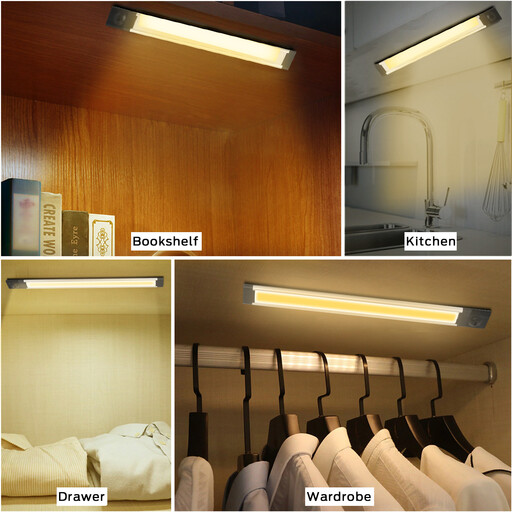
Why It Stands Out: This light’s standout feature is its gesture control. Instead of fumbling for a button, a simple wave of the hand turns it on or off and adjusts the brightness. Its slim aluminium body and versatile mounting options (magnetic or hanging hooks) make it incredibly adaptable.
Pros:
Who is it for? This is an excellent choice for modern interiors, ideal for use as an under-cabinet kitchen light, a wardrobe sensor light or a sophisticated hallway night light where its sleek design and interactive control can be appreciated.
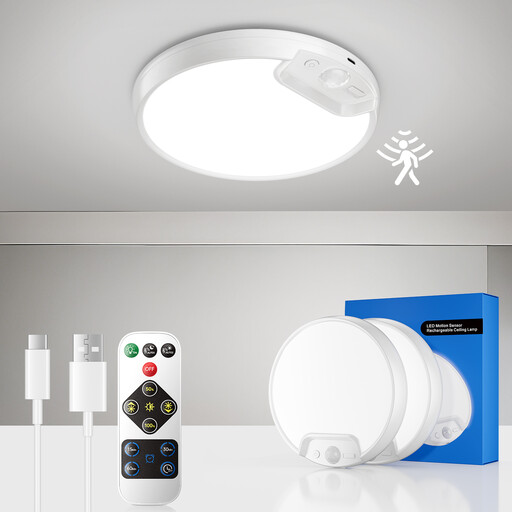
Why It Stands Out: This offering provides great value with two units in one pack, each powered by a substantial 8000mAh rechargeable battery. The inclusion of a remote control adds a layer of convenience, allowing you to manually override the sensor, adjust brightness and switch modes from a distance.
Pros:
Who is it for? This pack is ideal for homeowners needing a practical, long-lasting lighting solution for multiple utility areas like a garage, shed, loft or basement. The remote control makes it particularly useful for spaces with high ceilings.
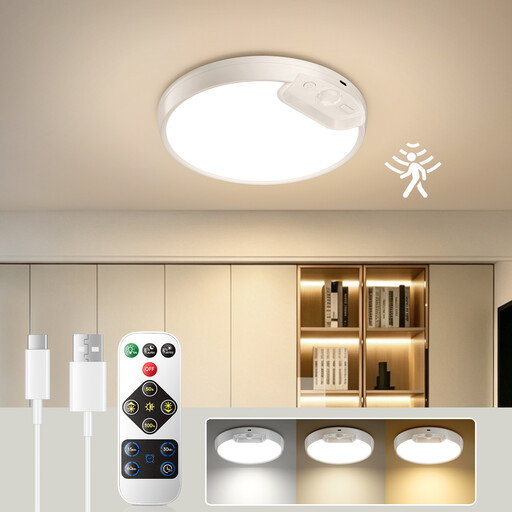
Why It Stands Out: This single ceiling light is all about customisation. It combines a powerful 500-lumen output with the ability to choose between three distinct colour temperatures (3000K, 4000K and 6500K). Paired with five brightness levels and a remote control, it offers complete control over your lighting environment.
Pros:
Who is it for? This is the perfect all-in-one solution for someone who wants maximum versatility from a single light. It’s well-suited for a multi-purpose garage, workshop or even a bathroom where you might want bright, cool light for tasks and warm, dim light for relaxing.
If these specific models aren't quite what you're looking for, don't worry. There is a wide variety of shapes, sizes and feature sets available to suit any need.
? Explore our full collection of Indoor LED Motion Sensor Lights to find the perfect fit for your home.
1. How long do rechargeable motion sensor lights last on a single charge? This depends heavily on the battery capacity (mAh) and how often the light is activated. Models with large batteries, such as the 8000mAh units mentioned, can last for several weeks or even up to 90 days in auto-sensor mode with average use (e.g., 10 activations per day). Smaller, slimline lights may require charging every one to three weeks.
2. Can I install a motion sensor light myself? Absolutely. The vast majority of these products are designed for easy DIY installation without needing an electrician. Common methods include magnetic backing that sticks to metal surfaces, strong adhesive pads for walls and cabinets, or a simple mounting bracket that attaches with one or two screws.
3. Where is the best place to install a motion sensor light? For safety, high-traffic areas like hallways, stairways and landings are ideal. For convenience, they are perfect for inside wardrobes, kitchen cupboards, pantries, sheds and garages. When placing your light, consider the sensor's detection range and angle to ensure it activates when you approach from the intended direction.