
24/7 Customer Support

Free returns

Same-day & Next-day Delivery

Quality Guaranteed

Unlock Your Welcome Offers: FREE Delivery | Up to 80% OFF | Free 30-day JoyPlus trial
Download the APP
Struggling to find things in a dark wardrobe? Fumbling for a light switch on late-night trips to the kitchen? Or perhaps you're looking for a simple way to make your stairs safer after dark. You're not alone. Many of us face these small but persistent frustrations at home, wishing for a straightforward lighting solution that doesn't involve complex wiring or calling an electrician.
As a Joybuy Product Recommendation Officer, my role is to help you find practical solutions. This guide is designed to walk you through the key features of rechargeable motion sensor lights and present some carefully selected options to help you illuminate your space with ease.
Before diving into specific products, let's cover a few key considerations. Thinking about these points will help you select the right light for your needs.
Most wireless LED lights use a PIR sensor light (Passive Infrared) to detect motion. This sensor is triggered by the heat signatures of people or pets moving within its range. Consider where you'll place the light. For a long hallway or stair lights, a wider detection angle and a longer range (e.g., 3-5 metres) are ideal. For a small cupboard light, a shorter range is perfectly sufficient. Some models also include a light sensor, so they only activate in the dark, which helps to conserve battery life.
Brightness is measured in lumens (lm). For task-oriented areas like under cabinet lighting in the kitchen, a brighter light (300-400 lm or more) is beneficial. For ambient or safety lighting, a softer glow is often enough.
Colour temperature, measured in Kelvin (K), affects the mood of the light:
The main appeal of these lights is their simple, tool-free installation. Most are stick on lights that use strong adhesive pads, often combined with magnets. This allows you to easily remove the light for charging without peeling the mount off the wall. Opting for USB rechargeable lights is generally more cost-effective and environmentally friendly than using disposable battery operated lights. Check the battery capacity (measured in mAh)—a higher number typically means a longer time between charges.
Here are a few recommended options that showcase the different features available, helping you find a suitable match for your home.
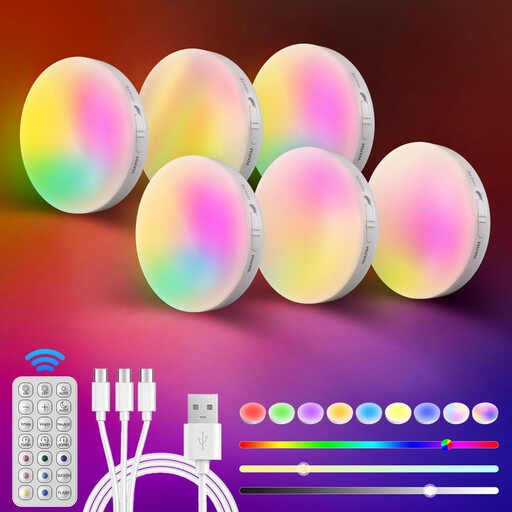
Why It Stands Out: This 6-pack offers exceptional versatility. It combines practical motion-sensing with decorative lighting, thanks to its remote control that allows you to switch between 7 RGB colours and 3 standard white temperatures.
Pros:
Who is it for?
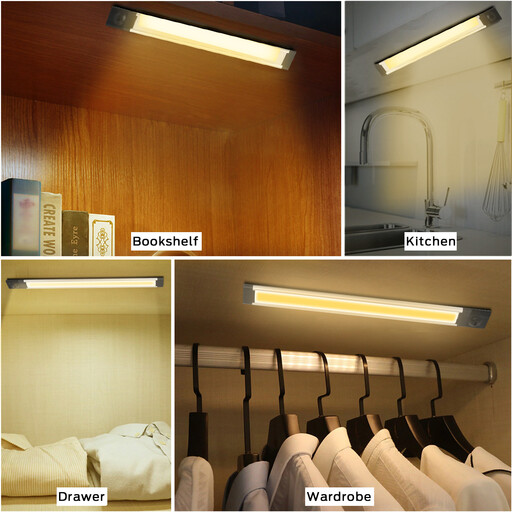
Why It Stands Out: The standout feature here is the modern gesture control. A simple wave of the hand turns the light on or off and adjusts the brightness, offering a hygienic, touch-free experience. Its sleek aluminium and ABS plastic construction gives it a premium feel.
Pros:
Who is it for?
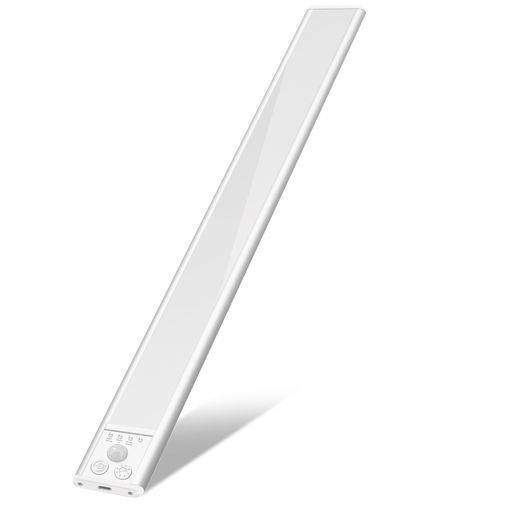
Why It Stands Out: This light's ultra-thin profile (10 mm thick) allows it to blend seamlessly into any space, making it an excellent wardrobe light or discreet under-shelf illuminator. It also boasts a large 1100mAh battery for extended use between charges.
Pros:
Who is it for?
If the recommendations above aren't quite the right fit, or if you're looking for a different size or style, there are many other solutions available.
? Explore our full range of wardrobe LED lamps to find the perfect light for your home.
They use a Passive Infrared (PIR) sensor to detect the heat (infrared energy) emitted by a person or animal moving into its field of view. When motion is detected, it triggers the light to turn on. After a set period of no motion, it automatically turns off to save power.
This depends on the battery's capacity (measured in mAh) and how frequently the light is activated. A light with a larger battery, such as one with 1100mAh, will generally last longer than one with a smaller capacity. On average, most lights can last for several weeks or even months on a single charge with typical household use.
For the most secure installation, stick on lights should be applied to a smooth, clean and dry surface like finished wood, metal, tile or painted walls. They may not adhere as well to porous, rough or textured surfaces like brick, raw wood or certain types of wallpaper. Always clean the surface before application to ensure a strong bond.