
24/7 Customer Support

Free returns

Same-day & Next-day Delivery

Quality Guaranteed

Unlock Your Welcome Offers: FREE Delivery | Up to 80% OFF | Free 30-day JoyPlus trial
Download the APP
For any motorhome or caravan owner, ensuring tyre safety on long journeys across the UK is a primary concern. An unexpected tyre failure can not only disrupt your holiday but also pose a significant safety risk. A reliable RV tyre pressure monitoring system (TPMS) provides real-time data, giving you the awareness needed to address potential issues before they escalate.
This guide is designed to help you navigate the key features to look for in a TPMS for larger vehicles. We will explore some practical considerations and present a few recommended options to help you make an informed choice for your travels.
Selecting a system for a large vehicle is different from choosing one for a standard car. Here are a few crucial factors to keep in mind.
The distance between the tyres on a long caravan or motorhome and the driver's cabin can be substantial. Standard wireless signals may struggle to provide a stable, consistent connection. For this reason, a TPMS with a signal booster (or repeater) is highly advisable. This device is installed between the sensors and the display unit to amplify the signal, ensuring you receive uninterrupted data, which is essential for any wireless tyre pressure system for trucks or long trailers.
Unlike passenger cars, the tyres on RVs, trailers and trucks operate at much higher pressures. It is vital to choose a system that can accurately monitor this higher range. Look for a motorhome tyre pressure monitor with a range that comfortably exceeds your vehicle's recommended tyre pressures, such as 0-188 PSI. Additionally, count how many tyres you need to monitor. If you are towing, you will need a trailer TPMS kit with enough caravan tyre sensors for both the towing vehicle and the trailer itself. Systems are often available with 4, 6, 8, or more sensors.
An effective TPMS should do more than just display pressure. Look for systems with multiple alarm modes, including alerts for rapid air leaks, high and low pressure and high temperatures. These immediate warnings allow you to react quickly. Also, consider the power source. Many modern units feature solar charging capabilities for the display and long-life batteries in the sensors, reducing maintenance and ensuring the system is always ready.
Here are a few systems that offer features well-suited for the demands of RV and trailer owners.
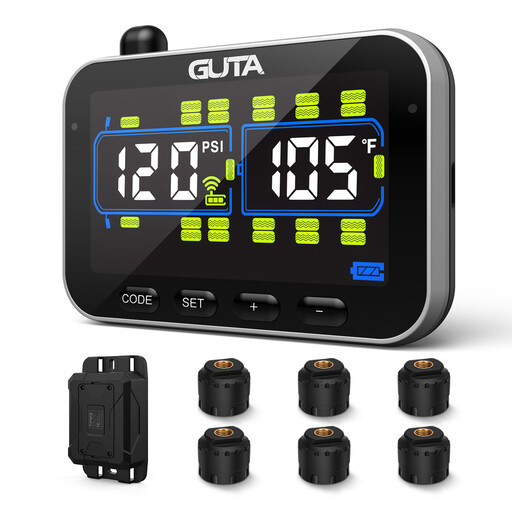
Why It Stands Out This GUTA system is designed specifically for long vehicles, offering a wide monitoring range of 0-188 PSI. It comes equipped with a signal repeater to maintain a stable connection over longer distances, making it suitable for large motorhomes and trailers. The large, colour LCD screen provides clear, real-time data for both pressure and temperature and its six distinct alarm modes offer comprehensive warnings for common tyre issues.
Pros
Who is it for? This 6-sensor kit is a practical choice for owners of medium-to-large motorhomes or those towing a single-axle caravan or trailer.
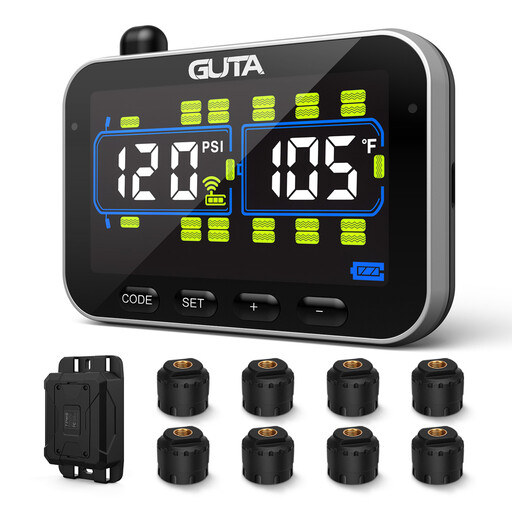
Why It Stands Out Building on the same reliable platform as the 6-sensor model, this version includes eight sensors to accommodate vehicles with more tyres. It retains the crucial 0-188 PSI pressure range and the included signal booster for dependable performance on vehicles up to 50 feet long. The system supports up to 24 tyres if additional sensors are purchased, offering excellent scalability for complex setups like fifth-wheel trailers or light-duty commercial trucks.
Pros
Who is it for? Ideal for drivers of large RVs towing a twin-axle caravan, operators of fifth-wheel trailers or small fleet managers who need to monitor more tyres simultaneously.
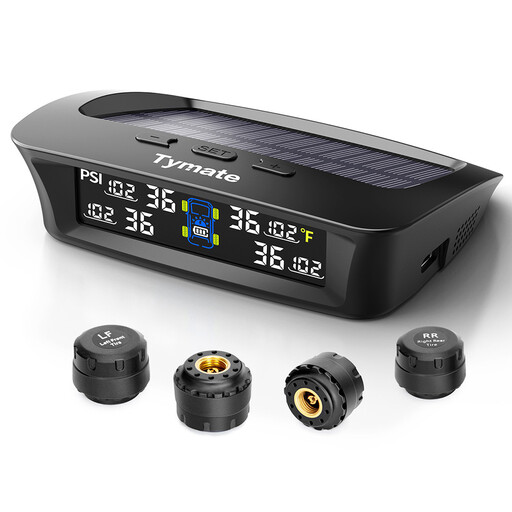
Why It Stands Out While designed with a lower pressure range of 0-87 PSI, this Tymate system is a solid option for smaller campervans, Class B motorhomes or for monitoring just the towing vehicle. It features a clear LCD colour screen and five alarm modes to keep you informed. The monitor includes a built-in lithium iron phosphate battery and supports solar charging, offering flexible power options for life on the road.
Pros
Who is it for? This system is well-suited for owners of smaller motorhomes, campervans or SUVs used for towing, where the tyre pressures do not exceed 87 PSI.
If the recommendations above don't quite match your vehicle's specific needs, or if you're looking for a different sensor count, there are many other models available.
? Explore our full range of Tyre Pressure Monitors to find the perfect fit for your vehicle.
1. Do I need a TPMS for my caravan? While not legally mandatory for all caravans in the UK, fitting a TPMS with caravan tyre sensors is highly recommended for safety. A caravan tyre failure can cause a dangerous loss of control. A TPMS provides an early warning of pressure loss or overheating, allowing you to pull over safely before a major incident occurs.
2. How does a wireless tyre pressure monitoring system work for a long trailer? A wireless tyre pressure system for trucks and long trailers uses battery-powered sensors screwed onto each tyre's valve stem. These sensors transmit pressure and temperature data via a radio frequency (typically 433.92MHz) to a display unit in the cab. For longer vehicles, a signal booster is often placed on the trailer's A-frame or at the rear of the towing vehicle to amplify the signal and ensure it reaches the display without interruption.
3. What is a good pressure range for a motorhome tyre pressure monitor? Motorhome tyres run at significantly higher pressures than car tyres, often between 50 and 100 PSI or more, depending on the vehicle's weight and tyre specifications. A good motorhome tyre pressure monitor should have a maximum range that comfortably exceeds your highest recommended pressure. A system with a range up to 180 PSI or higher provides a safe margin and ensures compatibility with a wide variety of Class A, B and C motorhomes.
By Joybuy Product Recommendation Officer