Sewists who clear the table after each session
You need room for the machine and moving fabric while you sew, then a manageable way to store the machine, pedal and lead. Body dimensions, a carry handle and a cover are useful details to compare.


Start with a machine whose body and working area fit your table; a compact mechanical model is a sensible choice for ordinary cotton placemats if you put it away after each session. If your designs have bulky binding or several layers, check clearance and feeding for the exact fabric stack. Electronic speed and needle-position controls are worth considering if they would make corners easier for you to sew.
You need room for the machine and moving fabric while you sew, then a manageable way to store the machine, pedal and lead. Body dimensions, a carry handle and a cover are useful details to compare.
You want straightforward straight seams, a way to secure them and stitch settings you can adjust. Bobbin access and threading may matter more to you than a long decorative-stitch list.
Overlapping layers can make corners and binding joins bulkier than a flat seam. Check presser-foot clearance, feeding features and the needle recommended for your actual fabrics.
Consider it when: You mainly sew cotton placemats and need to put the machine away; KMR Sewing lists the Janome J3-18 body at W390 × D150 × H280 mm.
Trade-off: Its mechanical controls do not offer the electronic corner-control functions described for the Brother Innov-is A16.
Consider it when: You have more table area and want features such as the Brother AE1700’s metal chassis and drop-in bobbin.
Trade-off: At W44.5 × D19.4 cm, its listed body uses more width and depth than the Janome J3-18 body listed by KMR Sewing; a metal chassis does not establish how it will handle your particular layers.
Consider it when: You want to set a slower sewing speed or position the needle before pivoting; Brother lists both controls for the Innov-is A16.
Trade-off: Those controls do not tell you whether the machine’s dimensions or fabric clearance suit your workspace and placemat layers.
For placemats on a small table, establish the working space and basic seam requirements before deciding whether thicker-layer features or electronic controls take priority.
| Concern | What to check | Who this matters to |
|---|---|---|
| Workspace and storage | Compare body width and depth with your clear tabletop; allow for the pedal, lead and fabric movement. | If I clear the table after sewing, the whole setup must be manageable, not just the machine body. Around 33% of consumers put workspace and storage first. |
| Basic seams | Check straight-stitch adjustment, reverse sewing or another seam-securing control, and bobbin access. | For simple cotton placemats, I want to make and secure seams without navigating functions I will not use. Basic seams come first for around 33% of consumers. |
| Bulky sections | Check presser-foot clearance and feeding information against your planned layers and binding joins. | My binding and seam intersections may be thicker than the placemat panels, so getting those sections through the machine matters most. Around 20% of consumers prioritise bulky sections. |
| Corner control | Compare the exact model’s speed control and needle-position functions. | When I approach a corner, I want time to slow down and position the needle before turning. Such control is the primary concern for around 14% of consumers. |
Body sizes differ: KMR Sewing lists the Janome J3-18 at W390 × D150 mm, while the Brother AE1700 measures W44.5 × D19.4 cm. Neither measurement includes the space needed to move a placemat.
Measure your clear work area and compare both machines in the same units, leaving room beside and behind the needle.
Extra stitch patterns do not establish whether a machine offers the straight-stitch adjustment and seam-securing controls you need for placemat construction.
Check those construction functions first, then decide which additional stitches or controls you would actually use.
A flat fabric stack may be easier to pass under the presser foot than a corner where batting, backing and binding overlap. A model’s feeding description is not a guarantee for every combination of fabrics.
List the layers at your bulkiest join and check the exact model’s presser-foot clearance and needle guidance before buying.
An electrical machine’s documentation, applicable marking and repair arrangements matter alongside its sewing features. GOV.UK describes different conformity-marking processes for Great Britain and Northern Ireland.
Confirm the version intended for your delivery region, its documentation and the seller’s warranty-repair route.
Janome offers several different points of comparison here, from the J3-18 mechanical model to the computerised 230DC.
The AE1700 and Innov-is A16 illustrate different priorities: a mechanical machine with listed body dimensions, and an electronic model with speed and needle-position controls.
The Simple 3223 is a mechanical option to examine if adjustable stitches and clearance for raised fabric sections matter to your project.
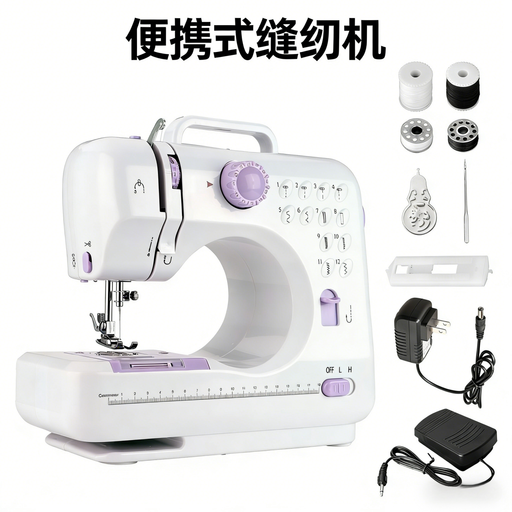
This compact sewing-machine option is worth assessing for a limited tabletop and straightforward placemat seams. Check its controls and clearance against your planned layers before choosing it for thicker work.
 No image available
Consider this compact-format machine if you need to clear a small table after sewing basic placemats. Its product name specifies 12 stitches, dual power and an LED light; compare the complete working setup with your available space.
Before using batting or bulky binding, confirm stitch-length adjustment, presser-foot clearance and suitable power arrangements for your version with the seller.
Allow more than the machine’s stated width and depth: the pedal, lead and fabric moving beside and behind the needle also need room. For body-size reference, KMR Sewing lists the Janome J3-18 at W390 × D150 × H280 mm, while the Brother AE1700 measures W44.5 × D19.4 × H37 cm.
Not necessarily: for cotton placemats, start by checking straight-stitch control, seam securing and how the machine feeds your planned layers. If you regularly sew bulky batting or binding joins, check the exact machine’s clearance and feeding features rather than relying on a category name.
Not for every placemat project: a long stitch list does not replace room to work or the controls needed to make and secure straight seams. Choose additional patterns when your designs call for them, and compare body dimensions separately.
Check the documentation and applicable marking for the version being sold to your delivery region. GOV.UK describes different conformity-marking processes for Great Britain and Northern Ireland; ask the seller which version you are buying rather than assuming that one marking answers every regional question.
Ask the seller for the warranty terms covering the exact model and who handles repairs if a fault develops. Confirm the repair route and any conditions before purchase rather than assuming another model’s arrangements apply.