First-time woven-skirt maker
You want manageable controls for sewing seams, waistbands and hems in stable woven fabric, without buying a machine primarily for specialist stretch finishes.


For simple skirts in stable woven fabric, start by considering a domestic sewing machine with the stitches and adjustments your pattern needs. A computerised model is worth considering if you will repeat a design and value speed control and convenient settings. Treat an overlocker or coverstitch machine as a separate, specialist decision when stretch fabric or a particular finish is central to the skirts you plan to sell.
You want manageable controls for sewing seams, waistbands and hems in stable woven fabric, without buying a machine primarily for specialist stretch finishes.
You expect to repeat a skirt pattern and care about controlling your sewing pace and setting up consistently between garments.
You plan to work regularly with jersey or other stretch fabrics, so the seams and hems you intend to make affect whether specialist equipment is worth considering.
Choose around the fabric and construction of your first skirt pattern, then decide whether repeated batches or a specialist finish justify a different machine route.
Consider it when: You are learning to make simple woven skirts and prefer direct dial controls.
Trade-off: Manual setup and a multi-step buttonhole, where fitted, may be less convenient when you repeatedly make the same design.
Consider it when: Controlling pace and returning to familiar settings matter across a small batch.
Trade-off: Extra controls may add complexity you do not need for occasional simple skirts; this route does not replace specialist knit-finishing equipment.
Consider it when: Stretch skirts or a specific edge or cover-hem finish recur in your planned range.
Trade-off: An overlocker and a coverstitch machine perform different finishing tasks and each adds another threading and setup workflow.
| Concern | What to check | Who this matters to |
|---|---|---|
| Simple woven-skirt setup | Check the stitch types, adjustable stitch length and ease of threading needed for your seams and hems. | I want to learn on stable woven fabric without struggling to set up each seam. Around 40% of consumers put straightforward construction first. |
| Repeatable small-batch sewing | Look for speed control and settings you can readily use again; check buttonhole options if the pattern has button closures. | When making several skirts from one pattern, I want a pace and setup I can manage consistently. Repeatable workflow comes first for around 30% of consumers. |
| Closures, layers and details | Match presser-foot access and any foot-pressure adjustment to the closures, enclosed areas and fabric layers in your pattern. | My skirt designs may change in their closures or hem construction, so I need to check those details before settling on a machine. Roughly 20% of consumers prioritise this flexibility. |
| Stretch seams and hems | Decide whether you need an overlock edge or a cover hem; for serging stretch fabric, check differential-feed controls. | If stretch skirts will be a regular product, I need seams and hems suited to that fabric. Specialist stretch finishing is the main concern for around 10% of consumers. |
A coverstitch machine is not interchangeable with an overlocker: Janome describes the CoverPro 2000CPX as a cover-hem machine, not an overlocker. Neither is an automatic first choice for straightforward woven skirts.
List the fabrics and finishes in your first collection, then decide whether a specialist machine addresses a task you will perform regularly.
A second machine also brings another threading and setup routine.
Differential feed serves particular serging tasks. Brother advises that its setting varies with fabric elasticity and warns against using it on thick, non-stretchable denim.
Test the intended seams and hems on scraps of your actual fabric, and follow the instructions for the machine and attachment you choose.
For skirts sold in England, Scotland or Wales, fibre-content labelling is part of preparing the finished product, not a sewing-machine feature. GOV.UK sets out the fibre-content requirement, while Business Companion explains how labels must be presented.
Keep the composition details for the fabrics and components you use, and plan legible, durable English-language labels before the craft fair.
Recording composition as you make each skirt can avoid having to revisit finished stock to prepare its labels.
These named model lines illustrate different machine routes; their features should not be assumed to apply to every machine from the same brand.
Janome UK & Ireland lists domestic models for basic woven-skirt construction and a separate CoverPro line for cover hems.
Brother presents the L14S as a beginner-oriented machine and the Innov-is A16 as an electronic option with additional controls.
Singer describes the Start 1306 as a beginner-oriented mechanical machine for basic sewing.
This compact domestic machine is a candidate to assess for simple skirt-making. Before relying on it for craft-fair batches, check that its stitches and adjustments suit your pattern and that it handles your chosen fabric and layered hems.
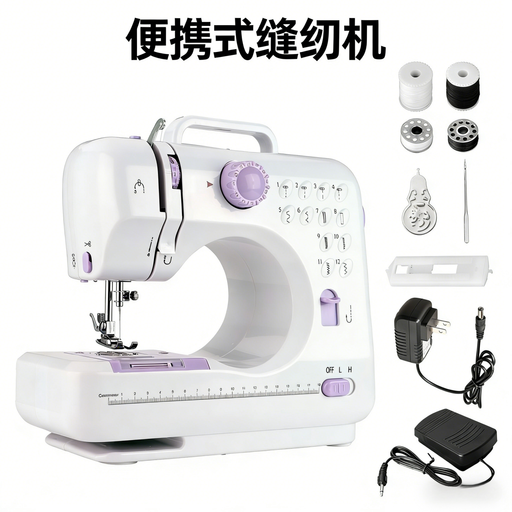 Image unavailable
For a simple skirt pattern, check that this machine can make the seams and hems you intend to sew. The named variant has 12 stitches, dual power and an LED light; confirm the included stitch types, available adjustments and suitability for your fabric and layered hems before choosing it for repeated work.
Not necessarily: a domestic machine is the starting route for simple woven-skirt construction. Consider specialist equipment when stretch fabric or a particular finish is central to your range, and distinguish an overlocker from a coverstitch machine; Janome says its CoverPro 2000CPX makes cover hems and is not an overlocker.
Test the planned seams and hems on scraps of your actual fabric, including the layers your pattern creates. If you serge stretch fabric, Brother advises testing differential-feed settings on a scrap because the suitable setting depends on fabric elasticity.
Speed control is worth considering if you want to manage your pace while learning or repeating details across several skirts. Brother lists slide speed control on the Innov-is A16, and Janome lists a maximum-speed controller on the 230DC; check the feature on the exact machine you plan to buy.
Skirts sold in England, Scotland or Wales need fibre-content information under the textile-labelling guidance published by GOV.UK. Where components have different fibre contents, check how each must be identified; Business Companion also specifies that labels must be in English, durable, legible, visible and accessible. Keep fabric-composition details as you make the skirts so you can prepare the finished labels.