
24/7 Customer Support

Free returns

Same-day & Next-day Delivery

Quality Guaranteed

Unlock Your Welcome Offers: FREE Delivery | Up to 80% OFF | Free 30-day JoyPlus trial
Download the APP
As a Joybuy Product Recommendation Officer, my role is to help you navigate the growing market of home wellness gadgets. With increasing awareness of indoor air quality, particularly in UK cities, many are looking for effective ways to create a healthier home environment. A smart air purifier can be a significant step, helping to reduce common airborne irritants like dust, pollen and pet dander.
This guide is designed to cut through the clutter. We will explore the key features to look for when choosing a home air cleaner and present a few of our top recommendations for 2026 to help you find a model that suits your space and needs.
Before diving into specific products, it’s helpful to understand a few core concepts. Considering these points will ensure you select a purifier that genuinely makes a difference in your home.
One of the most important specifications is the Clean Air Delivery Rate (CADR). This figure, measured in cubic metres per hour (m?/h), tells you how quickly the purifier can clean the air within a specific room size. A higher CADR means faster purification. As a general rule, look for a model with a CADR that is appropriate for the square footage of the room where you plan to use it most. Manufacturers usually provide a recommended room size, which makes this process straightforward.
The heart of any purifier is its filter. Most high-quality models use a multi-stage system:
The "smart" in smart air purifier refers to its connectivity and automation. An air purifier with app control allows you to monitor your home's air quality, adjust settings remotely and set schedules from your smartphone. Many also feature an 'Auto Mode', which uses sensors to detect changes in air quality and automatically adjusts the fan speed.
For bedrooms or offices, noise is a critical factor. A quiet air purifier for bedroom use should have a dedicated sleep mode that operates at a very low decibel (dB) level, typically below 30dB, ensuring it doesn't disturb your rest.
Here are a few standout smart air purifiers that offer a great balance of performance, features and user-friendliness.
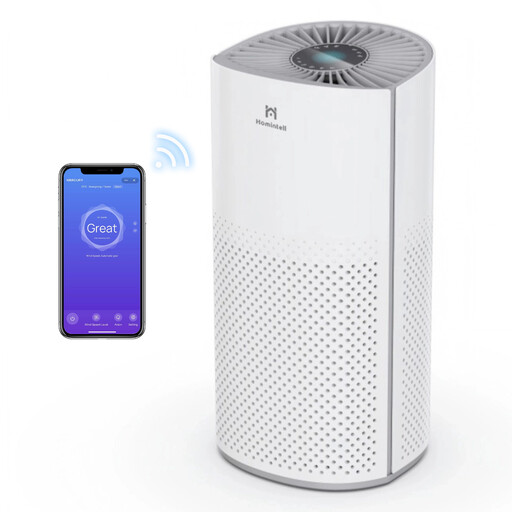
Why It Stands Out: The Homintell model is a compact yet feature-rich unit designed for efficiency in smaller spaces. Its 360-degree air intake ensures comprehensive room coverage, while the real-time PM2.5 display provides immediate visual feedback on your air quality via a colour-changing indicator. It combines a three-stage filter with UV sterilisation for an added layer of purification.
Pros:
Who is it for? This purifier is an excellent choice for bedrooms, home offices or other small to medium-sized rooms up to 25m?. It's ideal for users who appreciate having visual data and multiple purification technologies in one device.
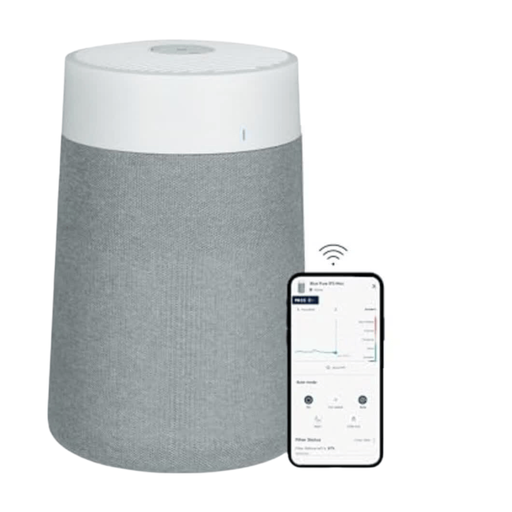
Why It Stands Out: Blueair combines Scandinavian design with advanced technology. The 511i Max uses HEPASilent filtration, which the brand states delivers high performance with lower noise and energy consumption than traditional HEPA filters. Its smart features are particularly advanced, with RealTrack technology providing an accurate calculation of remaining filter life based on actual usage and pollution levels.
Pros:
Who is it for? This model is well-suited for users with medium-sized living rooms or bedrooms who prioritise quiet performance and advanced smart home integration. The customisable aesthetic also appeals to the design-conscious.

Why It Stands Out: The Xiaomi Smart Air Purifier 4 Pro is built for performance in large spaces. It boasts a high CADR and integrates seamlessly into the Mi Home smart ecosystem. A key feature is its crisp OLED touchscreen, which displays not only PM2.5 levels but also temperature and humidity, giving you a comprehensive overview of your indoor environment.
Pros:
Who is it for? This is the purifier for those with large, open-plan living areas. It's also a natural fit for anyone already using Xiaomi's smart home products, offering a unified and powerful control experience.
If these recommendations don't quite fit your specific requirements, there are many other models to consider. Different sizes, feature sets and designs are available to suit every home and budget.
Explore our full range of air sensor and purification devices to find the perfect match for your needs.
This depends on the model, your home's air quality and how often you run the purifier. A general guideline is every 6 to 12 months. A major benefit of a smart air purifier is that most will track filter usage and notify you through an app when it's time for a replacement, taking the guesswork out of maintenance.
Yes, for many people it can. By filtering out airborne allergens like dust, pollen and pet dander, it can help reduce nighttime congestion and irritation that might otherwise disrupt sleep. When choosing a model for the bedroom, look for one with a dedicated 'Sleep Mode' and a noise rating below 30dB to ensure it runs without causing a disturbance.
The value of smart features comes down to convenience and efficiency. An air purifier with app control lets you manage your device from anywhere, which is useful for turning it on before you get home. Furthermore, the 'Auto Mode' found on most smart models adjusts fan speed based on real-time sensor readings. This means it only works as hard as it needs to, which can optimise performance and energy consumption.