Small-table draft-review teams
Several colleagues contribute edits from seats around one table while remote attendees follow the discussion. Seating distance and microphone coverage matter more than speaker volume alone.


For several colleagues reviewing a draft around one table, start with the manufacturer’s room guidance and microphone pickup range, then check for full-duplex audio if people are likely to interrupt or respond to remote attendees. If the furthest seats fall beyond one unit’s stated coverage, consider a model that supports linking two units. Confirm the connection method and exact meeting-platform variant before ordering.
Several colleagues contribute edits from seats around one table while remote attendees follow the discussion. Seating distance and microphone coverage matter more than speaker volume alone.
Contributors sit across a larger table or room, making a single tabletop unit’s stated coverage a key limit. These groups may need a model with confirmed two-unit pairing.
Colleagues move between shared desks and meeting rooms, so they need a connection method that works with their devices and regular conferencing application.
Check the seating layout and microphone reach first; then consider how the group talks, connects and moves between rooms.
| Concern | What to check | Who this matters to |
|---|---|---|
| Room coverage | Measure the furthest seat against the exact model’s microphone pickup range and room guideline. Check whether it supports linking units if one cannot cover the table. | When colleagues sit across the review table, I need remote attendees to hear the furthest contributor as well as the nearest one; around 36% of consumers put coverage first. |
| Two-way discussion | Check for full-duplex audio and review the model’s microphone features. Consider how background noise and room echo could affect a discussion. | During line-by-line edits, I want people in the room and on the call to respond without repeatedly waiting for the other side to finish; roughly 29% of consumers prioritise conversational flow. |
| Platform and setup | Confirm the exact variant’s connection and any required platform certification. Check that the conferencing app can select it as both microphone and speaker. | If the team joins reviews through a standard meeting platform, I need the right device and variant ready before discussion starts; around 21% of consumers put setup compatibility first. |
| Moving between devices | Check the connection type, dimensions, weight and stated battery operation where relevant. Keep Bluetooth device range separate from microphone pickup range. | When reviews move between rooms or devices, I need a unit I can carry and connect without changing how the meeting runs; approximately 14% of consumers place flexibility first. |
Voice-processing features cannot make up for contributors sitting beyond the microphone’s stated pickup range.
Measure the room and furthest seat before choosing. If one unit’s coverage is insufficient, check for confirmed pairing or linking capability rather than relying on a louder speaker.
Certification and controls can differ within a product line. Jabra lists Teams certification for Speak2 75 as variant-dependent.
Match the manufacturer’s product code and the retailer’s exact variant to the integration your organisation requires.
Bluetooth range describes the connection to a phone or computer, not how far a colleague can sit from the speakerphone and still be picked up.
Plan seating with the microphone pickup specification and room guideline; use Bluetooth range only when deciding where the connected device can sit.
The Speak2 75 illustrates a portable speakerphone route for a shared desk or small meeting room.
The Sync 40+ illustrates a USB and Bluetooth option for a small meeting space.
The PowerConf S500 illustrates a speakerphone route with two-unit expansion.
The EXPAND 40 illustrates a portable Bluetooth or USB-C option for meetings.
These choices cover a Bluetooth speakerphone to assess for a review table where linking units may matter, and a wired model to assess for a smaller shared space. Check seating coverage and the exact configuration before choosing between them.
 No image available
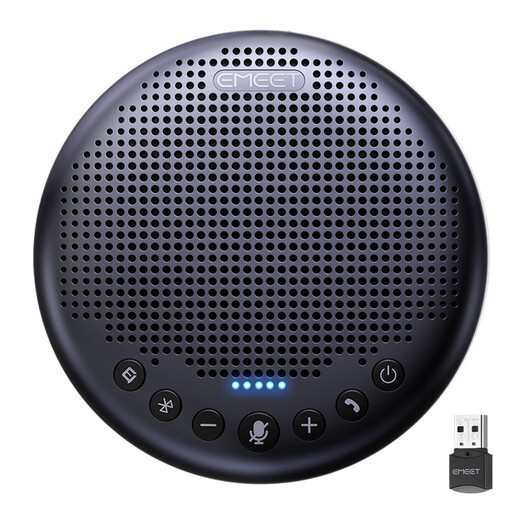
For a review table where linking two units may be useful, confirm the expansion method and whether the chosen package includes a second unit.
The product name specifies Bluetooth, eight microphones and a 5 W speaker. Check the manufacturer’s room and microphone-reach guidance against your seating layout, and confirm any platform certification your organisation requires.
 No image available
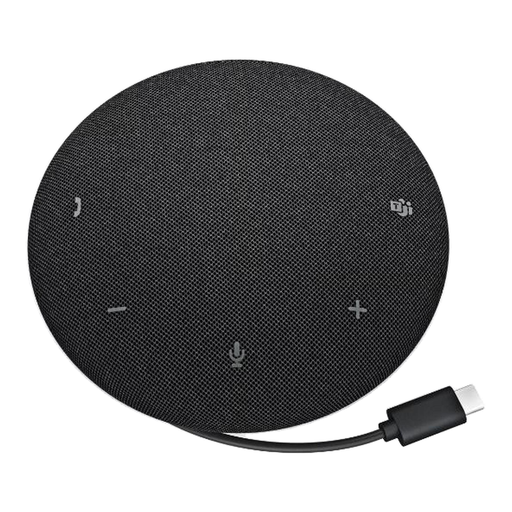
For a smaller review table using a wired connection, compare the furthest seat with the microphone coverage for this exact model.
Its product name identifies a wired speakerphone. Confirm the connector suits your computer, and check full-duplex support if in-room and remote colleagues often speak at the same time.
One unit is a reasonable starting point when every speaker sits within the exact model’s stated microphone reach and room guideline. Jabra specifies pickup up to 2.5 m for Speak2 75, and HP gives the same pickup figure for the cited Poly Sync 40+; check the furthest seat and consider a model with confirmed linking capability if one unit cannot cover the group.
No. Full duplex supports simultaneous two-way speech, which matters when colleagues interrupt or respond during edits, but it does not extend microphone coverage or remove loud background noise and room echo.
Use a connection method supported by the exact speakerphone and select it as both the microphone and speaker in the computer and meeting application. AnkerWork’s PowerConf S500 guide notes that users may need to choose the device manually in their PC system or conferencing software.
Choose a Teams-certified variant if your organisation requires certified integration or dedicated Teams controls, rather than assuming generic audio connection is enough. Jabra says Speak2 75 certification varies by version, while HP lists the cited Poly Sync 40+ model as Teams certified, so confirm the exact product code before ordering.