
24/7 Customer Support

Free returns

Same-day & Next-day Delivery

Quality Guaranteed

Unlock Your Welcome Offers: FREE Delivery | Up to 80% OFF | Free 30-day JoyPlus trial
Download the APP
Finding the right toy car can feel like navigating a crowded racetrack. With so many options promising flips, tricks and high-speed action, it’s easy to get lost in the marketing noise. You want something that will genuinely excite and entertain, whether it's for a child's birthday or a new hobby, but you also need it to be durable and worth the investment.
As a Joybuy Product Recommendation Officer, my role is to help you find products that deliver on their promises. This guide cuts through the hype to offer clear, practical advice on choosing the perfect stunt car. We will look at key features to consider and highlight a few standout models that offer great performance and fun.
Before you make a decision, here are a few key factors to consider. Thinking about these points will help you match a car to the user's age, interests and play environment.
The way a stunt car is powered directly impacts its convenience and running costs. Many models are now a rechargeable stunt car, often using a standard USB cable. This is a cost-effective and environmentally friendly option, as you won't need to keep buying disposable batteries. Check the product details for charge time versus playtime; a good balance is around 30 minutes of action per charge. Alternatively, traditional pull-back cars require no batteries at all, offering instant, repeatable fun powered purely by mechanics.
Stunt cars are built for action, which means they need to withstand bumps, tumbles and the occasional crash. Look for features like protective roll cages, robust plastic bodies and flexible, shock-absorbing suspension. The type of tyres is also crucial. Large, grippy rubber tyres are a hallmark of an all terrain rc car, enabling it to tackle everything from living room carpets to garden grass and gravel paths. For those who love the spectacle of a good collision, a purpose-built crash and smash toy car with break-apart and rebuildable parts can provide endless entertainment.
The type of control system determines the driving experience. Simple, button-based remote controls are perfect for younger children, allowing them to execute pre-programmed tricks like 360-degree spins with ease. For older children and hobbyists, a 4WD RC car with proportional steering and throttle offers a more nuanced and responsive drive, similar to a real vehicle. This advanced control is ideal for mastering precise turns and navigating complex obstacle courses. When looking at stunt capabilities, consider what kind of action you're after. Many are toy cars that do flips, while others are designed for speed, drifting or impressive crashes.
Based on features, design and play value, here are a few recommendations that stand out in the current market.
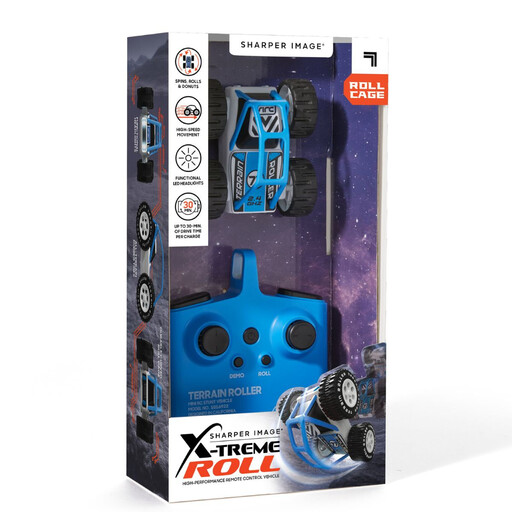
Why It Stands Out: This remote control stunt car is designed for non-stop action. Its most notable feature is the oversized, durable roll cage, which not only protects the vehicle but also allows it to self-right after a flip. This means less time spent running over to fix a crash and more time spent driving. The simple, one-button stunt controls make it incredibly accessible for beginners to perform impressive spins and tumbles straight out of the box.
Pros:
Who is it for? This is an excellent choice for children aged 6 and up who are new to RC cars. Its user-friendly controls and robust, self-righting design remove common frustrations, making it a fun and engaging introduction to the world of stunt driving.
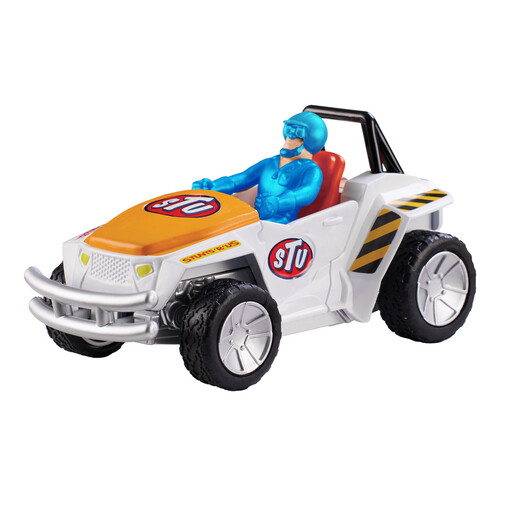
Why It Stands Out: Stuntman Stu offers a different kind of thrill. Instead of avoiding crashes, it encourages them. This pull-back crash and smash toy car is designed to dramatically fall apart on impact—the hood flies off, the body separates and the ejector seat sends the wobbly Stuntman Stu figure flying. The fun comes from creating spectacular crashes and then easily rebuilding the buggy to do it all over again.
Pros:
Who is it for? Perfect for children aged 5 and up who love hands-on, imaginative play. Its battery-free operation and focus on crashing and rebuilding make it a fantastic toy for those who enjoy creating their own action-packed stories.
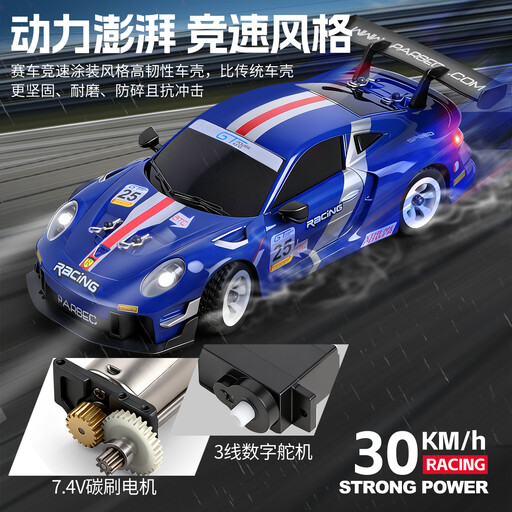
Why It Stands Out: For those seeking more performance and control, this RC buggy is a significant step up. It features a proper 4WD RC car system and independent suspension, delivering superior traction and stability on a variety of surfaces. Unlike simpler RC toys, it has proportional steering and throttle, meaning the car responds precisely to subtle inputs from the controller. This allows for high-speed cornering and a much more engaging driving experience.
Pros:
Who is it for? This rally car is aimed at older children, teenagers and entry-level hobbyists who want a taste of high-performance RC racing. Its responsive handling makes it a rewarding vehicle for developing driving skills.
The world of toy cars is vast, with models designed for racing, off-roading and every kind of stunt imaginable. If the recommendations above aren't quite what you're looking for, or if you'd like to see a wider variety of styles, there are many other vehicles to discover.
Explore our full collection of toy racing cars for more choices.
1. What is a good age for a remote control stunt car? This depends heavily on the model's complexity. Simpler, more robust cars with easy controls are often suitable for children aged 5 or 6 and up. More advanced models with higher speeds and proportional controls are better suited for children aged 8+ or teenagers. Always check the manufacturer's age recommendation, as some models contain small parts that can be a choking hazard for younger children.
2. Are rechargeable stunt cars better than ones that use disposable batteries? A rechargeable stunt car is generally more convenient and cost-effective in the long run. You won't have the recurring expense of buying batteries and charging via USB is simple. However, cars using disposable batteries can be back in action immediately if you have spares on hand, whereas a rechargeable car will have some downtime while it powers up.
3. What does 4WD mean for an RC car?4WD stands for four-wheel drive. In a 4WD RC car, the motor sends power to all four wheels simultaneously. This provides significantly better traction and handling compared to two-wheel drive (2WD) models, especially on slippery or uneven ground. It makes the vehicle a capable all terrain RC car, able to climb and corner with greater stability.