
24/7 Customer Support

Free returns

Same-day & Next-day Delivery

Quality Guaranteed

Unlock Your Welcome Offers: FREE Delivery | Up to 80% OFF | Free 30-day JoyPlus trial
Download the APP
As a Joybuy Product Recommendation Officer, my role is to help you navigate the crowded market of children's products. When it comes to finding a toddler trampoline, the goal is simple: a safe and enjoyable way for your little one to burn off energy indoors. However, many parents find themselves with a product that is noisy, unstable or simply gathers dust in a corner. Let's look at the common pitfalls to avoid before you buy.
The search for a great kids mini trampoline often leads to three main purchasing regrets:
A child's first trampoline should be a source of fun, not frustration. By focusing on a few key parameters, you can find a durable and safe option that your family will use for years.
To find a reliable indoor trampoline for toddlers, it's crucial to look past the bright colours and focus on the engineering. Here are the non-negotiable features to check.
The mechanism that provides the bounce is the most important feature. You have two main choices:
For a toddler, a handle is not optional; it's a critical stability feature. Look for a 36 inch trampoline with handle that is:
In many UK homes, space is at a premium. A small trampoline for kids is ideal, with a 36-inch (91 cm) diameter being a popular and practical size. It provides enough room for safe bouncing without dominating a room. For maximum convenience, consider models that are foldable, allowing them to be stored away easily when not in use.
Based on these practical criteria, we've matched a few standout options to different family needs.
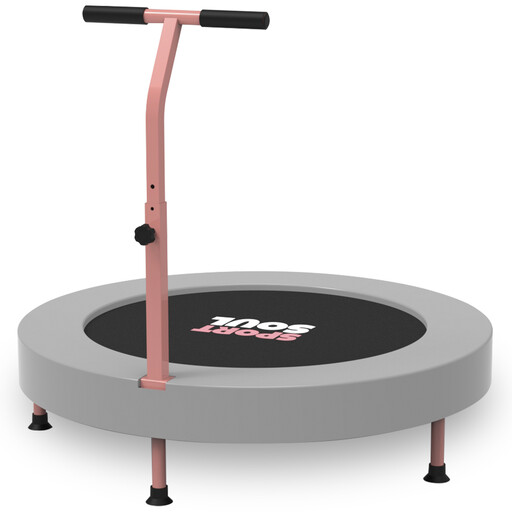
Why This Fits Their Persona: This model is ideal for flat living where noise is a primary concern. The springless design ensures near-silent bouncing, and its foldable frame makes it easy to tuck away in a cupboard or under a bed, preserving precious living space.
It directly solves the "Neighbour-Annoyer" problem by replacing loud steel springs with 24 elastic resistance bands. This also eliminates the pinch-point hazard entirely.
Quiet operation suitable for flats. Foldable design for compact storage. Adjustable T-shaped handle for growing children.
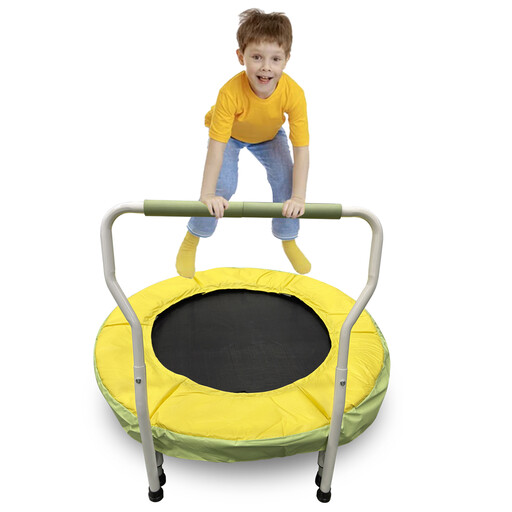
Why This Fits Their Persona: For the parent whose top priority is mitigating every possible risk, this model's standout feature is its comprehensive safety padding. It offers the classic bounce of springs while adding an essential layer of protection.
It tackles the "Pinch-Point Hazard" head-on with a full-coverage spring safety pad that leaves no gaps between the mat and the frame, providing peace of mind.
Comprehensive spring cover for enhanced safety. Provides a responsive, classic spring-based bounce. Features a sturdy, adjustable handle.
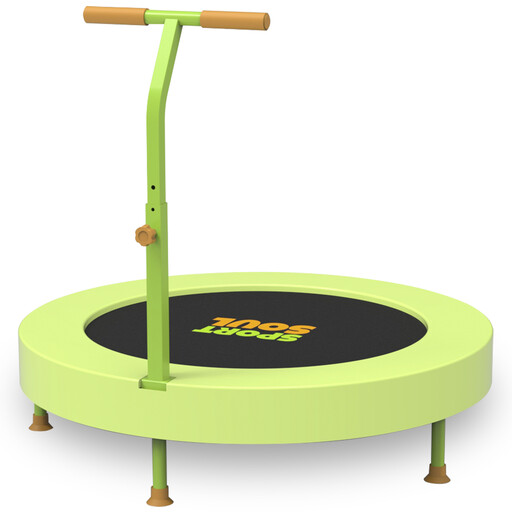
Why This Fits Their Persona: This user wants a product that will last. The combination of a durable steel frame, a low-maintenance elastic band system and a highly adjustable handle means this trampoline can adapt as a child grows from a wobbly toddler into a more confident bouncer.
It avoids the "Wobbly Frame" issue with a heavy-duty steel construction. The adjustable T-shaped handle ensures the product remains ergonomically suitable for a child over several years, preventing it from being outgrown quickly.
Height-adjustable handle accommodates growth. Durable steel frame for long-term stability. Quiet elastic band system requires minimal maintenance.
We have compiled a complete, real-time list of products that fully satisfy these strict selection criteria and UK safety regulations.
Most manufacturers recommend their child's first trampoline for ages 3 and up. The key is that the child should have stable balance and be able to stand and walk confidently. Regardless of age, constant adult supervision is essential. Always follow the specific age and weight guidelines provided by the manufacturer.
Both systems are designed for durability, but they wear differently. High-quality steel springs can last for years but may eventually stretch or break. Elastic bands are also very durable and resistant to weathering, but they can lose some elasticity over a long period of heavy use. For the typical use of a toddler trampoline, both systems offer excellent longevity. The choice often comes down to a preference for noise level and bounce feel.
For a standard 36-inch model, you should have at least 1-2 metres of clear space around the trampoline on all sides, away from furniture, walls and other hazards. Crucially, also check your overhead clearance. Ensure there is ample space above the trampoline to prevent any risk of the child hitting their head on ceilings or light fixtures.