Who is this for?

Dedicated hobby-room listeners

If you are assembling a separate hi-fi system and are comfortable cueing records yourself, check the deck’s setup requirements and how it will connect to your other components. Rega, Pro-Ject and Audio-Technica describe different manual designs, but their stated features do not establish how any one deck will sound in your room.

Owners of line-level systems

If your powered speakers or amplifier have a line-level input but no PHONO input, you need a suitable phono pre-amplifier in the signal path. It may be built into the turntable or supplied as a separate component; check the output setting before connecting it.

Listeners who prefer less handling

If you would rather not cue and return the tonearm by hand, a fully automatic turntable is worth considering. Check that it plays the record speeds in your collection and has an output that suits your speakers or amplifier.

What matters when choosing?

Start with the inputs on your existing system, then decide how much manual handling and adjustment you want from a turntable for your hobby room.

Concern What to check Who this matters to
System connection Identify whether your speakers are powered or passive, whether the amplifier has a PHONO input, and whether the turntable offers PHONO or LINE output. I want the turntable to work with the speakers and amplifier I already own, without connecting the wrong signal level. Around 36% of consumers would put connection compatibility first.
Manual listening and placement Check the required record speeds, documented damping or isolation features, and whether you have a stable place for the deck. I am happy to cue records by hand and want to assess how a manual deck will fit into my hobby-room setup. Around 29% of consumers would make that deliberate listening setup their main concern.
Ease of operation Confirm whether start, stop and tonearm return are automatic, and whether the deck supports the speeds you use. I would rather start an LP without learning to cue and return the tonearm immediately. For around 21% of consumers, simpler operation would be the priority.
Future flexibility Check the specified stylus and cartridge options, available adjustments, and whether 78 RPM is needed for your collection. I expect to explore compatible stylus or cartridge changes, or I own records that need another speed. Around 14% of consumers would place that flexibility first.

What should you avoid?

  • Assuming any turntable connects to any speaker

    Passive speakers still need an amplifier, and a PHONO-level turntable output needs a PHONO input or a separate phono pre-amplifier. Audio-Technica warns that feeding an internally pre-amplified LINE output into an amplifier’s PHONO input can distort sound and could damage connected equipment.

    Write down your amplifier or powered speakers’ inputs before choosing the turntable and its output setting.

    A separate phono pre-amplifier may be needed when the deck outputs PHONO level and your amplifier has only line-level inputs.

  • Treating isolation features as a room-performance guarantee

    Manufacturers describe features such as damped platters and isolation feet, but their effect in use depends on the deck’s support and nearby sources of vibration.

    Choose a stable position for the turntable and consider its stated isolation features alongside the furniture and floor in your hobby room.

  • Buying for record speeds or upgrades you have not checked

    Audio-Technica specifies 33 1/3 and 45 RPM for the AT-LP60X, while the AT-LP5X also supports 78 RPM. Stylus and cartridge adjustment options likewise depend on the exact model.

    Check your records before making 78 RPM a requirement, and confirm compatible parts and adjustments before planning a cartridge change.

    A planned change may require compatible parts or help with setup.

Brands to consider

Rega

Rega’s Planar 1 and Planar 1 Plus are manual options for a separately assembled listening system.

  • Rega specifies a factory-fitted Carbon cartridge and pre-set bias for the Planar 1; the Planar 1 Plus adds an integrated moving-magnet phono stage.
  • If your amplifier has only line-level inputs, confirm the phono-stage arrangement for the exact model rather than assuming the standard Planar 1 connects directly.

Pro-Ject

The manual Debut Carbon EVO is an option for listeners comparing speed selection and placement-related design features.

  • Pro-Ject specifies electronic 33/45 RPM speed change, a pre-adjusted Ortofon 2M Red cartridge, a TPE-damped steel platter and height-adjustable feet for this model.
  • Check how the Debut Carbon EVO will connect to your amplifier or powered speakers; these manufacturer features do not establish its sound in a particular room.

Audio-Technica

Audio-Technica offers different approaches across the automatic AT-LP60X and manual AT-LP5X and AT-LP7X.

  • Audio-Technica specifies automatic 33 1/3 and 45 RPM playback for the AT-LP60X, three-speed playback and a switchable MM/MC pre-amplifier for the AT-LP5X, and VTA adjustment for the AT-LP7X.
  • Those capabilities are model-specific: check the chosen deck’s record speeds, output setting and compatible stylus or cartridge parts.

Joybuy turntables for automatic playback

These Sony turntables suit listeners considering automatic playback and a Bluetooth connection. Check how either model will connect to the rest of your hobby-room system before choosing.
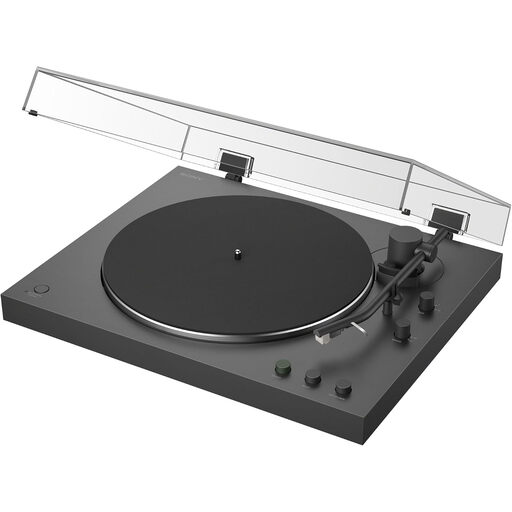
Sony PS-LX3BT automatic Bluetooth turntable

Sony PS-LX3BT automatic Bluetooth turntable

Consider this model if you prefer automatic playback and want a Bluetooth option. Confirm that your intended audio system supports the connection you plan to use; passive speakers still need an amplifier.

View on Joybuy
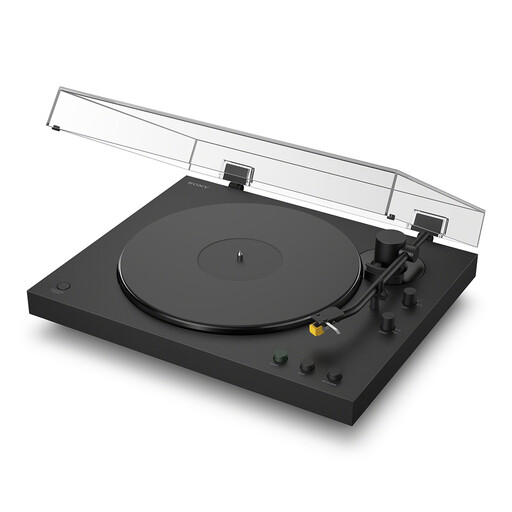
Sony PS-LX5BT automatic Bluetooth turntable

Sony PS-LX5BT automatic Bluetooth turntable

This is another automatic model for listeners considering a Bluetooth connection. Check the inputs and speakers in your existing system before deciding how to connect it; passive speakers require an amplifier.

View on Joybuy

Common questions

Do I need a phono pre-amplifier for a hobby-room turntable?

Yes, a phono pre-amplifier is needed somewhere in the signal path, but it may already be built into the turntable or amplifier. A PHONO-level output needs an amplifier’s PHONO input or a separate phono pre-amplifier before a line-level input. Audio-Technica advises against feeding a turntable’s pre-amplified LINE output into a PHONO input because double pre-amplification can distort sound and could damage equipment.

Can a turntable drive passive speakers directly?

No; passive speakers need an amplifier between them and the turntable. Powered speakers have their own amplification, but the turntable must provide a suitable line-level signal, whether through its own phono stage or a separate one.

Should I choose automatic or manual operation for classical LPs?

Choose automatic operation if easier starting and tonearm handling matter most; choose manual operation if you are comfortable cueing records and want to assess a deck’s setup features as part of your system. Operating style alone does not establish better sound for classical music.

Do classical records mean I need 78 RPM playback?

Only if your collection includes 78 RPM discs. Audio-Technica specifies 33 1/3, 45 and 78 RPM for the AT-LP5X, but only 33 1/3 and 45 RPM for the AT-LP60X; check the speed and suitable stylus arrangement for the records you own.