What matters when choosing?
OLED TV
Consider it when: Seats extend well to the sides and viewing is often in controlled light; LG describes wide viewing angles for its OLED range.
Check before choosing: Reflection features vary by model, so an OLED label alone does not settle how the screen will handle your room’s windows or lamps.
Mini LED or Neo QLED TV
Consider it when: A bright room is the main challenge and the exact model explicitly lists both anti-reflection and wide-viewing-angle features, as Samsung does for its QN90D.
Check before choosing: Those features cannot be assumed for every Mini LED or Neo QLED size or model; assess the intended side seats as well as the room’s reflections.
For group viewing, decide where people will sit before comparing panel features. The concerns below describe consumers choosing a TV primarily for architecture programmes with a large group, according to the need they would put first.
| Concern | Buying checks | Who this matters to |
|---|
| Picture from side seats |
Check the exact model’s viewing-angle features and, if possible, watch it from the planned left and right seats. |
If people sit well off-centre, I want them to follow changes in materials and shadow without relying on the central seat. Around 33% of consumers put the side-seat picture first. |
| Size and visible detail |
Measure the main seat-to-screen distance and compare sizes using a viewing-distance guide; confirm 4K support if your source provides 4K programmes. |
When the main seats are farther back, I need a screen that lets the group follow plans and building details without overwhelming those sitting closer. For around 27% of consumers, size and detail are the primary concern. |
| Reflections and room light |
Identify windows and lamps facing the screen; check the exact model’s anti-reflection features under similar lighting if possible. |
With daylight or lamps in the room, I do not want reflections to obscure darker interiors. Roughly 27% of consumers place reflection handling and brightness first. |
| Dialogue and connections |
Check the HDMI input count and eARC/ARC support if adding a compatible soundbar; listen to dialogue at a normal group-viewing level. |
If narration needs to reach listeners across the room, I want to hear it clearly and connect the devices I use. Sound and setup come first for around 13% of consumers. |
Joybuy TVs for this viewing setup
These TCL V6C Direct LED TVs offer four screen sizes to consider for the main seating distance. For a group spread across the room, check the picture from your side seats; if the room is bright, assess reflections on the exact model before choosing a size.
 No image available
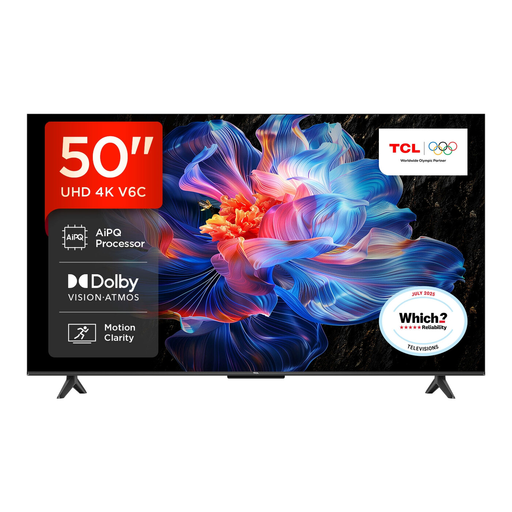
TCL 50V6C 50-inch Direct LED 4K HDR TV
Consider this size if it fits the distance from your main seats; check that viewers farther back can follow the programme’s details.
Google TV and Dolby Atmos are listed for this 50V6C variant. Its title specifies a 120Hz Game Accelerator at FHD, not 4K.
Check the view from side seats and the screen’s reflection handling in your room.
Joybuy
 No image available
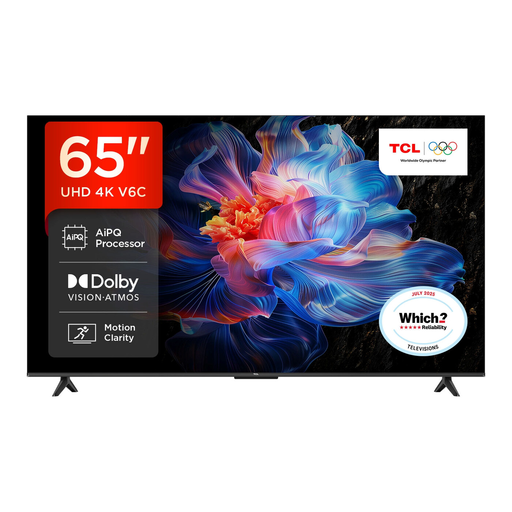
TCL 65V6C 65-inch Direct LED 4K HDR TV
Consider the 65-inch variant if your main viewing distance and available installation space suit it; check comfort from both near and side seats.
Google TV and Dolby Atmos are listed. The stated 120Hz Game Accelerator is specified at FHD.
Check reflections under your usual room lighting, along with the stand or mounting requirements.
Joybuy
 No image available
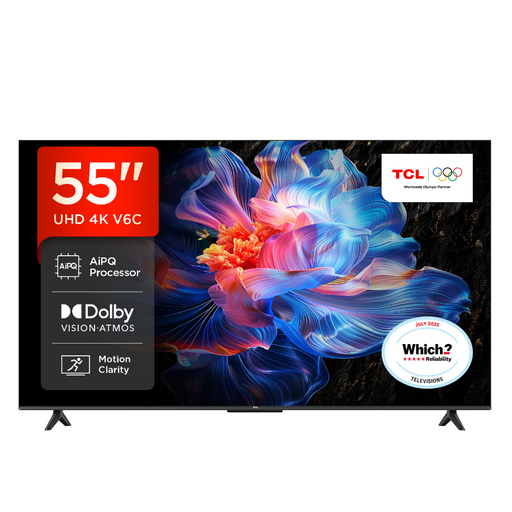
TCL 55V6C 55-inch Direct LED 4K HDR TV
Consider the 55-inch screen against the distance to your main seats, then check whether people at the sides can follow fine detail.
This 55V6C variant lists Google TV and Dolby Atmos; its 120Hz Game Accelerator is specified at FHD.
Assess reflections where the screen will sit rather than relying on its panel category alone.
Joybuy
 No image available
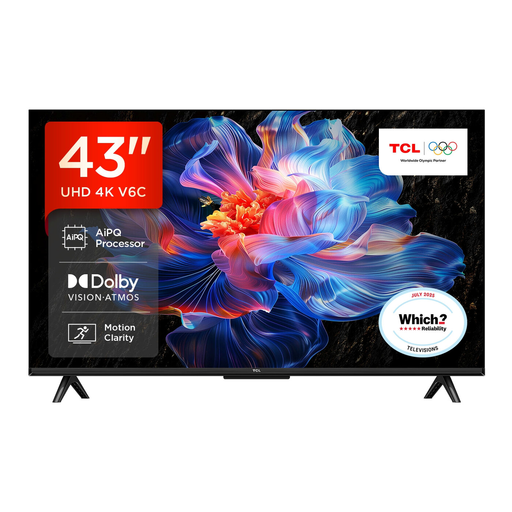
TCL 43V6C 43-inch Direct LED 4K HDR TV
Consider the 43-inch variant only after checking whether architectural details remain easy to follow from the group’s main and farthest seats.
Google TV and Dolby Atmos are listed for this model. Its stated 120Hz Game Accelerator applies at FHD.
Also check the view from side seats and any reflections from nearby windows or lamps.
Joybuy
Frequently asked questions
How should I choose a screen size for a large group?
Start with the distance from the usual main seats to the proposed screen position, then check the closest and side seats too. Which? advises measuring viewing distance and gives about 3.3 m for a 55-inch TV and 3.7 m for a 65-inch TV as size-guide starting points, not a substitute for checking your room layout.
Do I need a TV Licence for architecture programmes on BBC iPlayer?
In the UK, TV Licensing says you need a TV Licence to use BBC iPlayer. It also states that a licence is needed to watch live TV on any channel; the requirement concerns how you watch, not which television you buy.
Which energy figures should I compare between TVs?
Compare each model’s stated energy consumption in kWh per 1,000 hours as well as its energy class, taking screen size into account. The UK television energy-label specification published by GOV.UK includes on-mode SDR consumption and separate HDR information where applicable.
What should I do with an old TV if I replace it?
Look for reuse or an appropriate electrical-equipment collection route rather than putting the TV in general waste. GOV.UK describes the UK’s waste electrical and electronic equipment framework as encouraging recovery, reuse and recycling; check the arrangements offered by your local authority or retailer.


