Drivers focused on the road ahead
If you mainly want a record of ordinary journeys in front of your vehicle, a front-facing camera keeps the fitting and footage routine simpler. It will not record traffic behind you.


A front-facing dash cam suits drivers who mainly need a record of events ahead; a front-and-rear system adds context behind the vehicle but brings another camera, cable and recording stream to manage. If incidents while parked matter, check the chosen camera’s power and installation requirements. Whichever setup you choose, learn how to protect and retain the original clip before loop recording overwrites it.
If you mainly want a record of ordinary journeys in front of your vehicle, a front-facing camera keeps the fitting and footage routine simpler. It will not record traffic behind you.
If rear-end events or incidents behind the car are a particular concern, consider a compatible rear camera as well. Allow for cable routing and check how recording with both cameras affects storage.
If retaining a usable clip matters most, look for a way to protect a recording and transfer its original file before routine recording can overwrite it.
Choose the view you need first, then check whether parked-vehicle recording and a workable file-saving routine change the equipment or installation you need.
| Concern | What to check | Who this matters to |
|---|---|---|
| Simple forward coverage | Check the forward view and whether the camera can be positioned without blocking the driver’s view. | If I chiefly need to document what happens ahead, I would rather manage one camera than fit equipment I do not need; around 31% of consumers put straightforward forward coverage first. |
| Rearward context | Check rear-camera compatibility and cable routing, then confirm the recording settings with both cameras connected. | When an event behind my car could be disputed, a second viewpoint matters enough to justify the extra fitting; roughly 25% of consumers prioritise rearward context. |
| Recording while parked | Check the exact parking feature’s power requirements and whether its installation suits your vehicle. | If I need footage of an incident while my car is parked, I have to consider how the camera stays powered; about 19% of consumers place parked-vehicle recording first. |
| Keeping the original clip | Check manual file protection, the required memory card and how to copy an original recording. | I do not want an important clip lost to loop overwrite before I can save it; around 25% of consumers make footage preservation their primary concern. |
Driver and Vehicle Standards Agency and Department for Transport guidance says items fixed to vehicle windows must not block the driver’s view. A position behind the mirror still needs checking in the particular vehicle.
Sit in your normal driving position before fixing the mount and check that neither the camera nor its cable obstructs your view of the road and traffic ahead.
Parking features may depend on power after the ignition is off. Nextbase describes a voltage limiter in its Series 2 hardwire kit for a permanent-live connection; Garmin lists constant power, active Wi-Fi and a paid Vault subscription as requirements for its cited remote Parking Guard feature.
Check the selected model’s power route, vehicle fit and installer arrangements before relying on parked-vehicle recording. Check any vehicle-warranty implications against your vehicle maker’s terms.
Depending on the setup, a hardwire kit, installation work or an ongoing service may also be needed.
Nextbase says loop recording overwrites older unprotected files as storage fills. Protected files also need managing so that they do not consume the available card space.
Check the camera maker’s card requirements, learn its manual protect control and copy the original incident file promptly.
A camera records only what its view and settings capture; footage does not promise a particular fault, legal or insurance outcome.
Keep the original file and follow the receiving organisation’s submission instructions. For example, Hampshire and Isle of Wight Constabulary’s Hants Snap instructions require submitted footage to remain unedited and on the device.
Nextbase offers front-facing cameras, model-specific rear modules, mounting accessories and hardwire equipment.
Garmin has compact cameras and model-dependent app, storage and parking features.
Samsung’s PRO Endurance microSD range is a storage-card option, not a dash-cam system.
These choices include front-and-rear recording, a front-and-interior setup and a front camera with a stated hardwire requirement for parking mode. Compare the view each provides with the power and footage-saving routine you need.
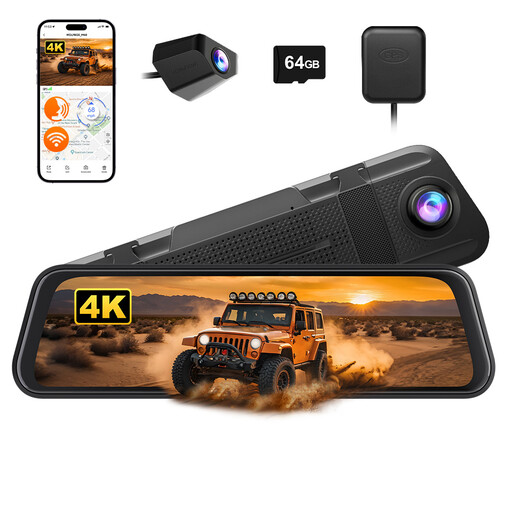 No image available
Consider this mirror-style setup if you want footage from both the front and rear of the vehicle.
The product name specifies 4K front and 1080P rear recording, Wi-Fi and GPS. It also lists an included 64GB card.
Check how much footage that card retains with both cameras recording. Parking monitoring requires checking the separate hardwire-kit and vehicle-installation arrangements.
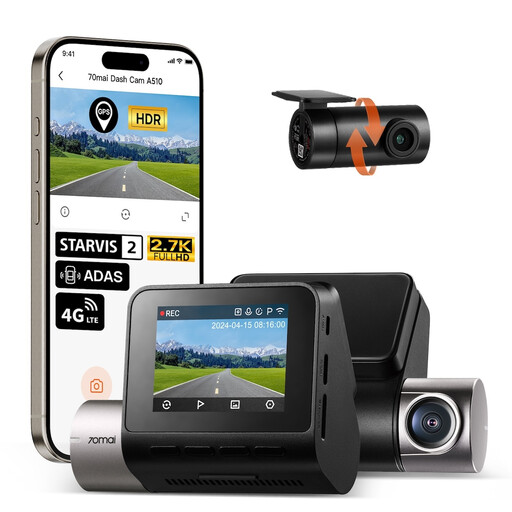 No image available
This dual-camera setup is worth checking if an incident behind the vehicle matters alongside the forward view.
The product name specifies 1944P front and 1080P rear recording, HDR, GPS and app control.
A microSD card is not included. Confirm a suitable card for dual recording; the stated parking functions require a separately sold UP04 hardwire kit, whose vehicle fit and installation should also be checked.
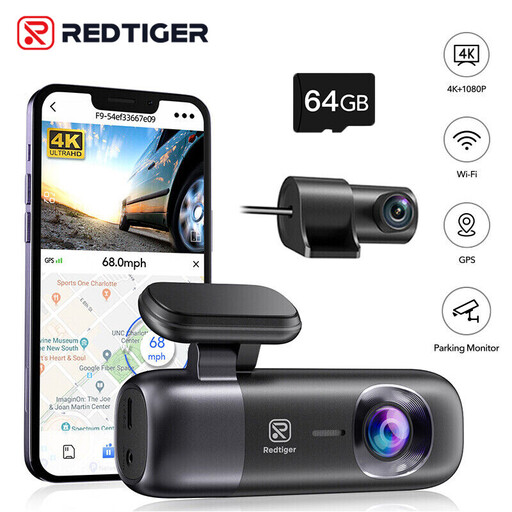 No image available
Look at this option if you want both road directions recorded and an included card.
The product name specifies 4K front and 1080P rear recording, Wi-Fi, GPS, loop recording and a 64GB card. It states support for cards up to 256GB.
Check retention at your chosen recording settings and confirm the power method and accessories needed for the stated parking mode.
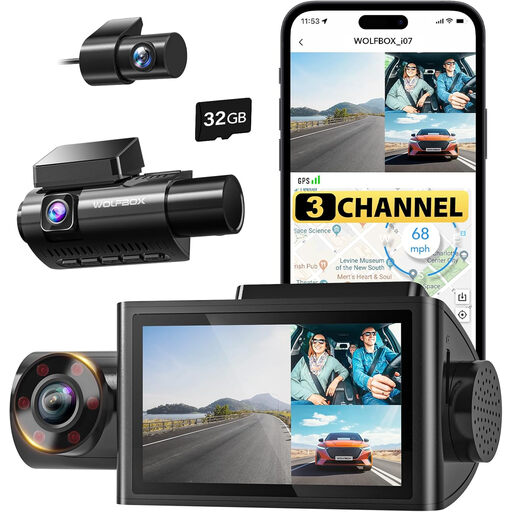 No image available
Choose its front-and-interior views only if cabin context is useful to you: the interior cameras are not a rear-window view of traffic behind the car.
The product name lists 1440P+1080P+1080P three-channel recording, Wi-Fi, GPS, a 3-inch screen and an included 32GB card.
Check its file-protection controls and the power arrangements for the stated parking mode before relying on either feature.
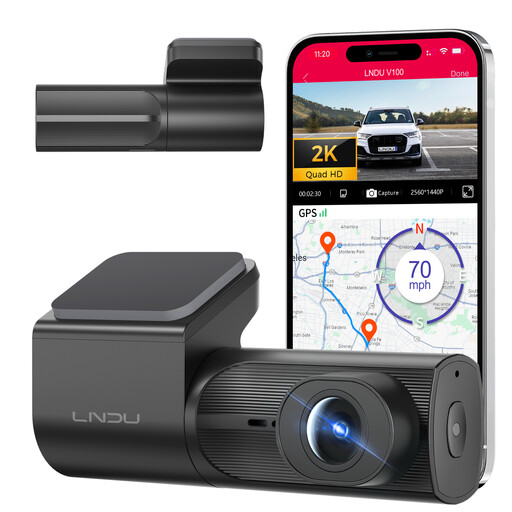 No image available
This front-facing option suits a forward-road view if you are also prepared to arrange the required installation for its stated parking monitoring.
The product name specifies 2K recording, Wi-Fi, loop recording, a G-sensor and app control.
Parking monitoring requires a separately purchased hardwire kit. Confirm its fit and power arrangement for your vehicle, as well as a compatible memory card.
Mount it where it does not obstruct your view of the road and traffic ahead. Driver and Vehicle Standards Agency and Department for Transport guidance says items fixed to vehicle windows must not block the driver’s view, so check the camera and cable position from your normal driving seat.
Yes, protect and retain the original clip if you may need to submit it. Hampshire and Isle of Wight Constabulary’s Hants Snap instructions require footage submitted through that scheme to be unedited, not deleted from the device and to include one minute on either side of the incident; check the instructions of whoever will receive your footage.
No: loop recording can overwrite older unprotected files when storage fills. Check how your chosen camera protects incident-triggered recordings, learn its manual protect control and copy the original clip promptly.
A rear camera adds a second viewpoint, but it also needs compatible equipment, cable routing and storage for another recording stream. Nextbase says its rear module can change the front camera’s recording resolution, so check the exact camera-and-module combination rather than assuming its front-only settings will remain unchanged.
Not every parking feature has the same power requirement, so check the particular camera and feature before buying. A setup that records after the ignition is off may need constant power or a permanent-live hardwire arrangement; confirm vehicle fit, battery protection and any connected-service prerequisites.