
24/7 Customer Support

Free returns

Same-day & Next-day Delivery

Quality Guaranteed

Unlock Your Welcome Offers: FREE Delivery | Up to 80% OFF | Free 30-day JoyPlus trial
Download the APP
Finding the right refrigeration for a compact UK kitchen can be a frustrating exercise. Whether you're renovating, replacing an old appliance, or furnishing a rental property, the market for built-in appliances is filled with options that look good on paper but fail in practice. A built-under fridge with ice box is often the perfect solution, but choosing the wrong one can lead to wasted money and daily inconvenience.
As a Joybuy Product Recommendation Officer, my role is to help you navigate these choices by highlighting the practical details that matter. Before you commit, let's look at the common pitfalls that many buyers overlook.
To ensure your new appliance is a help, not a hindrance, focus on these non-negotiable specifications.
The term 'built-in' can be confusing. A built-under fridge with ice box is specifically designed to fit beneath a standard kitchen worktop, typically around 82-87cm in height. It requires its own furniture door to be attached to the front to match your kitchen cabinetry.
This is arguably the most critical factor for a successful installation.
Don't just look at the total capacity. An undercounter fridge with ice box should offer genuine convenience. Check that the ice box, sometimes referred to as an integrated fridge with freezer compartment, is large enough for your needs—typically for ice cube trays and a few small frozen items. Look for adjustable shelves and door balconies that allow you to customise the space for taller items like bottles of milk or wine.
We've matched a suitable model to common buyer profiles to help you see how specific features solve real-world problems.
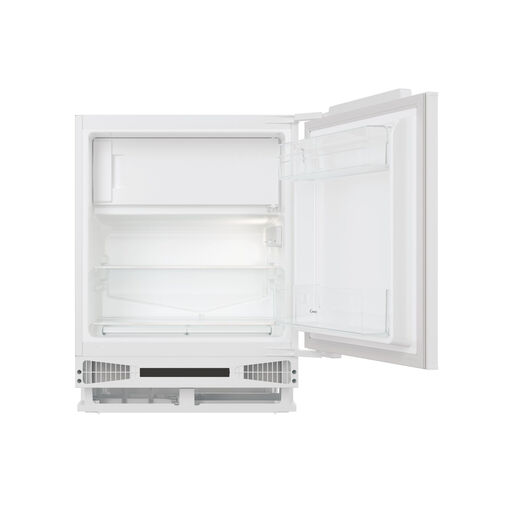
Why This Fits Their Persona: Perfect for those undertaking a kitchen refurbishment in a flat or smaller home. Its design is focused on seamless integration into new cabinetry, providing essential cooling without compromising a clean, modern aesthetic.
The built-in sliding hinge system directly prevents the common problem of the appliance door clashing with adjacent units, ensuring smooth operation in a brand-new, tightly planned kitchen layout.
Its standard 54cm width and built-under form factor make it easy for kitchen fitters to install. The adjustable glass shelves provide practical, flexible storage within its 68-litre capacity.
Why This Fits Their Persona: Landlords need reliable, cost-effective and easy-to-install appliances for rental properties. This model offers a practical solution that is straightforward to fit and maintain, minimising hassle and long-term expenses.
It avoids the running cost trap. As an E rated undercounter fridge, it provides compliant energy performance, keeping electricity bills reasonable for tenants and making the property more attractive.
The reversible door offers valuable installation flexibility, adapting to different kitchen layouts without issue. Its simple, functional design is durable and less prone to user error or damage.
Why This Fits Their Persona: Ideal for adding convenience to a secondary space like a home office, utility room or garden annex. It provides chilled drinks and ice without the footprint or cost of a full-size appliance.
It avoids the trap of over-speccing. Instead of a bulky, half-empty fridge-freezer, this model offers exactly what's needed: sufficient fridge space and a functional ice box for drinks, all neatly concealed.
The quiet operation (rated at 40 dB) ensures it won't be a distraction in a working or living environment. The adjustable thermostat allows for simple temperature management.
We have compiled a complete, real-time list of products that fully satisfy these strict selection criteria and UK safety regulations.
1. What is the difference between a 'built-under' and 'integrated' fridge? While the terms are often used interchangeably, 'built-under' specifically refers to an appliance designed to fit under a worktop. 'Integrated' is a broader term for any appliance designed to be concealed behind a cabinet door, which can include taller larder fridges. A built-under model is always integrated, but not all integrated models are built-under.
2. How much does it cost to run an E-rated undercounter fridge? Running costs depend on your electricity tariff, but an E-rated appliance is designed to be moderately efficient under the new 2021 energy label standards. It offers a significant improvement over older models that might have been rated A+ on the old scale. For a compact appliance used for supplementary cooling, an E rating provides a good balance of performance and affordability.