
24/7 Customer Support

Free returns

Same-day & Next-day Delivery

Quality Guaranteed

Unlock Your Welcome Offers: FREE Delivery | Up to 80% OFF | Free 30-day JoyPlus trial
Download the APP
Investing in professional-grade garage diagnostic equipment is a significant decision for any workshop owner or advanced DIY enthusiast. The right tool can streamline diagnostics, increase efficiency and unlock new repair capabilities. However, the market is filled with devices that promise the world but often fall short. Making the wrong choice can lead to wasted money on a tool that quickly becomes obsolete or is crippled by hidden fees.
As a Joybuy Product Recommendation Officer, my role is to help you navigate this complex market. We'll cut through the marketing jargon and focus on the critical factors that determine a tool's true value. Let's look at the common pitfalls to avoid:
To ensure your investment pays off, focus on the technical specifications that deliver real-world performance. Here are the non-negotiable features to scrutinise before you buy.
A genuine bi-directional scan tool does more than just read information from a vehicle's ECU. Its primary advantage is the ability to send commands back to the car's systems. This is what is known as an active test scan tool.
Instead of just seeing a fault code for a fuel pump, you can command the pump to turn on and off directly from the scanner. This allows you to test individual components like injectors, solenoids, fans and windows in real-time, drastically cutting down diagnostic time and confirming a fault without having to dismantle parts unnecessarily. For any professional technician, this two-way communication is not a luxury; it's a fundamental requirement for efficient and accurate work.
The automotive industry is constantly evolving, and so are the onboard diagnostic systems. Two of the most important recent developments are the CAN FD (Flexible Data-Rate) and DoIP (Diagnostics over Internet Protocol) protocols.
Purchasing a CAN FD DoIP scanner is not just about servicing the latest cars; it's about ensuring your equipment remains relevant and capable for years to come. A tool without this support will leave you unable to work on a growing number of vehicles entering your workshop.
The software is just as important as the hardware. An advanced ECU coding tool allows you to do more than just reset service lights. It enables you to perform tasks like programming new modules after a replacement, unlocking hidden features (like disabling the start/stop function), or performing adaptations for components. For those working with Volkswagen Audi Group vehicles, a tool with a VAG guided function can be invaluable, providing step-by-step instructions for complex procedures.
Equally important is the software update policy. Some tools offer lifetime free updates, which represents significant long-term value. Others require annual subscriptions that can add hundreds of pounds to the total cost of ownership over the tool's lifespan. Always clarify the update policy and any associated costs before making a purchase.
Based on these critical criteria, we've identified several tools that align with the needs of different users, from professional workshops to dedicated home mechanics.
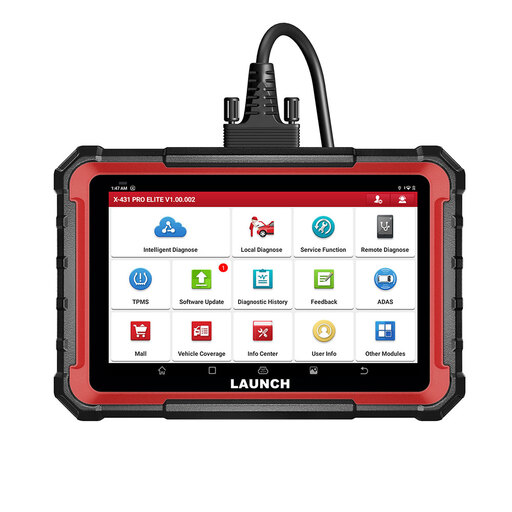
Why This Fits Their Persona: This is a comprehensive, OE-level diagnostic solution designed for the demands of a busy UK garage. Its extensive vehicle coverage and compatibility with expansion modules (like TPMS tools and oscilloscopes) make it a versatile workhorse for handling a wide variety of modern vehicles.
It includes full support for CAN FD and DoIP protocols, ensuring it won't become obsolete when newer vehicles arrive for service. Its advanced ECU coding and VAG guided functions prevent it from being just a simple code reader.
Features OE-Level full system diagnostics and full bi-directional control, providing dealership-level capabilities. Comes with 2 years of free updates to start.
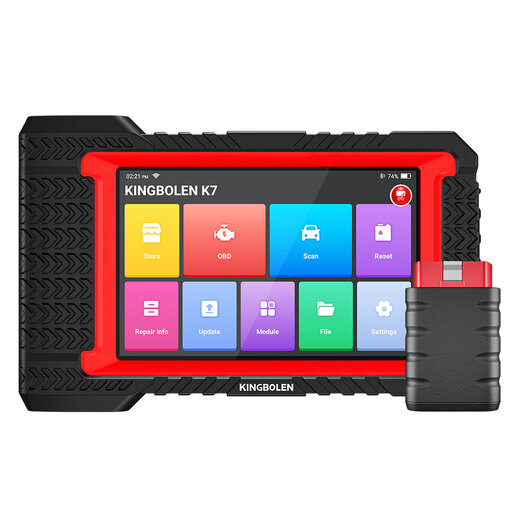
Why This Fits Their Persona: Ideal for independent technicians or small garages in the UK looking for maximum return on investment. It packs a powerful combination of bi-directional control, 28+ reset functions and ECU coding into a robust tablet.
Its standout feature is the lifetime free update policy. This directly counters the subscription trap, ensuring there are no hidden long-term costs to access new vehicle data and software features.
Offers a comprehensive feature set including active tests and ECU coding without ongoing subscription fees, providing exceptional long-term value.
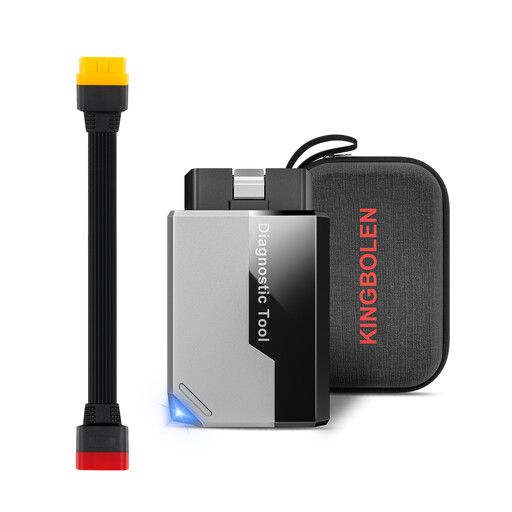
Why This Fits Their Persona: For the serious home mechanic who wants professional-level capabilities without the professional price tag. This compact Bluetooth adapter pairs with a smartphone, offering a powerful diagnostic suite that fits in a pocket.
It provides access to bi-directional control and over 15 reset functions with a lifetime free update model. This avoids both overspending on a full tablet and the recurring costs of a subscription service.
A highly cost-effective entry into bi-directional diagnostics. Its support for CAN-FD and FCA AutoAuth provides impressive coverage for its price point.
We have compiled a complete, real-time list of products that fully satisfy these strict selection criteria and UK safety regulations.
The difference is in the direction of communication. A standard OBD2 reader is a one-way device: it only reads data and fault codes from your vehicle's computer. A bi-directional scan tool is a two-way device. It can both read data and send commands to the vehicle's ECU, allowing you to actively test components and functions, which is essential for accurate troubleshooting.
This depends entirely on the manufacturer and model. Many professional tools require an active subscription to access all features, especially online coding and software updates for new vehicles. If the subscription lapses, the tool may revert to basic functions or stop working altogether. However, other models offer lifetime free updates, meaning you pay once for the hardware and receive ongoing software and vehicle coverage at no extra cost. Always verify the update policy before purchasing.