
24/7 Customer Support

Free returns

Same-day & Next-day Delivery

Quality Guaranteed

Unlock Your Welcome Offers: FREE Delivery | Up to 80% OFF | Free 30-day JoyPlus trial
Download the APP
Navigating the streets of the UK on two wheels, whether for a daily commute or a weekend adventure, often requires a reliable way to view your phone for GPS or fitness tracking. A good bike phone mount seems like a simple purchase, but the market is flooded with options that can quickly turn from a convenience into a liability. Many riders learn the hard way that not all mounts are created equal, often after a costly drop.
As a Joybuy Product Recommendation Officer, my role is to help you see past the marketing jargon. Before you add any mount to your basket, let's look at the common design flaws that lead to disappointment and wasted money.
The "Universal Fit" Myth: Many products claim to be a universal phone holder for bike use, but this promise often falls short. Handlebars on bicycles, motorcycles and electric scooters come in various diameters. A mount that's too loose will rotate and slip, while one that's too tight won't install at all. The same applies to phone compatibility; a "universal" clamp may not accommodate thicker, rugged cases, forcing you to choose between protection and convenience.
The Flimsy Clamp Catastrophe: The most critical component is the clamp that grips your phone. Low-cost mounts often use brittle plastic and weak springs that degrade under constant vibration and exposure to the elements. After a few months of bumpy roads and changing temperatures, these materials can become fragile, leading to a sudden failure and sending your phone tumbling onto the tarmac.
The Vibration Damage Blind Spot: This is a subtle but serious issue, particularly for motorcycle riders. Constant, high-frequency vibrations can travel directly from the engine and frame through a rigid mount into your phone. Over time, this can damage the delicate optical image stabilisation (OIS) mechanisms in modern smartphone cameras, resulting in blurry photos and costly repairs. A simple mount without any dampening features offers no protection against this.
To ensure your phone stays safe and accessible, focus on these non-negotiable features. Understanding them will help you select a durable and reliable secure bike phone mount.
The difference between a secure mount and a disaster waiting to happen often lies in the locking system.
Never take "universal" at face value. Always verify the numbers.
For daily commuters or delivery riders, efficiency is key. A quick release phone holder mechanism allows you to attach or detach your phone with one hand in seconds. This saves considerable time and hassle compared to mounts that require you to unscrew or wrestle with a stiff clamp every time you stop.
Based on these practical criteria, we've matched a product to a common user profile to help guide your decision.
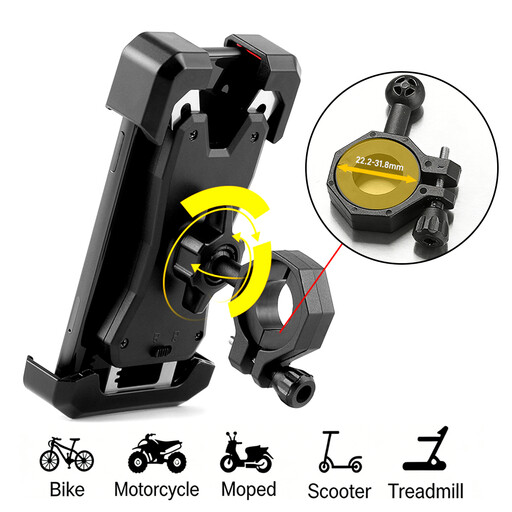
Why This Fits Their Persona: This mount is ideal for the UK commuter or recreational cyclist using a bicycle, electric scooter phone mount, or even a pushchair. It provides a secure, adjustable and easy-to-use solution for everyday journeys on roads and light trails.
It directly counters the "Flimsy Clamp Catastrophe" with a dedicated safety lock mechanism on the back, preventing accidental release. It also avoids the "Universal Fit Myth" by providing clear specifications for handlebar (1.5-3.5 cm) and phone (4.7-6.8 inches, ≤15 mm thick) compatibility.
The combination of a quick-release design and a 360° rotating ball head offers excellent convenience. The four-sided silicone padding provides full coverage, cushioning the phone against typical road vibrations.
We have compiled a complete, real-time list of products that fully satisfy these strict selection criteria and UK safety regulations.
Yes, this is a valid concern. High-frequency vibrations, particularly from a motorcycle phone mount, can potentially harm the delicate optical image stabilisation (OIS) components in many modern smartphones. To minimise this risk, look for an anti-shake phone mount that incorporates silicone or rubber dampeners. For standard bicycle use on paved roads, a mount with thick silicone padding is generally sufficient.
Do not rely on the word "universal". The most reliable method is to measure the diameter of your handlebars with a ruler or calliper. Once you have the measurement, check the product's listed specifications for its compatible handlebar diameter range (e.g., 22-32mm). A quality mount will often include removable silicone pads or shims to ensure a tight, non-slip fit on smaller bars.
The lifespan is directly related to its material quality. A well-constructed holder made from durable, UV-resistant plastic, silicone and metal parts should last for several years of regular use. In contrast, a cheap model made from brittle plastic may crack or fail within a single season, especially when exposed to constant sunlight and vibration. It is good practice to periodically inspect your mount for any signs of stress or wear.