Occasional dessert makers
If you mainly make crumbs for cheesecake bases, fridge cakes or toppings, a small appliance may be easier to store and wash. Check its working capacity against the quantity you normally use.


For occasional small batches of biscuit crumbs, consider a compact chopper if its working capacity fits your usual recipe. A full food processor makes more sense when crumbs are a regular task or you will also use its chopping, slicing, grating or dough tools; compare the supplied blade, short-burst controls, usable capacity and cleaning requirements rather than motor wattage alone.
If you mainly make crumbs for cheesecake bases, fridge cakes or toppings, a small appliance may be easier to store and wash. Check its working capacity against the quantity you normally use.
If you make biscuit bases repeatedly and also prepare pastry or dough, compare full processors by their usable capacity and supplied tools. A larger bowl does not, by itself, establish how many biscuits you can process at once.
If crumbs are one of several preparation jobs, a compact full processor may cover chopping, slicing and grating without taking the approach of a single-task chopper. Check where its attachments will go between uses.
Choose the appliance format around your usual batch and other cooking tasks, then check how you will control texture and clean the parts.
Choose it when: Crumbs are an occasional, small-batch task and cupboard space matters.
Trade-off: A small working bowl may mean processing a larger recipe in several batches.
Choose it when: You also expect to chop, slice or grate ingredients regularly.
Trade-off: The extra attachments need storage and cleaning.
Choose it when: Frequent baking or broader food preparation makes a larger bowl and more tools useful.
Trade-off: Allow more room for the appliance and its parts; bowl size is not the same as the permitted biscuit quantity.
| Concern | What to check | Who this matters to |
|---|---|---|
| Crumb texture | Look for a chopping blade and a pulse, moment or other short-burst control. Check the manual for operating limits. | If I want coarse topping crumbs on one occasion and finer crumbs for a base on another, I need to stop and inspect them between bursts. Around 36% of consumers would put texture control first. |
| Small batches and space | Compare working capacity with your usual biscuit quantity, then check the appliance's storage dimensions. | A single dessert rarely calls for a large machine in my kitchen, but I still need the batch to fit without overfilling. Small-batch use and space would come first for around 29% of consumers. |
| Capacity and other jobs | Check usable capacity and the accessories supplied with the exact model for tasks you expect to do. | When I bake often, I want the same appliance to handle crumbs and other recurring preparation jobs. Around 21% of consumers would make broader use and batch capacity their primary concern. |
| Cleaning and handling | Check which removable parts are dishwasher-safe, where accessories are stored and the blade-handling instructions. | For a quick crumb-making job, I do not want assembly and washing to take longer than the task warrants. Ease of cleanup and handling would lead the decision for around 14% of consumers. |
Motor wattage does not establish whether a processor offers the blade, controls or capacity you need for your preferred crumbs.
Compare the exact model's chopping blade, short-burst control and usable capacity before using wattage to distinguish models.
Published capacities describe different things: Magimix lists both 2.6 L total and 1 L working capacity for the 3200XL, while Russell Hobbs gives a 500 ml working capacity for the Desire mini chopper.
Use working or usable capacity where stated, and follow the model manual's fill limits when planning a biscuit batch.
A chopping blade does the relevant work; slicing discs and dough tools are useful only if they match your other cooking plans.
Check the exact contents of the box and choose extra functions for jobs you expect to do regularly.
Blades remain sharp when you fit them, empty the bowl and wash the parts. A food-processor manual warns against putting hands or utensils in the bowl while it is operating.
Disconnect the appliance before handling its blade and follow the instructions for your model when cleaning it.
These examples show how particular product lines differ; check the exact model and included accessories before choosing.
The MultiPro Express FDP65.180SI is a full-processor example for buyers who also want preparation tools beyond a chopping blade.
The 3200XL is a multifunction option to examine if you expect to use a processor regularly.
The MultiTalent 3 MCM3100WGB illustrates a compact full-processor format with accessories stored in its bowl.
The Desire mini chopper provides a small-batch alternative to a full processor.
Ninja's food-processor range is relevant if crumbs are one of several planned preparation tasks.
These choices include small choppers and full processors for making biscuit crumbs or handling other food-preparation jobs. Match the bowl and controls to your usual recipe rather than assuming that every listed capacity is a usable biscuit-batch limit.
 No image available
Consider this full processor if biscuit crumbs are one of several baking or preparation jobs.
The listing names a 3 L bowl, 1000 W motor, pulse function, six accessories and dishwasher-safe attachments. Kenwood GB lists a knife blade and dough and slicing/grating tools for the FDP65.180SI; check the exact supplied set and the permitted quantity for your biscuit batch.
 No image available
Consider this mini chopper for occasional small quantities if its bowl fits your usual recipe.
The title specifies a 350 ml bowl, 300 W motor, two speeds and a dishwasher-safe bowl. Check the supplied blade, short-burst operation and biscuit-batch limit in the model instructions.
 No image available
Consider the combined processor and blender format if you plan to use both functions, not just make crumbs.
The title states a 750 W motor and 2 L processor bowl. Check which blade comes with the bowl, how to control a short run and the permitted biscuit quantity.
 No image available
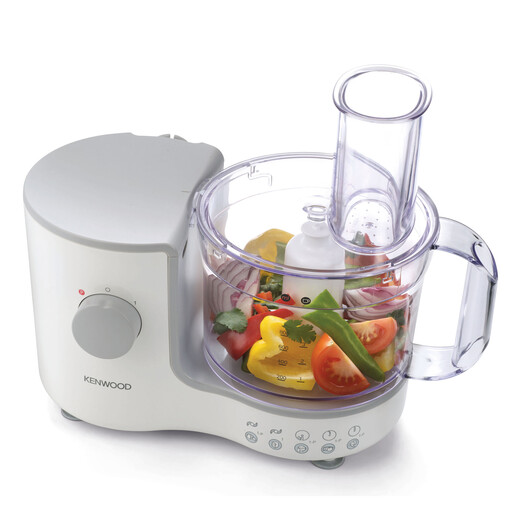
Consider this compact full processor if you want a chopping appliance that also has other preparation functions.
The title specifies a 1.4 L bowl, 400 W motor, chopping function and shredder disc. Check its controls, supplied blade and usable biscuit-batch limit for your preferred crumbs.
 No image available
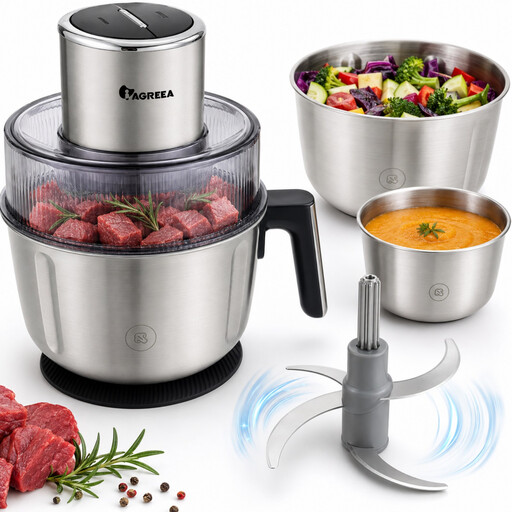
Consider the separate bowls if you expect to use a chopper for different food-preparation quantities as well as crumbs.
The title specifies a 350 W motor, two speeds, triple-curved blades and 304 stainless-steel bowls of 2.5 L, 2.2 L and 1.8 L. Confirm which bowl is appropriate for biscuits, its usable batch limit and how each part should be cleaned.
A mini chopper can suit small batches if its working capacity fits your recipe. Russell Hobbs UK specifies a 500 ml working capacity for its Desire mini chopper; if you also regularly need slicing, grating or dough preparation, compare full processors instead.
Use a chopping blade with a short-burst control and inspect the crumbs between runs. Kenwood GB lists pulse control for the FDP65.180SI, while Bosch GB lists a moment function for the MCM3100WGB; the result will still depend on your biscuits, quantity and running time.
Only put a part in the dishwasher when the instructions for that exact model permit it. Bosch GB describes the MCM3100WGB accessories as dishwasher-safe, and Russell Hobbs UK says the removable parts of its Desire mini chopper are dishwasher-safe.
Stop and disconnect the appliance before handling its blade, and follow its cleaning instructions. A food-processor manual warns that blades are sharp during fitting, removal and cleaning, and says not to put hands or utensils into the bowl while it operates.