Space-first black-tea drinkers
If you make one or a few cups and have little worktop space, compare the appliance’s width, depth and height before choosing by capacity. Leave room to open the lid and follow the exact model’s placement instructions.


Choose an automatic basket tea maker if ending the infusion without watching the clock matters most; choose a tea-infuser kettle if you would rather manage steeping yourself and also use it to heat water. For black tea, check the tea pack’s directions against the available temperature settings, then measure the appliance and the space needed to use it safely.
If you make one or a few cups and have little worktop space, compare the appliance’s width, depth and height before choosing by capacity. Leave room to open the lid and follow the exact model’s placement instructions.
If you want the leaves removed at the end of infusion without watching a timer, look for documented automatic basket movement. Temperature control alone does not end the steep.
If you regularly make several servings or heat water for other drinks, compare usable fill levels and hot-water functions as well as tea-making controls.
Choose it when: You regularly brew loose-leaf tea and want the appliance to lower the basket and lift it after infusion.
Trade-off: The dedicated jug and basket need a practical place on the worktop and a cleaning routine that suits you.
Choose it when: You also want an ordinary hot-water kettle and are content to manage the infusion yourself.
Trade-off: Unless the exact model documents a steep timer or basket lift, you must time the brew and remove the leaves.
Choose it when: A separate teapot and water tank suit the way your household serves tea.
Trade-off: Check the complete arrangement against your available space and your tea’s brewing instructions.
For black tea, the UK Tea & Infusions Association gives a water-temperature range of 90–98°C and advises following the tea pack’s instructions. In a small kitchen, the usable space around the appliance matters as much as its stated size.
| Concern | What to check | Who this matters to |
|---|---|---|
| Worktop fit | Measure width, depth and height; consult the exact model’s instructions for lid access and placement clearance. | With little permanent worktop room, I need to be able to position and use the brewer without obstructing cupboards or nearby appliances. Around 40% of consumers would put workable placement first. |
| Brewing control | Check the black-tea temperature setting and whether a timer or basket lift ends the infusion. | If I brew loose-leaf tea often, I want the leaves out of the water at the intended time rather than relying on temperature alone. Roughly 40% of consumers would prioritise repeatable brewing. |
| Serving and secondary use | Compare minimum and maximum fill levels, hot-water operation and any keep-warm controls. | When I make a household round or need water for other drinks, a single small serving is less useful to me. About 20% of consumers would make serving and secondary use their main concern. |
A jug can hold a suitable amount of tea yet still be awkward to position or open beneath a cupboard. Sage lists its current Tea Maker at 21.9 × 21.4 × 25.8 cm, while Gastroback lists its Design Automatic Tea-maker Advanced Plus at 175 × 300 × 310 mm.
Measure the intended spot in three dimensions and follow the placement instructions for the exact model; a product name containing “compact” is not a substitute for those measurements.
A kettle can heat water and hold a tea infuser without lifting the leaves when brewing time is up. Sage describes automatic basket movement for its Tea Maker, which is a different function.
If avoiding over-steeping is your priority, check for a documented basket lift or infusion timer. Otherwise, plan to time the brew and remove the infuser yourself.
The UK Tea & Infusions Association’s 90–98°C guidance for black tea still needs to be read alongside the instructions on your tea pack. Karaca describes 90°C brewing water for its Robotea Pro programme, at the lower edge of that range.
Check the exact programme temperature and steeping controls against the black tea you drink. If you regularly use different teas, consider whether the settings give you the adjustment you need.
Hot liquid and steam require care around the lid and vessel. Sage’s Tea Maker Compact instructions warn against opening the lid during operation and say scale build-up can affect the appliance over time.
Follow your model’s fill markings, placement and descaling instructions, and let it cool before handling it as directed in its manual.
Sage’s current Tea Maker BTM800UK is a dedicated automatic basket model with a black-tea programme.
The Design Automatic Tea-maker Advanced Plus combines tea programmes with electric-kettle use.
Karaca’s Robotea Pro represents a Turkish-style teapot-and-water-tank arrangement.
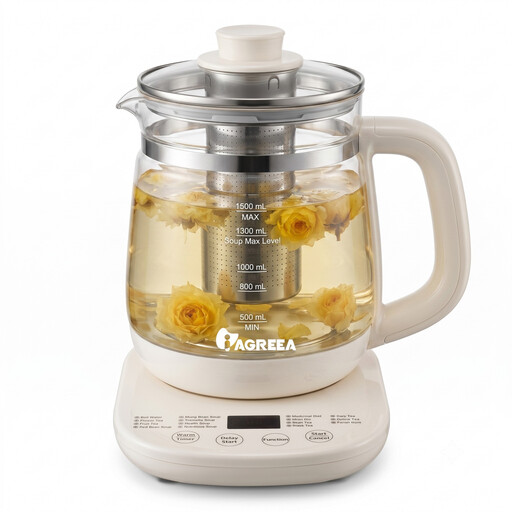
This tea-infuser kettle is worth considering if you want to heat water for tea and other drinks and are willing to check and manage the steeping time yourself. Measure your intended worktop position before deciding whether it fits.
 No image available
Consider this model if you want a tea infuser in an appliance that also heats water for other drinks and are prepared to manage steeping yourself.
The product name specifies a 1.5 L borosilicate-glass kettle, stainless-steel tea infuser, 14 preset programmes, six adjustable constant-temperature settings and a keep-warm function.
Before buying for black tea, check the exact temperatures available and how you would remove the leaves. Compare its dimensions, fill markings and placement instructions with your kitchen space.
The UK Tea & Infusions Association advises 90–98°C water for black tea, while also recommending that you follow the tea pack’s instructions. Check that the appliance offers a suitable setting, and consider how you will control steeping time.
Only if the exact model’s placement instructions and the available space allow it. For its discontinued Tea Maker Compact, Sage specifies a stable, dry, heat-resistant surface and at least 20 cm from walls or heat- and steam-sensitive materials; do not apply that clearance figure to every model.
Follow the cleaning and descaling method in the manual for your exact model. Sage says scale build-up can affect its Tea Maker Compact over time, so do not substitute a different process where your appliance’s instructions specify one.
Check the appliance’s permitted ingredients, fill markings and placement instructions before use. Sage’s Tea Maker Compact manual warns that opening its lid during operation can cause scalding, so follow your own model’s directions when handling hot liquid and steam.
An old electrical tea maker can be taken to a local household waste recycling centre. GOV.UK identifies these centres as a disposal option for unwanted electrical products.