
24/7 Customer Support

Free returns

Same-day & Next-day Delivery

Quality Guaranteed

Unlock Your Welcome Offers: FREE Delivery | Up to 80% OFF | Free 30-day JoyPlus trial
Download the APP
Choosing blackout curtains sounds straightforward until the panels arrive too short, leave bright gaps around the window or fail to hang properly on the existing pole. Marketing descriptions can also use “blackout”, “thermal” and “energy saving” loosely, making it difficult to compare ready-made curtains on a like-for-like basis.
As the Joybuy Product Recommendation Officer, I focus on the details that affect everyday use: sizing, header style, fabric construction and the difference between genuine light reduction and a fully darkened room.
“Room darkening curtains” may reduce incoming light without creating near-dark conditions. This can be suitable for a sitting room, nursery or home cinema, but sleepers and shift workers may want stronger coverage.
Look for a stated light-blocking percentage or a clear description of the fabric construction. For example, some triple-weave curtains specify 60–75% light reduction, while others list 85–95%. Neither figure guarantees total darkness because light can still enter around the sides, top and bottom of the window.
A pair of curtains measuring 140cm per panel does not necessarily cover a 280cm window attractively. Curtains need extra fabric to create folds when closed.
As a practical guide, the combined curtain width should be around 1.5 to 2.6 times the width of the pole or track. Using less fabric can create a flat appearance and leave gaps between pleats. Always check whether the listed width applies to one panel or the complete pair.
Eyelet curtains slide directly over a compatible pole, while pencil pleat curtains require hooks, rings or suitable track hardware. Back-tab curtains create a softer, less visible hanging arrangement but may not suit every pole.
Length measurements also vary. Eyelet curtains may be measured from the top of the ring, whereas pencil pleat curtains are usually measured from the heading tape. Measure from the point where the curtain will hang rather than assuming the product length equals the distance from the ceiling to the floor.
For bedrooms and nurseries, consider blackout curtains 2 panels made with dense polyester, a lining or triple-weave construction. A “100% blackout” description should still be assessed alongside the panel dimensions and installation method, since no fabric can cover gaps caused by an undersized pole or recessed window.
For sitting rooms, room darkening curtains, floral curtains or patterned velvet curtains may provide a useful compromise between privacy and natural daylight. Light-filtering linen styles can be more appropriate where you want daytime brightness rather than a darkened room.
Thermal curtains and insulated window curtains can add a fabric layer between the room and the glass. This may help reduce draught perception and moderate heat transfer, although the result depends on glazing, wall insulation, window gaps and how closely the curtains fit.
For a practical improvement, choose long curtains that reach close to the floor or windowsill and extend beyond the window edges. Keep radiators and heaters unobstructed where possible. Fabric marketed as energy saving should not be treated as a substitute for proper draught-proofing or insulation.
Check the wash temperature, ironing instructions and whether hooks or rollers must be removed before cleaning. Heavy curtains require securely fixed poles, brackets or tracks. In homes with young children, keep cords and drawstrings out of reach and follow the relevant product warnings.
Curtains should also be kept away from open flames, heaters and other ignition sources unless specifically labelled otherwise. Sustainability statements should be read carefully: a product may contain recycled material, but this does not automatically mean the whole curtain is recyclable.

Why This Fits Their Persona: The shorter 145cm length suits smaller windows, compact bedrooms and rented flats where floor-length drapes may be impractical.
The listing states the light reduction as 60–75% rather than implying guaranteed total darkness, helping buyers set realistic expectations.
Two 140cm-wide panels, eight eyelets per panel and 100% polyester fabric listed at 230 g/m².
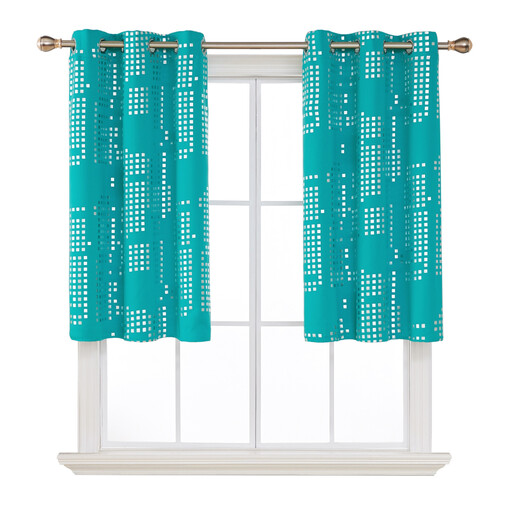
Why This Fits Their Persona: The peacock blue colour and silver foil check pattern suit buyers seeking a decorative feature for bedrooms, dining rooms or living spaces.
The listing gives panel dimensions, eyelet quantity and specific cool-wash instructions, rather than relying only on style-led descriptions.
Two 97cm by 214cm panels, six rust-resistant metal eyelets per panel and a triple-weave construction.
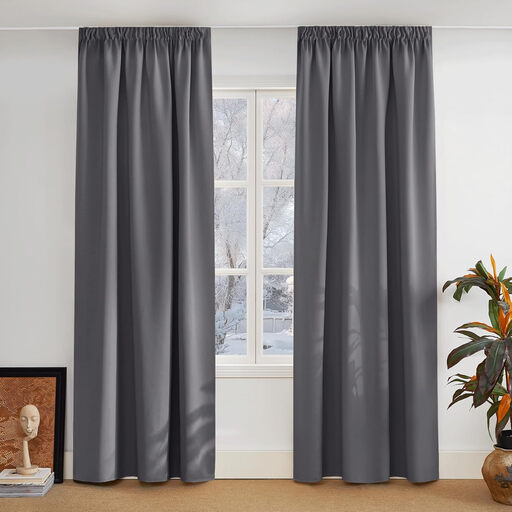
Why This Fits Their Persona: The full-length format is suited to tall windows, patio doors and bedrooms where stronger light and temperature control are priorities.
The product gives a stated 85–95% light-blocking range and explains compatible hanging options instead of assuming every pole uses eyelets.
230 g/m² polyester, pencil pleat header and compatibility with rings and hooks, ceiling-rail rollers or cord systems.
We have compiled a complete, real-time list of products that fully satisfy these strict selection criteria and UK safety regulations.
Measure the curtain pole or track, not just the glass. Choose a combined curtain width of approximately 1.5 to 2.6 times the pole width for usable fullness. For stronger privacy and light control, allow the fabric to extend beyond the window edges where the room layout permits.
Thermal curtains can provide an additional fabric barrier at the window and may help a room feel warmer in winter or cooler in summer. Their contribution depends on the window, lining, fit and how fully the curtains are closed. They work alongside, rather than replace, glazing improvements and draught-proofing.
Eyelet curtains are generally quick to fit when the pole diameter suits the eyelets: simply thread the pole through the rings. Pencil pleat curtains offer more flexibility with poles and tracks but normally need hooks, rings or rollers. Check the hardware before ordering and ensure it can support the curtain weight.