
24/7 Customer Support

Free returns

Same-day & Next-day Delivery

Quality Guaranteed

Unlock Your Welcome Offers: FREE Delivery | Up to 80% OFF | Free 30-day JoyPlus trial
Download the APP
A weekend away at a festival or a spontaneous family camping trip sounds idyllic. That is, until you’re wrestling with a tangle of poles at dusk or being woken by the 5 AM summer sunrise. The promise of a blackout pop up tent is simple: a shelter that goes up in moments and provides a dark, restful interior. However, the market is filled with options that can lead to disappointment.
As the Joybuy Product Recommendation Officer, my role is to help you see past the marketing jargon. Many campers find their new tent falls short due to a few common but costly design flaws. Before you buy, be aware of these frequent pitfalls:
instant setup tent is lost if the mechanism is flimsy. Cheaper pop-up frames can bend in a moderate breeze or break after only a few uses, making them impossible to fold away.To ensure your tent is a reliable retreat, focus on a few core specifications. These details determine whether your tent will be a joy to use or a source of frustration.
A tent's waterproof capability is measured by its Hydrostatic Head (HH) rating. This figure indicates how much water pressure the fabric can withstand before it leaks. For typical three-season UK camping, which often involves unpredictable showers, a rating of PU2000mm is a practical benchmark. This means the fabric can hold up a 2,000 mm column of water. It’s sufficient for most rain, ensuring you stay dry without the extra weight and cost of expedition-grade materials. Anything less might struggle with more than a brief, light drizzle. A good waterproof quick pitch tent should clearly state its HH or PU rating.
Effective blackout technology does more than just look dark. Look for tents with multi-layer fabrics, often featuring a silver or vinyl coating on the interior. This construction doesn't just block light for a better night's sleep; it also reflects solar radiation. This helps keep the tent's interior cooler during the day.
A crucial related feature is the Ultraviolet Protection Factor (UPF). A UPF50+ rating is highly recommended, as it indicates the fabric blocks over 99% of harmful UV rays. This is particularly important for families with children, creating a safer space for daytime naps or playing out of the sun.
The "pop-up" mechanism is the heart of an easy up tent for festivals or family trips. The most basic models use a coiled spring-steel frame that can be difficult to control and prone to twisting. A more robust and reliable option is a pre-attached fibreglass auto frame. This design uses hinged poles that lock into place as you lift the structure. It offers superior stability, can often withstand stronger winds (look for wind-force ratings) and is generally more durable over the long term.
Based on these practical criteria, here are a few options suited to different types of campers.
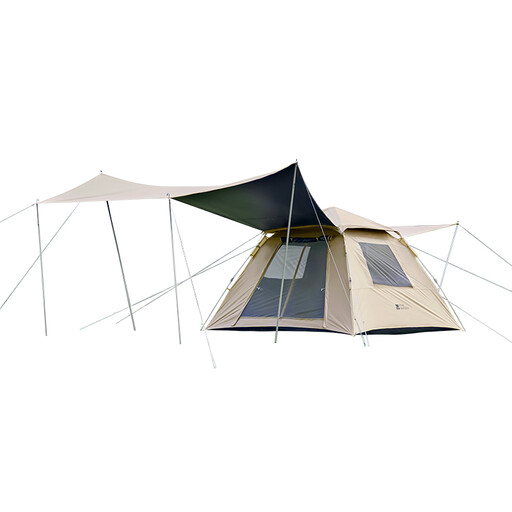
Why This Fits Their Persona: This model is ideal for families who need a reliable base for weekend trips. The included tarp extends the living space, creating a sheltered area for cooking or relaxing, while the generous interior can accommodate a small family. It's a practical 5 person family camping tent solution.
The high-resilience fibreglass auto frame is more robust than basic pop-ups, and the 6-layer blackout fabric with a UPF50+ rating provides true darkness and sun protection, not just shade.
Features a PU2000mm waterproof rating suitable for UK rain and five-sided ventilation for excellent airflow, reducing condensation and heat build-up.
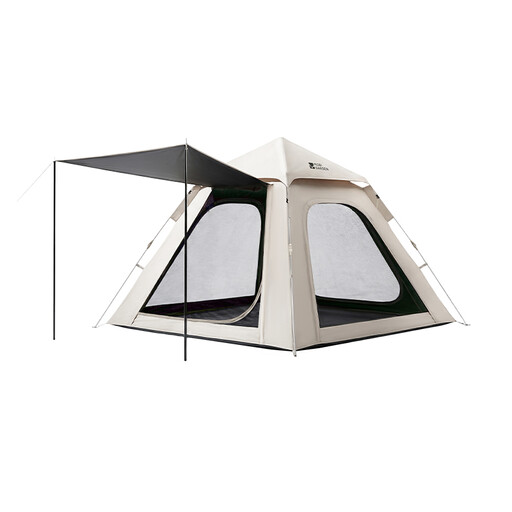
Why This Fits Their Persona: For festival-goers, speed and sleep are paramount. This tent's 3-second setup means less time faffing and more time enjoying the event. The full blackout fabric is a huge plus for sleeping in after a late night, making it a top-tier easy up tent for festivals.
It uses a full blackout composite fabric that insulates against light and heat, unlike cheaper dark-coloured tents. The fibreglass auto poles are rated to withstand Force 6 winds, avoiding frame failure in exposed festival fields.
Offers a squared interior of approx. 5.76 m?, providing ample space for gear and sleeping. The simple folding process is beginner-friendly, preventing frustrating pack-down experiences.
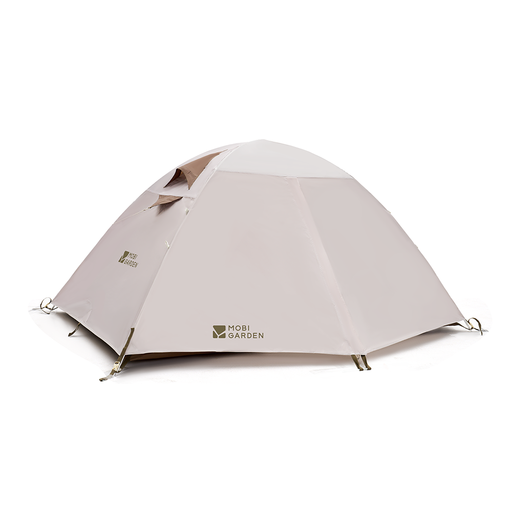
Why This Fits Their Persona: While not a pop-up, this is for those who value a small packed size above all. If your car boot is tight or you prefer a lighter load, this "easy setup" pole tent is a strong alternative. It offers excellent weather protection in a far more compact package.
It bypasses the bulky packed size of many pop-up tents. Its traditional pole design is inherently strong and the impressive PU4000mm groundsheet offers superior waterproofing from below.
Extremely lightweight at approx. 2.64 kg with a very compact packed size (41 × 16 cm). The setup is still straightforward for two people, offering a balance of convenience and portability.
Once you've chosen your shelter, ensuring you have the right gear for comfort and safety after sunset is the next step.
We have compiled a complete, real-time list of products that fully satisfy these strict selection criteria and UK safety regulations.
For most casual camping and festival use in the UK, a Hydrostatic Head (HH) rating of PU2000mm on the flysheet and floor is a reliable standard. This will handle typical downpours and keep you dry. If you plan to camp in more exposed, mountainous areas or for extended periods, you might consider a higher rating of 3000mm or more.
Tents that simply use a dark fabric can become very hot. However, a true blackout pop up tent with a reflective inner coating (like silver or vinyl) is designed to combat this. By reflecting sunlight, these fabrics help to keep the interior noticeably cooler than a standard tent, making them more comfortable for daytime use. Good ventilation is also key, so look for models with multiple mesh-covered doors and windows.
The classic, cheap "spring-loaded" pop-up tents can be notoriously tricky to fold, often requiring a specific twisting motion that can be frustrating to master. However, modern automatic-frame tents are designed for a much simpler pack-down. You typically release a central hub and the hinged poles fold inwards systematically. It's always a good idea to practise once or twice at home before your first trip.