Single-serve iced-latte makers
If you normally make one drink at home or work, a cup-sized blender may fit your routine better than a jug. Check the cup capacity and whether a drinking lid comes with the model you choose.


For one iced latte, choose a cordless portable blender if you need to blend away from a socket, or a corded personal blender if you usually make it near one. A compact jug is worth considering when you also make larger batches. Whichever format you choose, check that the exact model and supplied blending parts are stated to handle ice.
If you normally make one drink at home or work, a cup-sized blender may fit your routine better than a jug. Check the cup capacity and whether a drinking lid comes with the model you choose.
A cordless blender makes sense when your break spot has no convenient mains socket. For an iced latte, confirm that the exact portable model is stated to process ice.
If breaking up ice is your main requirement, look for an explicit ice-crushing or frozen-ingredient claim for the model and its supplied blending parts. A general smoothie description is not enough to establish that capability.
Choose it when: You need to blend one drink away from a socket and the exact model is stated to process ice.
Trade-off: Cordless use adds charging to your routine; portability alone says nothing about ice capability.
Choose it when: You normally blend near a socket and want to prepare one drink in a personal cup.
Trade-off: You need mains power, and cup, lid and ice-handling details still depend on the model.
Choose it when: You also want to make more than one drink or need a larger working capacity.
Trade-off: A jug takes more storage space and may mean more parts to handle after a single latte.
| Concern | What to check | Who it matters to |
|---|---|---|
| Ice handling | Look for an explicit ice or frozen-ingredient claim for the exact model and supplied cup, blade or jug; read its ice-use instructions. | If my afternoon latte contains ice, I need a model stated to handle it rather than relying on a smoothie label; around 42% of consumers put ice handling first. |
| Single-serve convenience | Compare cup size and included lids; decide whether you need cordless operation or will blend near a socket. | For one drink during a short break, I want a cup I can take with me and, if no socket is handy, a cordless machine; roughly 33% of consumers put single-serve convenience and portability first. |
| Cleaning and wider use | Check which parts are removable or dishwasher-safe, and compare working capacity if you may make several drinks. | I want manageable clean-up after a quick latte, but may also make more than one serving; about 25% of consumers make cleaning and wider use their primary concern. |
Ice capability is model-specific; neither a portable design nor a motor rating establishes that a blender can process ice.
Check the exact model's ice or frozen-ingredient claim and instructions for its supplied blade and vessel before buying.
A jug can be useful for larger batches, but its size and separate parts may be less convenient when you make only one afternoon latte.
Compare working capacity, storage space and the parts you will need to wash with those of a cup-based blender.
Electrical products and batteries need appropriate disposal. UK government guidance says the crossed-out wheelie-bin symbol means an item should not go in household rubbish.
Use an electrical-waste collection route when the appliance reaches the end of its life, following local guidance for any removable battery.
Ninja UK describes the cordless Blast BC151UKBK for ice, frozen ingredients and iced lattes, while its corded BL580UKV personal blender is described for blending ice into a travel cup.
An Amazon.co.uk listing describes the nutribullet Ultra as a 1200 W personal blender with a 900 ml cup, an automated blend cycle and a pulse option.
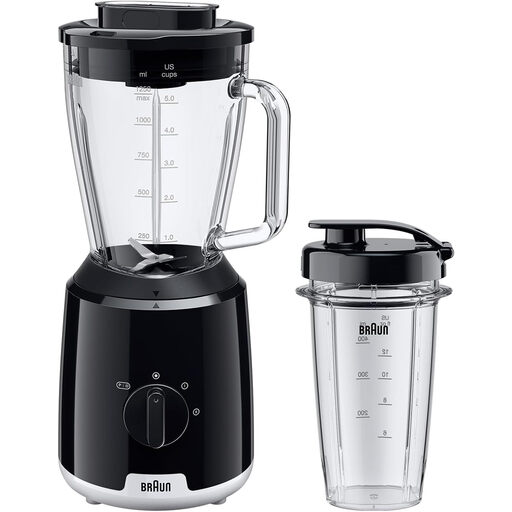
Braun Household GB lists the PowerBlend 1 JB1051BK as a jug blender with a 1.25 L working liquid capacity, an ice-crush programme and a smoothie-to-go bottle.
Tefal UK Shop distinguishes mini and portable blenders from larger jug formats, giving shoppers several ways to match a blender to their routine.
These choices cover blending a drink near a socket: a corded personal blender for cup-based preparation and a jug blender for those who also want batch flexibility. Check the exact ice-use instructions and package contents before choosing either.
 No image available
This corded, cup-based model suits one iced latte made near a socket. An Amazon.co.uk listing for the nutribullet Ultra describes ice and frozen-fruit crushing, an automated blend cycle and pulse control. Check which cups and drinking lids come with this package if you plan to take the drink away.
 No image available
This jug model suits an iced latte when you also want the option to make larger batches. It has two speeds and an ice-crush function; the product title specifies a 1.5 L glass jug and a Smoothie To Go bottle. Braun Household GB gives the JB1051BK a 1.25 L working liquid capacity, so check the working figure when planning portions.
No: choose a model whose product information or instructions explicitly state that it can process ice or frozen ingredients. Check that the claim applies to its supplied blade and cup rather than relying on a general smoothie description.
Choose a portable model when you need to blend away from a socket, provided that exact model is stated to handle ice. If you usually have a socket nearby, a corded personal blender gives you a cup-based format without adding charging to your routine; check its ice capability too.
Check which parts detach and which are dishwasher-safe; do not assume the whole appliance can go in a dishwasher. Braun Household GB says the disassembled jug, lid and blades of its PowerBlend 1 JB1051BK can be placed in one, but follow the instructions for the model you buy.
Use an appropriate electrical-waste collection route rather than household rubbish. UK government guidance says the crossed-out wheelie-bin symbol on electrical products and batteries indicates that they should not go in household rubbish; follow local guidance if the battery can be removed.