Single-serve small-kitchen drink makers
If you usually make one cooler, compare the maximum fill line with your recipe, then consider where the complete blender will be stored and how its parts are cleaned.


Choose a cordless portable blender if you mainly make one smaller mango cooler away from a socket and are happy to charge it. For frequent drinks with frozen mango or ice, a mains-powered personal blender with an exact-model claim for those ingredients is a more cautious choice; a multi-function set makes sense only if you will use its other attachments and have room to store them.
If you usually make one cooler, compare the maximum fill line with your recipe, then consider where the complete blender will be stored and how its parts are cleaned.
If frozen mango or ice goes into most drinks, check the exact model’s ingredient guidance. Portability or motor wattage alone does not establish how a blender will handle your recipe.
If you want to blend away from a mains socket, a cordless model offers that flexibility, provided its usable fill level suits your drink and you are willing to manage charging.
Choose when: You want one smaller drink without being tied to a socket.
Trade-off: You must allow for charging and a potentially lower maximum fill level.
Choose when: You often blend at home and regularly use frozen ingredients, provided the exact model is stated to handle them.
Trade-off: Blending requires a socket and space for the appliance and cup.
Choose when: Grinding, juicing or making different drink sizes will justify the additional parts.
Trade-off: Attachments also need cupboard space and washing.
| Concern | What to check | Who this matters to |
|---|---|---|
| Frozen mango and ice | Look for an exact-model statement covering your intended frozen ingredients, then follow its instructions for quantities and use. | If frozen mango or ice goes into my usual cooler, I want a blender whose instructions cover those ingredients rather than relying on its portable design. Around 42% of consumers put frozen-ingredient handling first. |
| Storage, serving size and cleaning | Compare the maximum fill line with your recipe, measure storage space for all parts and check which parts can be washed separately or in a dishwasher. | With little cupboard space and only one drink to make, I need the serving to fit without leaving a collection of parts to store and wash. Storage and single-serve convenience come first for roughly 33% of consumers. |
| Plug-free use | Check the exact model’s charging arrangement and whether its usable fill level suits your drink. | When a socket is inconvenient, I would rather charge a blender than choose where to make my cooler around a plug. About 25% of consumers make cordless use their primary concern. |
The maximum fill line can be lower than the cup’s stated capacity, leaving less room for mango, liquid and ice than the cup size suggests.
Compare your usual recipe with the maximum line before choosing a cup size.
A cordless design does not, by itself, establish suitability for frozen mango or ice.
Check the exact model’s ingredient guidance and use it within the stated instructions.
Cups, lids, blades, jars and juicing attachments can take up storage space beyond the motor base.
Measure the complete set you expect to keep, and decide whether its extra functions earn that space.
UK guidance from the Office for Product Safety and Standards says unwanted batteries and electrical products should go to an appropriate recycling collection point rather than household rubbish.
Use an appropriate electrical-waste collection route for the blender; follow the collection service’s instructions for any battery.
The UK range includes a cordless Portable model and a mains-powered 600 Series, offering two different approaches to a single mango cooler.
VonShef’s 4-in-1 model combines personal-blending cups with attachments for other tasks.
These two personal blenders offer different ways to make a mango cooler: a cordless model for smaller plug-free servings and a mains-powered model for blending near a socket. Check each one against your ingredients, recipe volume and available storage space.
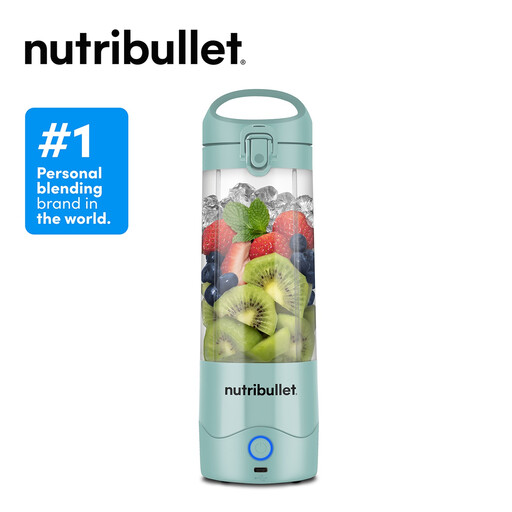 Image unavailable
Consider this cordless model when you want to make one smaller cooler away from a socket.
Although the cup holds 475 ml, nutribullet UK gives the matching Portable model a 350 ml maximum fill line and dimensions of 27.2 × 8 × 9.5 cm. The product listing includes USB-C charging and states 15 or more blending cycles per charge; charging remains part of regular use.
nutribullet UK states that its Portable model can process frozen fruit and ice. Follow the model’s ingredient instructions and check that your complete recipe fits below the maximum line.
 Image unavailable
Consider this mains-powered personal blender if you make coolers near a socket and want to check a model listed for ice and frozen fruit.
Its product name states a 1200 W motor, a 900 ml cup and two blending options. Those figures do not establish the finished drink’s texture or the cup’s usable maximum fill level.
Before choosing it for one drink in a small kitchen, check the maximum fill line, the space needed to store the appliance and cup, and the model’s instructions for your frozen ingredients.
A cordless blender can suit one smaller cooler if its maximum fill line fits your recipe and the exact model’s instructions cover your ingredients. For example, nutribullet UK states that the Portable model can process frozen fruit and ice, but its maximum fill line is 350 ml. If you regularly want a larger serving, compare a mains-powered model’s usable fill level and ingredient guidance.
Use the maximum fill line to judge whether your mango, liquid and ice will fit. nutribullet UK lists a 475 ml cup but a 350 ml maximum line for its Portable model, and an 840 ml cup with a 570 ml maximum line for the 600 Series.
Clean the food-contact parts after use, following the model manual for safe blade handling and dishwasher suitability. Check the cup, lid and blade instructions separately rather than assuming the whole appliance can go in the dishwasher.
Take it to an appropriate electrical-waste collection route rather than putting it in household rubbish. The UK Office for Product Safety and Standards advises separate recycling for unwanted batteries and electrical products; follow the collection service’s instructions on whether any battery should be removed.