
24/7 Customer Support

Free returns

Same-day & Next-day Delivery

Quality Guaranteed

Unlock Your Welcome Offers: FREE Delivery | Up to 80% OFF | Free 30-day JoyPlus trial
Download the APP
A blender can look like a straightforward kitchen purchase, but the wrong model may quickly become frustrating. A small personal blender may struggle with family-sized portions, while a powerful countertop blender may take up valuable worktop space for a single morning smoothie.
The most common buying pitfalls are not always obvious:
Choose the format around your usual portions:
Check whether the listed volume is total or recommended working capacity. For hot food, follow the manufacturer’s instructions carefully. A sealed jug can build pressure when hot liquid produces steam, so never assume that a cold smoothie blender is suitable for hot ingredients.
Wattage provides a useful indication of electrical input, but it should be considered alongside the blade system and controls. For occasional smoothies, a 300W–600W model may be sufficient when used with enough liquid and suitably sized ingredients. Models rated around 800W or above may offer more capacity for frozen fruit, ice, nuts and thicker mixtures, depending on their design.
Look for practical controls rather than impressive-sounding labels. Pulse functions help break up ice and briefly process chunky ingredients, while multiple speeds allow better control over sauces, dips and drinks. An ice-crushing blender should specify an ice or pulse function rather than relying on wattage alone.
Jug geometry also affects circulation. A shaped or ribbed jug may guide ingredients back towards the blades, reducing the need to stop and scrape the sides. This is particularly useful for thicker smoothies and frozen drinks.
Glass jugs are heat-resistant in some models and less likely to retain odours, but they are heavier. Tritan or other shatter-resistant plastic is lighter and convenient for personal blending. Check whether cups are BPA-free, whether blades can be removed and which parts are dishwasher-safe.
For a dishwasher-safe blender, verify the exact components included in that claim. The motor base should never be immersed in water. Removable blades still require careful handling because they are sharp.
UK shoppers should also check the plug and electrical details. Most domestic models should be suitable for the UK’s 220–240V supply, but the Philips 5000 series HR2765/00 listed below comes with a standard EU power cord and requires a suitable adapter for UK use. Always follow the supplied instructions and safety guidance.
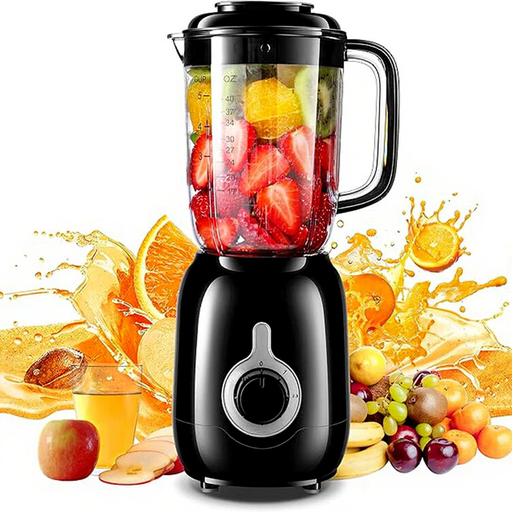
Why This Fits Their Persona: A practical choice for first-time buyers wanting a family-friendly smoothie blender for drinks, purées and sauces without moving to a larger appliance.
Its 1.2L jug, two speeds and pulse function provide more control than a single-button mini blender, while the safety lock helps prevent operation when incorrectly assembled.
500W motor, four stainless steel blades, grinding and chopping cups, plus a non-slip base.
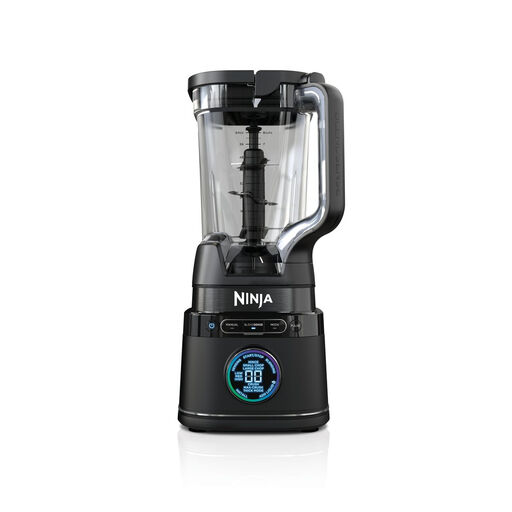
Why This Fits Their Persona: Suitable for households that want one appliance for family jugs, individual smoothies, frozen drinks and food preparation.
The package includes both a traditional jug and two single-serve cups, so buyers do not need to purchase a second personal blender for smaller portions.
1200W motor, 10 speeds, BlendSense programmes and top-rack dishwasher-safe jugs, cups and blades.
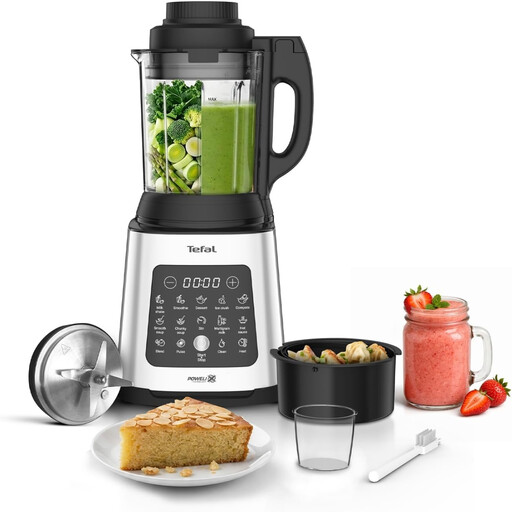
Why This Fits Their Persona: Designed for home cooks who want a hot and cold blender for soups, sauces, jams, smoothies and steaming without using several separate appliances.
It is specifically described as a cooking blender with a heatproof glass jug, hot programmes and a 1.75L useful capacity, rather than relying on a standard cold-use jug.
1400W motor, 10 automatic programmes, steam basket, removable blades and automatic deep-clean programme.

Why This Fits Their Persona: A cordless option for blending a single smoothie or shake at work, in student accommodation, at the gym or while travelling.
The rechargeable battery removes the need for a socket during use, while the 475ml cup and leak-proof lid make the capacity and transport arrangement clear.
USB-C charging, over 15 listed blending cycles per charge and dishwasher-safe cup, lid and blade assembly.
We have compiled a complete, real-time list of products that fully satisfy these strict selection criteria and UK safety regulations.
Running cost depends on motor power, blending time and electricity rates. A higher-wattage model can use more electricity per minute, but a shorter blending cycle may offset some of that difference. For occasional smoothies, the practical difference is usually influenced more by usage frequency and programme duration than the headline wattage.
No. Many standard smoothie blenders and personal blenders are intended for cold ingredients only. Steam can create pressure inside a sealed jug, so use a model specifically designed for heating, such as a soup maker blender, and follow its maximum temperature and filling instructions.
Lifespan varies with construction, workload, cleaning and correct use. Regularly overfilling the jug, blending unsuitable ingredients or running the motor for longer than instructed can increase wear. Choosing the right capacity, using pulse settings appropriately and checking warranty and repair information before purchase can help avoid premature replacement.