
24/7 全天候客户支持

免费退货

当日/次日达

品质保障

开启新人专享福利: 全场免邮 | 低至 2 折 | 免费试用 30 天 JoyPlus 会员
下载 Joybuy
Choosing a blood glucose monitor kit for home use should be straightforward, but product listings often make comparison harder than it needs to be. A low price may hide the cost of replacement strips, while impressive terms such as “advanced accuracy” may not tell you whether the meter is practical for everyday use.
For adults with diabetes or prediabetes, carers, older people, pregnant women who have been advised to monitor glucose and anyone tracking readings at home, the useful questions are practical:
The following guide highlights common buying traps, essential specifications and suitable product profiles available through Joybuy.
Blood glucose test strips are generally model-specific, rather than universally interchangeable. A Yuwell meter, for example, requires the matching Yuwell strips for its designated model. Likewise, Safe AQ Smart, Safe AQ Pro I, Safe AQ Pro III and Safe-Accu2 strips should not be treated as interchangeable simply because they come from the same manufacturer.
Before ordering, check:
A cheap box of incompatible strips is not a saving. If you already own a meter, search by its full model name rather than by the general phrase “blood sugar monitor”.
A complete diabetes testing kit may include 10 or 50 strips, but the meter itself is only one part of the ongoing cost. People who test frequently should compare the price per strip and check whether lancets are included.
Also look for storage instructions. Some products state that strips must be used within a set period after opening, such as three or six months. Opening several bottles at once can create unnecessary waste, particularly for occasional users.
Several listed meters provide results in approximately five seconds, while the Safe-Accu2 system provides a reading in around ten seconds. Speed is useful, but technique still matters. Wet or unwashed hands, an insufficient blood sample, expired strips or poorly sealed containers can affect the testing process.
Home readings should be interpreted according to advice from your GP, diabetes team or midwife. A home blood glucose meter is not a substitute for professional diagnosis or treatment guidance.
For most UK users, an mmol/L blood glucose monitor is the practical choice. Some meters allow users to select between mmol/L and mg/dL, while others are supplied specifically in mmol/L versions.
Check the setting before the first test and compare the displayed unit with the unit used in your care plan. A result displayed in the wrong unit can cause confusion, especially when readings are being recorded for a clinician.
The required sample is measured in microlitres (μL). A smaller stated sample requirement can make testing more convenient, particularly for older users or people who test regularly.
Examples in this range include:
The lancing device is also important. Adjustable depth settings can help users select a setting that produces a suitable sample without unnecessarily deep puncturing. Always follow the supplied instructions and use a fresh lancet for each test.
No-coding or auto-coding meters are designed to reduce manual setup when a strip is inserted. This can be helpful for carers, older people and users who want a simpler routine.
However, “no coding” does not mean that any strip will work. Confirm the approved meter-strip pairing. Keep strips in their original container, close the cap promptly and do not use them after the stated expiry date. Used lancets and strips should be disposed of safely, following local guidance and the product manual.
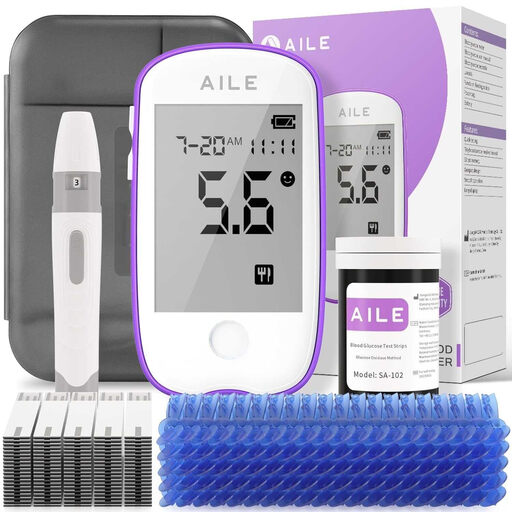
Why This Fits Their Persona: A complete home diabetes testing kit with 50 strips, 50 lancets, a lancing device and storage case is convenient for someone starting a regular testing routine.
The listing specifies mmol/L and mg/dL selection, no manual coding and the compatible AILE meter range for its strips.
Five-second results, a large LCD screen, 50 test strips and five adjustable lancing depths.
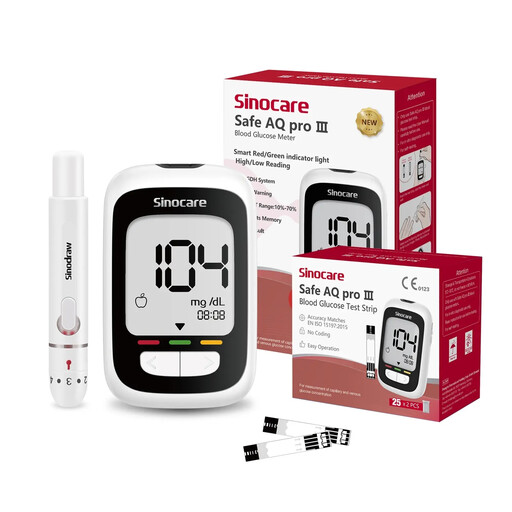
Why This Fits Their Persona: Users prioritising a fuller feature specification may prefer a kit with a five-electrode system, auto-coding and a wide stated HCT range.
The kit clearly states that it contains the meter, 50 compatible strips and 50 lancets, reducing uncertainty at checkout.
Five-second readings, 1 μL sample requirement and a stated 20%–70% HCT range.
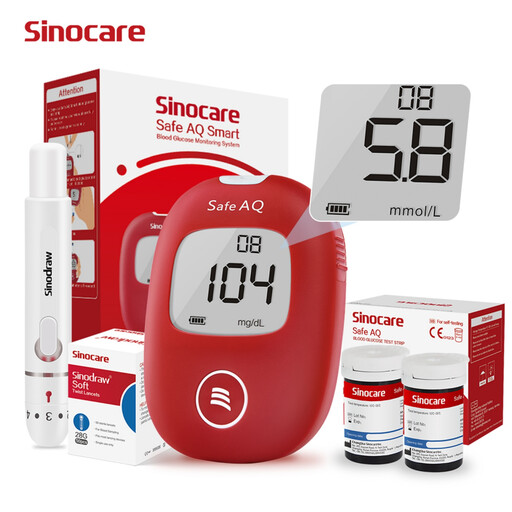
Why This Fits Their Persona: A portable set with 50 strips and 50 lancets suits users who want supplies ready for repeated testing at home or while travelling in the UK.
The no-coding design removes a manual step, while the product page identifies the matching Safe AQ Smart strips.
Results in five seconds, a 0.6 μL sample requirement, large display and adjustable lancing depth.
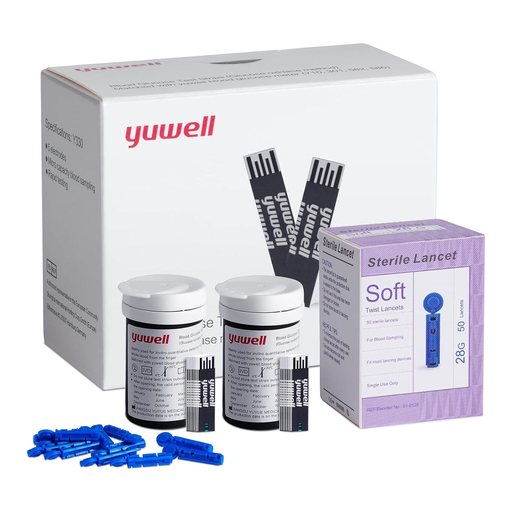
Why This Fits Their Persona: This strips-only pack is suitable for an existing Yuwell Model 710 owner who needs routine replacement supplies rather than another meter.
The listing explicitly states that the strips are for the designated Yuwell model and are not interchangeable with other brands or models.
Includes 50 test strips and 50 lancets, helping simplify a repeat purchase.
We have compiled a complete, real-time list of products that fully satisfy these strict selection criteria and UK safety regulations.
Read the manual before the first test and check that the meter is set to mmol/L. A typical routine is:
Do not share a meter or lancing device. Store strips in their original, tightly closed container and keep all testing components away from children. If a result appears unexpected or does not match how you feel, follow your healthcare professional’s advice rather than changing medication independently.
The ongoing cost depends mainly on how often you test and the price of compatible strips and lancets. Compare packs by calculating the cost per test, not simply the initial meter price. A kit containing 50 strips may be convenient, but check its expiry date and any after-opening usage period to avoid unused supplies.
This varies by product. The supplied information for some kits specifies six months after opening, while Safe-Accu2 strips are stated to require use within three months after opening. Always follow the product label and keep the container sealed to protect strips from moisture.
Do not assume universal compatibility. Test strips are usually designed for a named meter or model family, and some lancing devices require a particular lancet format. Check the product description and user manual before purchasing replacements. For a broader comparison of blood glucose test strips, visit the test strips diabetes range.