
24/7 Customer Support

Free returns

Same-day & Next-day Delivery

Quality Guaranteed

Unlock Your Welcome Offers: FREE Delivery | Up to 80% OFF | Free 30-day JoyPlus trial
Download the APP
Buying blood glucose test strips should be straightforward, but compatibility, storage and coding requirements can easily turn a low-cost purchase into wasted money. Whether you live with diabetes, monitor prediabetes, support a family member or need replacement supplies, the strip must work with the correct meter and suit your regular testing routine.
Joybuy Product Recommendation Officer guidance focuses on the details that are easy to miss behind prominent packaging claims.
Blood glucose meters use strip designs that are not universally interchangeable. A strip may look similar to another product while using a different electrical connection, calibration system or sample port.
Before ordering, check the exact meter model, not only the manufacturer name. For example, Safe AQ Smart test strips are not automatically suitable for Safe-Accu 2 or Safe AQ Pro I meters. The same applies to AILE products: the listed AILE strips are compatible with A608, A601, A606, A616 and W33 meters only.
A box may contain 50 strips, but the contents still need to be used within the stated period after opening. Some products specify three months after opening, while others specify six months. Moisture can also affect strips if the vial is left open.
Look for:
Buying a larger pack is only economical if you test often enough to use it within the stated period.
Terms such as “fast”, “no code” and “small sample” can be useful, but they should be assessed against your routine. A five-second result may suit people who test outside the home, while automatic sample uptake may be more helpful for users who find manual application difficult.
Also check whether lancets are included. Some listings contain strips only, whereas glucose test strips with lancets can reduce the need to source compatible diabetic testing supplies separately.
No-code glucose test strips remove the need to enter a calibration code manually. This can simplify setup, particularly for people who test regularly or carers assisting another person. However, “no code” does not mean universal compatibility. The meter model remains the first check.
Read the product listing and the meter manual together. If you cannot confirm a match, avoid opening the pack until compatibility has been verified.
Sample volume is measured in microlitres (μL). The listed products require a 0.6 μL sample, which is a small quantity. A smaller sample can make the collection step more manageable, but the finger-pricking technique and lancet depth still matter.
Testing time varies by product:
These timings refer to the product information and should not be treated as a substitute for following the meter instructions.
Some products specify an enzyme technology such as FAD-GDH or a glucose oxidase method. These are technical details describing how the strip reacts with the blood sample. If you have been advised by a healthcare professional to use a particular meter or strip type, follow that guidance.
Safe-Accu 2 product information lists automatic temperature compensation between 10°C and 35°C. Storage and use outside the stated conditions may affect performance, so keep strips sealed and follow the supplied instructions.
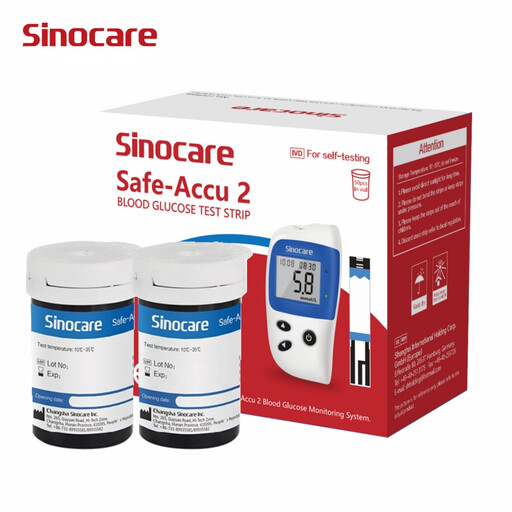
Why This Fits Their Persona: A practical replacement pack for Safe-Accu 2 owners who want strips and lancets together for routine home blood glucose monitoring.
The listing states compatibility only with the Safe-Accu 2 meter, helping buyers avoid assuming that all Sinocare strips fit every Sinocare device.
50 strips and 50 lancets; no coding required; 0.6 μL sample and approximately 10-second reading time.
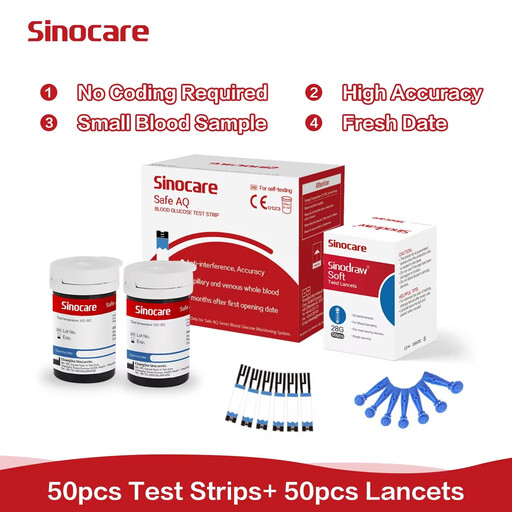
Why This Fits Their Persona: Suits Safe AQ Smart users who value quick readings and a matched supply of strips and lancing devices for frequent testing.
The product is identified specifically for the Safe AQ Smart monitor and states that no manual coding is required.
50 strips and 50 lancets; approximately 5-second testing; 0.6 μL sample requirement and automatic meter activation when inserted.
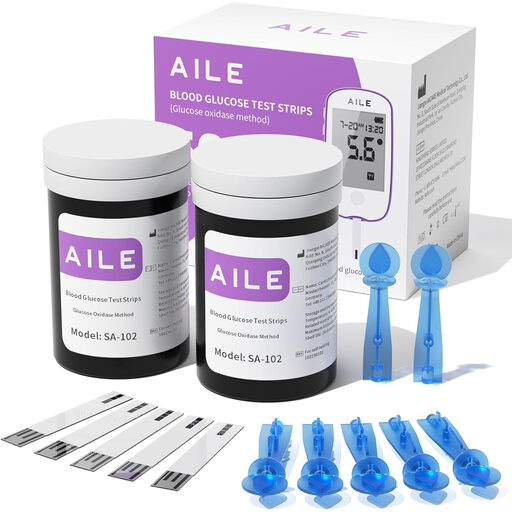
Why This Fits Their Persona: A suitable option for users who already own a listed AILE meter and need a portable supply for regular testing at home, work or while travelling.
Compatibility is clearly limited to AILE A608, A601, A606, A616 and W33 meters, rather than being presented as a universal strip.
50 strips; no coding required; siphon-style sample uptake and approximately 5-second reading time.
We have compiled a complete, real-time list of products that fully satisfy these strict selection criteria and UK safety regulations.
It depends on the product. The Safe-Accu 2 listing states that strips should be used within three months after opening, while the Safe AQ Smart listing states six months. Always follow the instructions on your specific pack and record the opening date on the vial.
No. Glucose meter test strips are generally designed for specified meter models. Confirm the exact model number before purchasing. AILE strips, for example, are listed for five AILE meters, while the Sinocare options above are assigned to particular Safe-series monitors.
The ongoing cost depends on testing frequency, pack size, lancet replacement and whether the strips are sold with lancets. Calculate the number of tests per week, then check whether the pack can be used before its opening-life limit. A 50-strip pack may suit regular users, while occasional users should pay close attention to expiry and storage requirements.