If you have room to position two speakers around your listening seat, an active stereo pair is a sensible starting point for blues recordings because it provides physically separated left and right channels without a separate amplifier. Choose a single wireless speaker instead if app-led, multi-room playback matters more than that layout, or look for a suitable phono input if records are your main source. In an open-plan flat, judge the setup at your normal listening level rather than choosing by bass output or wattage alone.
Who each setup suits
Stereo-first blues listeners
If you want separate left and right speakers for vocals, guitar and ensemble recordings, plan for two positions around your main listening seat. KEF UK describes the LSX II LT as a two-speaker system with streaming and wired inputs.
Open-plan convenience listeners
If straightforward Wi-Fi playback and room grouping matter more than starting with two speakers, a single-speaker setup may appeal. Sonos lists Wi-Fi, AirPlay 2 and a line-in for Five, with stereo pairing available if you later use two units.
Turntable-centred listeners
If records are a regular source and furniture space is limited, check for an input suited to your turntable. Ruark Audio specifies a moving-magnet phono input on the compact MR1 Mk3 active pair.
What matters when choosing
For blues listening in an open-plan flat, settle on your main listening position and playback sources before deciding how much space to give the speakers.
Networked active stereo pair
Choose when: You want separated left and right speakers alongside direct streaming and TV or computer connections; KEF UK lists these options for the LSX II LT.
Allow for: Two speaker positions, power and an interspeaker connection.
Single multi-room speaker
Choose when: App-led Wi-Fi playback and room grouping take priority over placing a separated pair; Sonos Five can be used on its own.
Allow for: A second Five if you later want physically separated stereo channels.
Compact pair with phono input
Choose when: A moving-magnet turntable is central to your listening; Ruark Audio lists a dedicated phono input for the MR1 Mk3.
Allow for: Two cabinets even with a compact system, and check how they fit around your usual listening seat.
| Concern |
What to check |
Who this matters to |
| Main listening area |
Check whether two speakers can sit apart around your usual seat, and assess the setup at your normal listening level. |
If I listen across a shared living area, I want a layout that works where I actually sit; around 36% of consumers put coverage of that area first. |
| Neighbour impact |
Check that volume is easy to control, and consider whether you would use extra bass output considerately. |
I want to enjoy a normal listening session without making bass a problem for neighbours; around 29% of consumers put manageable neighbour impact first. |
| Playback sources |
Match your TV, computer, CD player or turntable output to an actual input; check whether a turntable needs a phono stage. |
When I move between recordings on different devices, I need each source to connect to the system I choose; around 21% of consumers make compatibility their primary concern. |
| Space for the setup |
Measure for cabinets, power connections and any cable between speakers, not just one speaker footprint. |
With limited furniture space, I want built-in amplification without crowding my listening area; around 14% of consumers put compact placement first. |
Buying pitfalls
-
Choosing by bass output or wattage alone
A subwoofer output is an expansion option, not evidence that a flat needs a subwoofer. Rated power figures also cannot, by themselves, tell you how loud different systems will seem in your room or how sound will affect neighbours.
Start with the speaker arrangement at your usual listening level, then decide whether additional low-frequency output is appropriate for the space.
Adding a subwoofer later also means finding a suitable position for it; a stereo pair may need stands or a longer interspeaker cable.
-
Assuming every turntable connects directly
Sonos says some turntables need an external preamp before they connect to Five’s line-in. Ruark Audio’s MR1 Mk3 phono input is specifically for moving-magnet cartridges, subject to its stated maximum 7 mV input condition.
Identify your turntable’s cartridge and output, then match them to the exact speaker input.
The connection may require a suitable cable or an external phono preamp.
-
Assuming daytime volume cannot cause a nuisance
Westmorland and Furness Council’s noise guidance says that what is reasonable depends on circumstances, rather than a set time alone. Bass, frequency of playback and its effect on others can all matter.
Listen considerately at any hour and consult your local council’s guidance if you have a specific noise concern.
-
Expecting a single speaker to place channels apart
Sonos Five can work alone or as part of a stereo pair, but one enclosure does not put a separate speaker on each side of your listening position.
Decide whether one-box convenience or a separated left and right layout matters more before choosing the setup.
Creating a separated pair with Five requires a second matching speaker and space to position it.
Brands to consider
KEF
KEF UK positions the LSX II LT as a networked active stereo pair for streaming and wired sources.
- The LSX II LT lists Wi-Fi, Bluetooth, HDMI ARC, USB-C, optical input and a subwoofer output.
- It needs two speaker positions and an interspeaker connection; stands and a longer connection cable are separate items.
Sonos
Sonos presents Five as an app-led Wi-Fi speaker that can be used alone or paired for stereo.
- Sonos lists AirPlay 2, a 3.5 mm line-in and iOS-based Trueplay room tuning.
- Separated stereo playback requires two units; Sonos says some turntables also need an external preamp for line-in use.
Ruark
Ruark Audio offers the MR1 Mk3 as a compact active stereo pair with a moving-magnet turntable input.
- Ruark lists Bluetooth, USB-C, optical and line input, a subwoofer output and a moving-magnet phono stage.
- Its compact format does not, on its own, establish how it will suit every large open-plan layout.
Audioengine
Audioengine describes the A5+ Wireless as a powered stereo system for Bluetooth and analogue sources.
- Audioengine specifies 50 W RMS per channel, RCA and 3.5 mm inputs, Bluetooth and a variable RCA line output.
- Check the supplied plug and power specification for your location; Audioengine’s published specification describes manually switchable 115/240 V input.
Joybuy products for this setup
These options cover a compact two-speaker desktop setup and a tabletop speaker for multi-room playback. For either arrangement, check placement and source connections against the way you listen in your flat.
 No image available
Edifier M60 Bluetooth 5.3 desktop speakers
Consider these if you can position two compact speakers around your listening spot and use Bluetooth or wired playback.
The listed connections are Bluetooth 5.3, USB-C and AUX; the stated total output is 66 W RMS. That rating alone does not establish coverage of your open-plan room, so check the arrangement at your normal listening level.
View on Joybuy
 No image available
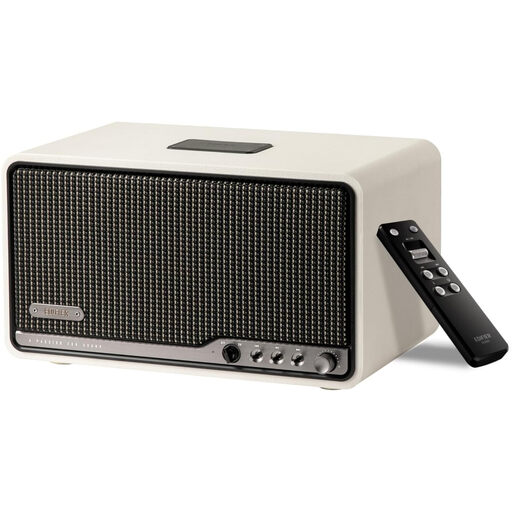
Edifier S300 Ivory multi-room tabletop speaker
Consider this tabletop speaker if multi-room playback matters and you prefer to start with one unit; confirm the supplied arrangement if separated stereo is important to you.
The listing describes Bluetooth 5.4, AirPlay 2, USB-C and AUX. It says multiple S300 speakers can form a left and right pair; check your turntable’s required connection separately if records are a main source.
View on Joybuy
Common questions
Should I choose one speaker or a stereo pair for blues recordings?
Choose a stereo pair if you can position left and right speakers around your main listening seat and value that separation. A single speaker takes a different approach: Sonos says Five can be used alone or paired with another Five for stereo, while KEF UK describes the LSX II LT as a two-speaker system.
Can I connect a turntable directly?
Yes, if its output matches the speaker input. Ruark Audio specifies a moving-magnet phono input for the MR1 Mk3, with a maximum 7 mV input condition; Sonos says some turntables need an external preamp before connecting to Five’s 3.5 mm line-in. Check your cartridge and turntable output before ordering.
Can the same speakers play music and TV sound?
They can if the connections match. KEF UK lists HDMI ARC and optical input for the LSX II LT, so check the outputs and settings on your television against the input you intend to use.
Does daytime listening remove the risk of a noise complaint?
No: daytime listening is not an automatic exemption from noise concerns. Westmorland and Furness Council advises that reasonableness depends on circumstances rather than set times alone; keep playback considerate and check your own local council’s guidance for a specific concern.


