
24/7 Customer Support

Free returns

Same-day & Next-day Delivery

Quality Guaranteed

Unlock Your Welcome Offers: FREE Delivery | Up to 80% OFF | Free 30-day JoyPlus trial
Download the APP
Buying Bluetooth speakers can seem straightforward until you compare power ratings, battery claims, codecs, water resistance and connection options. A compact model may suit a desk but disappoint at a garden gathering, while a large party speaker can be awkward to move and excessive for everyday listening.
The right choice depends on where you listen, how loud you need your music to be and whether portability matters more than stereo detail. Before choosing, watch for these common buying pitfalls.
A high-power Bluetooth speaker can produce greater volume, but wattage alone does not describe clarity, bass control or distortion. Check the speaker configuration, driver sizes and whether the stated figure is RMS output, rather than a short-term peak figure.
For desktop and home listening, two separate speakers can create a more convincing stereo image than a single cabinet. For parties, a larger woofer and passive radiators may be more relevant than fine stereo separation.
“Portable” only describes mobility. It does not automatically mean a speaker can handle rain, dust or splashes. If you want an outdoor Bluetooth speaker, look for a stated IP rating and check what it covers. An IP68-rated product offers a different level of protection from a speaker with no water-resistance information.
Also consider the charging port cover, handle design and weight. A 13.8 kg party speaker may be portable around the home, but it is not as convenient for public transport or a day trip as a 561 g rechargeable speaker.
Bluetooth 5.3 or 5.4 can support modern connectivity features, but sound quality also depends on the supported codec, source device and speaker electronics. For high-resolution listening, check for features such as LDAC, ALAC, USB audio or Wi-Fi streaming. Compatibility can vary between Android, Apple and Windows devices.
For clear near-field listening, compact desktop speakers with dedicated tweeters and mid-bass drivers can work well beside a monitor. The Edifier M60, for example, uses a 3-inch mid-bass driver and 1-inch tweeter per speaker, with bundled stands designed to angle sound towards ear level.
For fuller low-frequency output, look for larger drivers, bass reflex ports or passive radiators. Speakers with deep bass may be more suitable for dance music, films and gaming, although placement near a wall can make bass sound boomy.
If you are considering bookshelf speakers or Hi-Fi speakers, confirm whether they are active or passive. Passive models need a compatible amplifier or receiver. The HiVi-Swans D3.1MKII is a passive 8-ohm pair, with a recommended amplifier range of 10–120W, so it is not a plug-and-play Bluetooth speaker by itself.
Manufacturers commonly state maximum playtime under controlled conditions. Actual battery life can change with volume, lighting, bass settings and connected features. Check whether the specification gives one clear figure and whether the product supports mains operation as well as battery use.
A small rechargeable speaker may be convenient for travel, whereas a high-power model can require a trolley or two-person lift. Consider storage space, charging time and whether a USB-C powerbank function would be useful away from a socket.
For outdoor use, prioritise a published water and dust-resistance rating. Keep charging ports closed and follow the maker’s limits around immersion. Water resistance does not mean the speaker should be charged while wet.
For home flexibility, useful connections can include AUX, USB, optical input, microphone input and guitar input. Multi-device Bluetooth pairing can help at social events, while wireless linking may allow two compatible speakers to operate together. Check the exact Bluetooth version and supported profiles rather than assuming all wireless speakers offer the same functions.
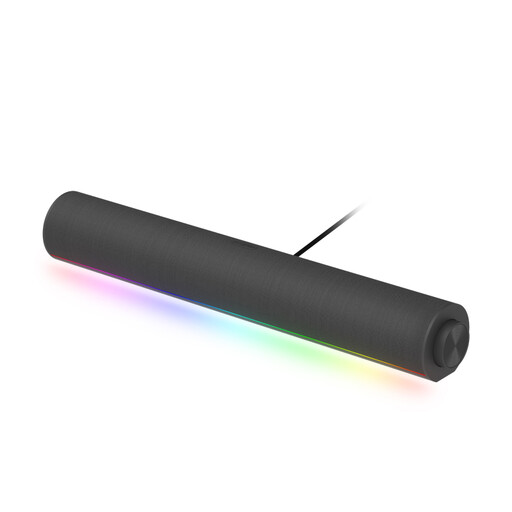
Why This Fits Their Persona: A compact option for UK students, home-office users and casual listeners who need sound for a laptop, projector or small room.
Its specifications identify a 2.1-channel layout, Bluetooth 5.0 and a 10-metre transmission distance, while clearly stating that it is not water-resistant.
Touch controls, mains or built-in battery operation and a slim 46.3 cm-wide desktop format.

Why This Fits Their Persona: Suitable for listeners building a tidy desktop, study or small living-room system with wired and wireless sources.
Bluetooth 5.3 is paired with LDAC support, USB-C and AUX inputs, giving you more than a basic wireless connection.
66W RMS output, Hi-Res Audio support and angled aluminium stands for desktop positioning.
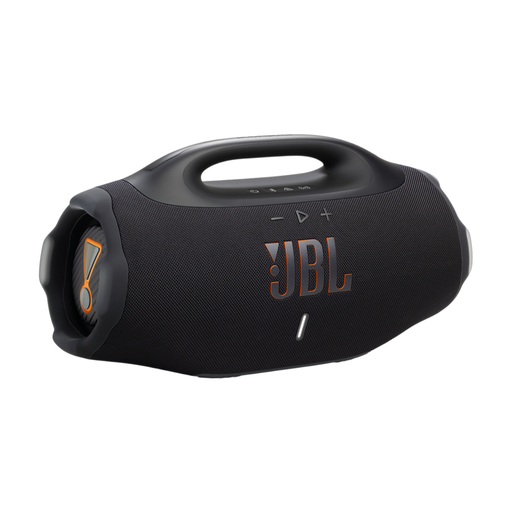
Why This Fits Their Persona: A practical match for garden gatherings, beach trips and users who want a substantial rechargeable speaker for extended sessions.
The published IP68 rating identifies protection against water and dust, rather than relying only on the word “portable”.
Bluetooth 5.4, USB-C powerbank functionality, three passive radiators and a specified weight of 5.89 kg.
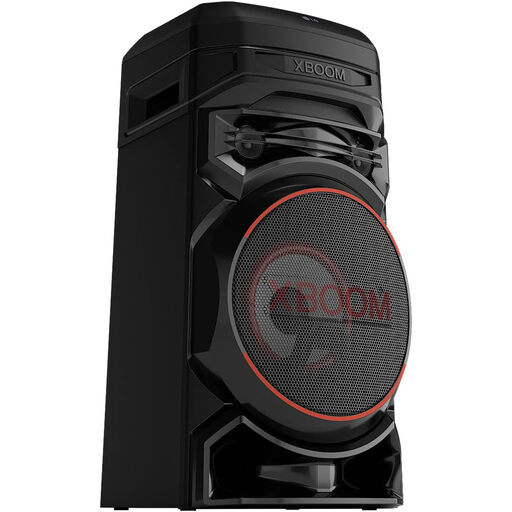
Why This Fits Their Persona: Designed for living-room celebrations, garden parties and karaoke sessions where inputs and visual effects matter as much as music playback.
Its feature list specifies an 8-inch woofer, microphone and guitar inputs, independent mic volume, voice cancellation and key changing.
RGB lighting, two USB ports, LG app control and wireless linking for two compatible speakers.
We have compiled a complete, real-time list of products that fully satisfy these strict selection criteria and UK safety regulations.
They can be, but wireless audio may introduce delay depending on the television, console and speaker. For gaming or films where lip-sync is important, check for a low-latency mode or use a wired AUX, optical or USB connection where available.
Battery lifespan depends on charging frequency, storage temperature and usage. Maximum playback figures are not guaranteed in every setting. To reduce battery stress, avoid leaving the speaker in extreme heat, use an approved charger and follow the manufacturer’s storage guidance.