Choose no-added-sugar jelly pots if a dessert-style serving works for your Bonfire Night table; choose reduced-sugar gummies if a chewy sweet matters more than avoiding sugar. These are different products, not interchangeable sugar-free options: Marks & Spencer lists 36.9g sugars per 100g for Reduced Sugar Percy Pig, while HARIBO UK lists 66g per 100g for its standard Jelly Beans. Check each pack for ingredients, sweeteners, dietary suitability and age warnings before sharing.
Who is each option for?
Hosts serving a jelly dessert
Ready-to-eat no-added-sugar pots suit a shared table where a spoonable dessert can take the place of chewy sweets. Tesco describes Hartley's Raspberry Jelly pots as no added sugar and suitable for vegans and vegetarians; they are not gummy sweets.
Shoppers who want a chewy sweet
A reduced-sugar gummy keeps the sweet format, but does not remove sugar. Marks & Spencer lists 36.9g sugars per 100g for Reduced Sugar Percy Pig, so compare its nutrition panel with your reason for choosing it.
Hosts serving guests with different requirements
Check each pack rather than assuming a sugar claim answers every dietary or age question. Tesco lists pork gelatine in Hartley's Create Your Own Jelly Crystals, while Marks & Spencer warns that Reduced Sugar Percy Pig is not suitable for children under 36 months because of a potential choking hazard.
What should you check before buying?
Start with the serving format guests expect, then compare the sugar wording and pack information for that exact product.
| Priority |
What to check |
Your needs |
| Sugar wording |
Read the claim alongside sugars per 100g. Tesco labels Hartley's Raspberry Jelly pots no added sugar; Marks & Spencer lists 36.9g sugars per 100g for Reduced Sugar Percy Pig. Neither description makes the other product equivalent. |
I want to know whether I'm buying a no-added-sugar dessert, a reduced-sugar sweet or a conventional sweet. |
| Serving format |
Check whether the product is ready to serve or needs making ahead. Tesco says Hartley's Create Your Own Jelly Crystals must be prepared with a sugar-free drink to keep the jelly sugar-free. |
For a table I can set out straight away, I'd choose ready-to-eat servings; if I have preparation time, crystals are another dessert option. |
| Ingredients and warnings |
Read the sweetener and ingredient statements on the exact pack. GOV.UK specifies labelling for foods with sweeteners and a laxative-effect warning where added polyols exceed 10%. |
I'm sharing treats with a group and need to spot ingredients or warnings that matter to individual guests. |
| Dietary suitability |
Check the vegan claim and gelatine source separately from the sugar claim. Tesco lists pork gelatine in Hartley's sugar-free crystals but describes its ready-to-eat Raspberry Jelly as vegan. |
Some guests avoid animal-derived ingredients, so I need the label for the particular jelly I'll serve. |
| Age guidance |
Read the age and choking statements before putting chewy sweets in a shared bowl. Marks & Spencer says Reduced Sugar Percy Pig is not suitable for children under 36 months because of a potential choking hazard. |
If young children will be at the gathering, I want to check the warning on each sweet rather than relying on its sugar claim. |
Common buying mistakes
-
Treating “reduced sugar” as “sugar-free”
Reduced-sugar gummies can still contain sugar. Marks & Spencer lists 36.9g sugars per 100g for Reduced Sugar Percy Pig; HARIBO UK lists 66g per 100g for its standard Jelly Beans.
Decide whether you want a no-added-sugar dessert, a reduced-sugar chewy sweet or a conventional sweet, then read the claim and nutrition panel on the exact pack.
-
Assuming every sugar-free jelly is vegan
A sugar claim says nothing by itself about gelatine. Tesco lists pork gelatine in Hartley's Create Your Own Jelly Crystals, although it describes Hartley's ready-to-eat Raspberry Jelly as vegan.
Check ingredients and dietary labelling for each flavour and format you plan to serve.
-
Overlooking sweetener information
Sweetener formulations differ between products. Tesco's Hartley's Blackcurrant jelly listing, for example, carries phenylalanine information.
Read the ingredients and warning statements, particularly when buying several packs for guests with different requirements.
-
Relying on an earlier stock listing
Tesco marked its Fruity Gems Sugar Free Jellies listing out of stock when checked, so a product page alone is not a dependable plan for the event.
Recheck availability before shopping and decide whether a jelly dessert would also suit your table.
Relevant brand references
Hartley's
Its jelly range illustrates the difference between ready-to-eat pots and make-at-home crystals, neither of which is a chewy sweet.
- Tesco describes the Raspberry Jelly pots as no added sugar and suitable for vegans and vegetarians.
- Tesco says the Create Your Own Jelly Crystals need a sugar-free drink to remain sugar-free when prepared; they contain pork gelatine.
M&S
Reduced Sugar Percy Pig is a chewy-sweet option for shoppers who are not seeking a sugar-free product.
- Marks & Spencer labels this product vegan.
- Its nutrition panel lists 36.9g sugars per 100g, and its pack warns that it is not suitable for children under 36 months because of a potential choking hazard.
Haribo
Jelly Beans provide a conventional sweet to compare with the sugar-reduction options.
- HARIBO UK describes Jelly Beans as suitable for vegans.
- HARIBO UK lists 66g sugars per 100g and names sugar and glucose syrup among the ingredients; this is not a sugar-free option.
Tesco
Tesco's listings include ready-to-eat jelly, make-at-home crystals and a chewy sugar-free jelly product.
- Its product information distinguishes no-added-sugar Raspberry Jelly pots from crystals that require preparation.
- Its Fruity Gems Sugar Free Jellies listing was marked out of stock when checked; recheck stock and the current label before planning around it.
Joybuy jelly options
These options cover a make-at-home sugar-free strawberry jelly and a ready-to-eat grape konjac jelly. The konjac jelly should not be treated as a sugar-free or reduced-sugar choice.
 No image available
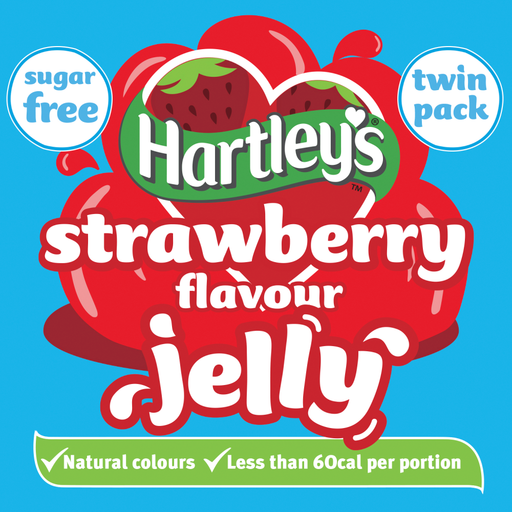
Hartley's Sugar Free Strawberry Jelly 23g
A make-at-home dessert jelly for a table where preparation and setting time are possible, rather than a ready-to-eat chewy sweet. Check its pork gelatine, aspartame and phenylalanine information against guests' requirements.
View on Joybuy
 No image available
Orihiro Prunto Grape Konjac Jelly 6pcs 120g
This ready-to-eat jelly offers a different serving format from prepared jelly pots, but is not established as sugar-free or reduced-sugar; check the nutrition panel if sugar content drives your choice. Its product information warns of choking risk and says it is not suitable for children under 4.
View on Joybuy
Frequently asked questions
Does “reduced sugar” mean sugar-free?
No. Marks & Spencer lists 36.9g sugars per 100g for Reduced Sugar Percy Pig, whereas Tesco describes Hartley's Raspberry Jelly pots as no added sugar. Check the claim and sugars per 100g for the product you are buying.
Can I make Hartley's Create Your Own Jelly Crystals with an ordinary drink?
Tesco says to prepare these crystals with a sugar-free drink to keep the finished jelly sugar-free. If that claim matters to you, follow the preparation wording on the pack rather than substituting a drink without checking it.
Which sweetener warnings should I read?
Read the ingredients and warning statements on the exact product. GOV.UK specifies wording for foods containing sweeteners and a laxative-effect warning where added polyols exceed 10%; also check for phenylalanine information on products containing aspartame.
Are sugar-free jelly products always vegan?
No. Tesco lists pork gelatine in Hartley's Sugar Free Create Your Own Jelly Crystals, while it describes Hartley's ready-to-eat Raspberry Jelly as vegan. Check the ingredients of the flavour and format you choose.
What should I check before offering gummies to young children?
Read the age and choking warning on the exact pack. Marks & Spencer states that Reduced Sugar Percy Pig is not suitable for children under 36 months because of a potential choking hazard; a reduced-sugar claim does not change that warning.


