Hosts who want an easy pass-around sweet
A mini-bite packet or sharing tub suits a table where guests will help themselves. Check whether the stated portion refers to one bite or to a serving that could contain several pieces.


Choose mini bites if guests need to help themselves without the host cutting fudge first, but read the description: some products with fudge in the name are biscuit or cake-style bites rather than traditional fudge. Choose conventional fudge if its texture matters more and you can portion it before the meeting. For guests with allergies or intolerances, check the current pack label before serving.
The useful distinction for a book-club table is whether guests can take a ready-sized piece or the host needs to portion traditional fudge.
A mini-bite packet or sharing tub suits a table where guests will help themselves. Check whether the stated portion refers to one bite or to a serving that could contain several pieces.
Choose conventional fudge if a biscuit, cake or caramel bite would not meet the group’s expectations, and allow time to divide it before the meeting.
Keep the current packaging available to check ingredients and precautionary allergen statements for the exact product being served. The Tesco and Waitrose mini-bite listings, for example, declare several allergens and warn that nuts may be present.
Start with the type of sweet your group expects, then check how it will be portioned and what its current label says.
| Priority | What to check | Your needs |
|---|---|---|
| Portion format | Look for a stated per-bite measure, serving count or pack format. A serving count does not establish how many individual pieces or wrappers are inside. | I’d like guests to help themselves without cutting sweets at the table. Tesco Groceries gives nutrition per mini bite for its Chocolate Fudge Mini Bites; Waitrose & Partners lists approximately 18 servings for its Millionaire Mini Bites tub. |
| Type of sweet | Read the description and ingredients to distinguish conventional fudge from chocolate-coated fudge pieces and biscuit or cake-style bites. | If the group expects traditional fudge, I don’t want to substitute a biscuit or caramel bite simply because its name sounds similar. |
| Ingredients and allergens | Check the current pack’s ingredient list, emphasised allergens and any “may contain” wording for the exact product. | I need to check what can be served to guests who have declared allergies or intolerances, rather than relying on an earlier online listing. |
| Meeting-day planning | Confirm stock shortly before buying, then check the pack size and whether you will need to portion the sweet yourself. | For a scheduled meeting, I need an option I can obtain in time. Tesco Groceries marked its Cadbury Fudge Bites 120G listing out of stock when checked, so I would reconfirm availability before planning around it. |
A fudge-named snack may also contain biscuit, cereal or chocolate, while a millionaire-style bite may contain no fudge.
Check the description and ingredients before choosing between conventional fudge and a mixed mini bite.
Ingredients can change, and an online description may not reflect the pack you serve. That matters when a guest has declared an allergy or intolerance.
Read the current package, including precautionary statements. If buying loose food, ask the seller for its allergen information.
A last-minute substitution could change both the sweet’s format and its ingredients.
Check stock close to the meeting and decide in advance whether a different mini bite or portioned traditional fudge would work for the group.
A tub’s suggested serving count does not tell you whether its contents are wrapped separately or how many pieces each guest will take.
Check the physical format before deciding whether to put out a shared bowl, serving utensils or the original packaging.
These examples show how differently products labelled as fudge or mini bites can work on a book-club table; they are not all traditional fudge.
Tesco Groceries describes its Chocolate Fudge Mini Bites as a 196 g chocolate-coated mix of biscuit, fudge cubes, crisped rice and oats.
Tesco Groceries describes Cadbury Fudge Bites 120G as fudge pieces covered with milk chocolate.
Waitrose & Partners lists Millionaire Mini Bites as a 288 g tub of biscuit, caramel and milk-chocolate pieces.
M&S lists a 135 g Clotted Cream Fudge made with Cornish clotted cream.
Tesco Groceries lists Thorntons Chocolate Fudge Brownie Bites as a 10-pack in its cake-bites category.
For a book-club table where chocolate-coated fudge minis appeal more than cake-style bites or fudge that needs cutting, this is a mini-format option to consider. Check the pack details and availability before planning portions for guests.
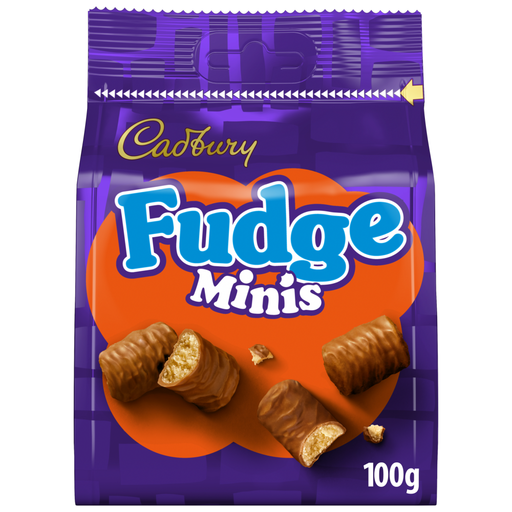 No image available
A mini format for passing around without cutting; the product description identifies a soft fudge centre with a milk-chocolate coating. The pack is 100G. Check the current label for ingredients and allergens, and confirm the piece count and availability if those affect your plans.
No. Tesco Chocolate Fudge Mini Bites combine fudge cubes with biscuit, crisped rice and oats, while Tesco describes Cadbury Fudge Bites as chocolate-covered fudge pieces. Waitrose Millionaire Mini Bites are biscuit, caramel and chocolate rather than fudge, so read the description before choosing.
Check the current label on the exact pack, including ingredients and any “may contain” statement. The Tesco Chocolate Fudge Mini Bites listing declares milk, wheat, oats, barley and soya and says the product may contain peanuts and nuts; the Waitrose Millionaire Mini Bites listing declares milk, wheat, oats and soya and says it may contain nuts.
Use each product’s stated unit as a starting point, not a guarantee of one piece per guest. Tesco Groceries gives nutrition per mini bite for its Chocolate Fudge Mini Bites, Waitrose & Partners lists approximately 18 servings for its 288 g Millionaire Mini Bites tub, and Tesco lists approximately four portions for Cadbury Fudge Bites 120G. Check the number of pieces if each guest needs an individual bite.
Yes, provided you can give guests the allergen information they need. GOV.UK guidance says allergen information for loose food should be available in writing or by speaking to staff, so ask the seller before buying and keep that information available when you serve it.