Blues listener building a separates system
You want to choose your amplifier and music sources independently, with the option to change components later rather than replace the whole system.


Choose passive standmount speakers if you have a suitable stereo amplifier or want to change system components independently. Choose an active wireless system if direct streaming and fewer separate boxes matter more. For either route, plan speaker positions and consider how much bass weight you want in the loft before choosing by cabinet size or music genre alone.
You want to choose your amplifier and music sources independently, with the option to change components later rather than replace the whole system.
You want streaming and connections for everyday sources without a separate amplifier and source stack.
You are deciding whether a compact speaker or a larger standmount will fit your available positions and your preference for low-end weight.
For a blues collection in a converted loft, decide how you will connect your music sources, then check the bass and placement requirements of the speakers you are considering.
| Concern | What to check | Who this matters to |
|---|---|---|
| System and connections | For passive speakers, check amplifier compatibility. For an active system, confirm the inputs needed for your music sources and other devices. | If I want to stream blues without a stack of separate equipment, connections to my everyday sources come first; around 40% of consumers put system simplicity and connectivity first. |
| Bass and room scale | Compare the exact models' published specifications, then consider where both speakers could stand and whether the system allows a subwoofer later. | In an open loft, I want enough low-end weight without assuming a larger cabinet will sound right in my room; around 30% of consumers put bass scale first. |
| Placement and flexibility | Measure safe positions for speakers and stands. For a passive system, allow space for the amplifier and cable routes. | I need speaker positions that work in the loft and want the option to change electronics later; around 30% of consumers put placement and upgrade flexibility first. |
Q Acoustics says its standmount speakers are designed to perform at their best on suitable stands. A cabinet fitting on furniture does not, by itself, establish a workable position for the stereo pair.
Measure possible stand locations and cable routes before settling on cabinet size; check shelf placement against the guidance for the exact model.
A passive standmount setup may also require stands and longer speaker cables.
Passive speakers need an external amplifier. For example, KEF specifies a 15–180 W amplifier requirement for the Q Concerto Meta; that figure should not be applied to a different model.
Check the amplifier guidance and connections for the exact speaker, alongside the space needed for the amplifier and cables.
Driver size and frequency-response figures help distinguish models, but they do not establish the bass balance you will hear after placing speakers in a particular loft.
Check the proposed positions and the retailer's audition or return arrangements before deciding whether a larger standmount or a subwoofer suits your setup.
KEF offers both passive Q Series standmount speakers and active LS wireless systems, making its ranges relevant to the separates-versus-integrated decision.
Its passive standmount range is relevant if you are comparing cabinet sizes for a conventional amplifier-and-speaker system.
The passive Debut 3.0 DB63 provides published specifications to use when considering amplifier matching and speaker size.
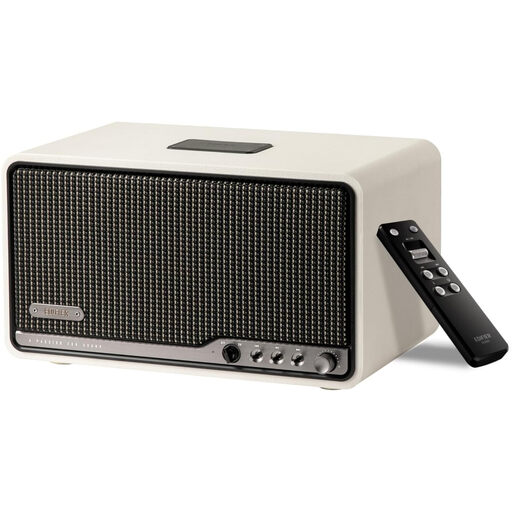
These choices include passive speaker pairs for a separate amplifier and a wireless tabletop speaker. If you want a stereo setup from the tabletop option, confirm the included quantity and pairing arrangement before buying.
 No image available
Consider this pair if you want to build your loft system around a separate amplifier; check that amplifier against the stated speaker requirements.
The listed configuration is two-way, with a 6.5-inch mid-bass driver, 28 mm soft-dome tweeter, rear bass reflex, 8-ohm impedance and a stated 10–120 W power range. Check cabinet dimensions against your planned positions.
 No image available
Consider this tabletop option if you want a wireless music setup with fewer separate components. Confirm the included speaker quantity, how stereo pairing works and compatibility with each source you intend to use.
 No image available
This pair is another option if you want passive speakers with a separate amplifier. Its title specifies a 6.5-inch driver; check amplifier compatibility and the cabinet dimensions before choosing positions in the loft.
Yes, passive bookshelf speakers need an external amplifier. KEF, for example, specifies a 15–180 W amplifier requirement for its passive Q Concerto Meta; check the requirements of the exact model you choose rather than applying that range to other speakers.
They can be considered, but the word bookshelf does not determine where they should go or how they will sound in the room. Measure workable positions for both speakers and, if choosing standmounts, allow for suitable stands; Q Acoustics recommends stands for its standmount range.
Check that the exact system connects to every source you plan to use and that its setup works in your home. KEF lists streaming, HDMI ARC, Bluetooth, USB-C and a subwoofer output for the LSX II LT, and says a home Wi-Fi network is required for its full feature set.
Faulty speakers may give you statutory remedies under the Consumer Rights Act 2015; a retailer's voluntary returns policy is separate from those rights. Keep your order record and contact the retailer about the fault rather than assuming a change-of-mind returns policy determines the outcome.