Who these speakers suit

Listeners focused on vocals and instruments

If lead vocals, guitar, fiddle and harmonies are your priority, compare how speakers present those parts at your usual volume. A two-way or three-way driver layout tells you about the design, not which sound you will prefer.

Open-plan living-room listeners

A shared lounge and kitchen gives you more positions and listening distances to account for than a single fixed seat. Plan where both speakers can stand securely, then consider how wall proximity and neighbour-friendly volume affect your choice.

Streaming and TV users who want fewer components

An active system may suit you if you would rather not choose a separate amplifier. Check the connections your TV and music sources need, as well as where the powered speakers can go.

What matters when choosing

Passive speakers

Choose when: You want a conventional stereo setup and can select an amplifier to suit the speakers.

Allow for: Amplifier and cable connections, plus stable positions for the cabinets; larger three-way models need particular care over space and support.

Active speakers

Choose when: Built-in amplification and direct connections for your music or TV sources would simplify the setup.

Allow for: Suitable powered-speaker positions and the system’s own connection options rather than assuming you can change its amplification later.

Concern What to check Who this matters to
Vocals and acoustic instruments Compare two-way and three-way designs, then listen to familiar recordings if possible. Driver layout alone cannot establish your preferred tonal balance. If singing and acoustic instruments are central to my listening, I want them to remain easy to follow rather than choosing on bass claims alone. Around 25% of consumers put this detail first.
Scale and controlled bass Check cabinet size and the stated conditions for bass-response figures. Consider the listening distance and where you can adjust the speakers’ position. Across a lounge and kitchen, I want music to carry to where I sit without making the low end intrusive. For around 31% of consumers, room scale and bass control are the primary concern.
Music and TV connections Decide whether you want a separate amplifier; for an active system, confirm the inputs required by your TV and music sources. I would rather connect my usual sources without finding space for another component. Around 19% of consumers make straightforward connectivity their first priority.
Placement and shared-space use Measure the proposed positions and check support, wall clearance and cable routes against the selected model’s guidance. If speakers must fit around everyday movement and neighbours, I need secure placement and a volume I can live with. Placement and considerate use come first for around 25% of consumers.

Buying pitfalls

  • Buying passive speakers as though they were a complete system

    Passive speakers need an external amplifier. Manufacturer guidance differs between models: KEF specifies 15–180 W for Q Concerto Meta, Wharfedale 25–120 W for EVO4.2 and ELAC 20–140 W for DB63.

    Before choosing a passive pair, check the selected model’s amplifier and impedance guidance and plan the speaker-cable run.

    You will also need a compatible amplifier and speaker cable, with stands if suitable shelving is unavailable.

  • Expecting a bass-response figure to describe your room

    A manufacturer’s frequency figure has a stated measurement condition; nearby walls and the room layout also affect what you hear. A rated extension is not a promise of the same bass balance at your listening position.

    Compare figures measured on the same basis, keep some flexibility in speaker placement and listen with the main speakers positioned before deciding whether you want a subwoofer.

  • Assuming a large standmount will fit an ordinary shelf

    Wharfedale specifies EVO4.2 at 13.4 kg per speaker, while KEF specifies Q Concerto Meta at 9.5 kg per speaker. A shelf or stand must safely support the chosen cabinet and leave it in a usable position.

    Measure the width, depth and load capacity of the intended support, and keep stands clear of routes where they could be knocked.

    A change of furniture or stand position can also affect the space available in a shared room.

  • Overlooking the powered-speaker version supplied

    Connection features are only part of the setup: a powered speaker also needs a suitable mains arrangement for its intended position.

    Before ordering, check the supplied-market version, plug and power information for the particular product. If purchasing for Northern Ireland, check the applicable product information rather than assuming Great Britain guidance is identical.

Brands to consider

These brands illustrate different speaker-system choices; the distinctions below concern the named models, not every product each brand makes.

KEF

KEF’s Q Concerto Meta is a passive three-way standmount; its LSX II LT is an active system for buyers considering built-in amplification and direct source connections.

  • KEF specifies a 15–180 W amplifier requirement for Q Concerto Meta and HDMI ARC, USB-C, optical and Bluetooth connections for LSX II LT.
  • The passive model needs separate electronics, while the active system needs suitable powered-speaker positions. Their different designs do not establish which will suit your room better.

Wharfedale

EVO4.2 is a substantial passive three-way standmount for a setup with a separate amplifier and stable support.

  • Wharfedale specifies 8-ohm nominal impedance and a 25–120 W recommended amplifier range for EVO4.2.
  • At a specified 13.4 kg per speaker, EVO4.2 calls for a careful check of available space and support.

ELAC

Debut 3.0 DB63 offers a passive two-way option for listeners who do not require a three-way design.

  • ELAC specifies a 6.5-inch woofer, 6-ohm nominal impedance and a 20–140 W recommended amplifier range for DB63.
  • DB63 still needs an appropriately matched external amplifier and speaker cable; its two-way design alone does not predict how you will hear vocals or bass in your room.

Joybuy product choices

These choices include two passive pairs for a separate-amplifier setup and one wireless tabletop speaker for considering a simpler component arrangement. Check the supplied stereo configuration of the tabletop model before treating it as an alternative to a speaker pair.

HiVi-Swans D3.1MKII passive bookshelf speaker

HiVi-Swans D3.1MKII passive bookshelf speakers

Consider these for a conventional music system if you have, or plan to add, an amplifier.

The product name specifies a two-way design, a 6.5-inch mid-bass driver, a 28 mm soft-dome tweeter, a rear bass-reflex port, an 8-ohm rating and a 10–120 W power range.

Check amplifier suitability and leave room to adjust placement near the wall.

Joybuy

HiVi-Swans DIY3.1 passive bookshelf speaker

HiVi-Swans DIY3.1 6.5-inch passive bookshelf speakers, pair

Consider this pair if you want a passive stereo setup and can provide a separate amplifier.

The product name identifies a 6.5-inch variant supplied as one pair.

Check the amplifier-matching guidance and cabinet measurements before deciding where the pair can stand.

Joybuy
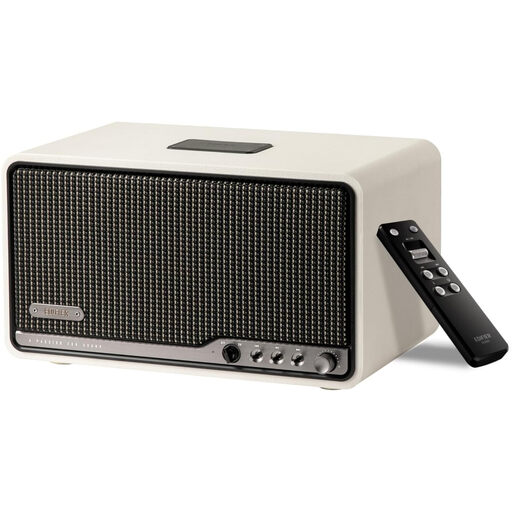
EDIFIER S300 wireless tabletop speaker in Ivory

EDIFIER S300 wireless tabletop speaker, Ivory

Consider this wireless tabletop model if you are looking at a setup with fewer separate components.

The product name identifies the S300 Ivory variant as a wireless, multi-room tabletop speaker.

Confirm whether this item supplies one speaker or a stereo pair, along with the connections and power arrangement needed for your intended position.

Joybuy

Common questions

Do bookshelf speakers need a separate amplifier?

Passive bookshelf speakers do; active systems have amplification built in. Match a passive model to the maker’s amplifier and impedance guidance rather than assuming that any existing amplifier will suit it.

Where should I place speakers in an open-plan flat?

Start with a stable, reasonably symmetrical pair of positions and adjust them from your usual listening spot. KEF’s general guidance suggests an approximately equilateral listening triangle, 1,800–2,400 mm between speakers and experimenting with 300–1,000 mm from the rear wall; follow the selected model’s instructions where they differ.

When are speaker stands worth considering?

Consider stands when a shelf cannot support the speakers securely or position them usefully for listening. Check cabinet compatibility, stand footprint and stability; Wharfedale makes a 617 mm stand for EVO4.2, but that accessory is not a requirement for every room.

What should I check for a powered speaker supplied in Great Britain?

Check that the particular speaker is intended for the GB market and confirm its plug, power and conformity information. GOV.UK describes requirements under the Electrical Equipment (Safety) Regulations 2016 for relevant equipment placed on the Great Britain market and says CE marking continues to be recognised for many products alongside or instead of UKCA; the applicable requirements depend on the product. Northern Ireland has a distinct regime.

What if an online speaker purchase is unsuitable or faulty?

For an eligible distance purchase, GOV.UK says consumers can notify the seller within 14 days of receiving the item that they wish to cancel. A fault is a separate issue that may give rise to a repair, replacement or refund remedy; check the applicable terms for the purchase and keep proof of purchase.