Listeners short of furniture space
If the speakers must fit on a shelf or compact stands, start with their dimensions and the room available for positioning. A small cabinet does not remove the need to check wall clearance.


Choose the speaker format around the space available and the equipment you want to use: a compact passive pair suits a tight layout if you have a compatible amplifier, while powered speakers suit listeners who want fewer separate components. A larger passive standmount needs more room, and any speaker placed near a wall deserves a check against its model-specific placement guidance before you decide.
If the speakers must fit on a shelf or compact stands, start with their dimensions and the room available for positioning. A small cabinet does not remove the need to check wall clearance.
A passive pair is an option if your amplifier can drive the exact model. Check the speaker's stated requirements against the amplifier's supported load rather than assuming any passive pair will match.
If music usually comes from a phone, tablet or computer, powered speakers can incorporate amplification and connections. Check the inputs you need, mains-socket access and what is required for a stereo pair.
Choose when: Shelf or stand space is tight and you have, or plan to add, a compatible amplifier.
Allow for: A separate amplifier and speaker cable; compact size alone does not establish how much bass you will hear in your room.
Choose when: You can spare more cabinet and positioning space while keeping a separate amplifier.
Allow for: The larger footprint and the same amplifier-matching checks as a compact passive pair.
Choose when: Integrated amplification and direct connections matter more than choosing an amplifier separately.
Allow for: Mains power, cable routing and fewer opportunities to change the amplifier independently.
| Concern | What to check | Who this matters to |
|---|---|---|
| Placement and bass balance | Measure the available shelf or stand space and wall clearance; check the exact model's port position and placement guidance. | If the speakers must sit near furniture or a wall, I need room to adjust their position when the bass sounds uneven. Around 33% of consumers put placement first. |
| Amplifier compatibility | For a passive pair, compare its stated impedance and amplifier guidance with your amplifier's supported speaker load. | If I already own an amplifier, I want speakers I can connect to it appropriately without replacing the rest of my system. Around 25% of consumers prioritise that match. |
| Simple streaming | Check the powered model's inputs, wireless options, mains-power needs and requirements for stereo playback. | When I mainly play music from a phone or computer, I would rather avoid a separate amplifier. For around 25% of consumers, a simpler streaming setup comes first. |
| Compact footprint | Compare cabinet dimensions and any space needed for stands or cables; do not use cabinet size alone to judge sound. | If speakers would crowd the room, I need a pair that fits alongside everyday furniture. Around 17% of consumers make minimum intrusion their primary concern. |
KEF advises that rear-ported speakers are more sensitive to wall placement than front-ported designs. A cabinet that fits the shelf may still need room for positioning.
Measure the available depth, check the port location and follow the exact model's placement guidance. Start with a balanced stereo arrangement, then adjust distance and angle while listening.
Stands or isolation pads may be useful if existing furniture prevents workable positioning.
A passive pair needs an amplifier; a phone or other line-level source cannot drive the speakers directly.
Before choosing a pair, check the amplifier's supported speaker load against the model's stated requirements and account for speaker cable.
Q Acoustics specifies a turntable with a built-in preamp for connection to its M20 powered speakers.
Check whether your turntable provides a line-level output. If it does not, confirm the phono-stage arrangement needed for the powered model's input.
A separate phono stage may be needed for a turntable without a built-in preamp.
A speaker's format and published specifications do not establish how every traditional dance recording will sound in your living room.
Where possible, listen to familiar recordings at your usual level and weigh what you hear alongside placement and system compatibility.
Its range provides examples of compact passive, mid-size passive and powered speakers: the 3010c, 3020c and M20 respectively.
The Q1 Meta is a compact passive speaker for listeners prepared to match it with an amplifier and plan its placement.
Wharfedale describes the passive DIAMOND 12.0 as a small-footprint option within its DIAMOND 12 series.
These choices include passive bookshelf speakers for an amplifier-based system and powered options for a more compact listening setup. Check dimensions, connections and stereo-pair contents against your room before choosing; the desktop-focused option needs particular attention to placement.
 No image available
A passive option for listeners using a compatible amplifier. The title specifies a 6.5-inch mid-bass driver, 28 mm tweeter, 8-ohm impedance, 10–120 W range and rear bass-reflex design.
Check the cabinet dimensions and the model's rear-wall placement guidance against your available space.
 No image available
A passive pair to consider if you have an amplifier; the title specifies a 6.5-inch driver.
Check cabinet dimensions and the exact amplifier-matching guidance before deciding whether this pair suits your room and system.
 No image available
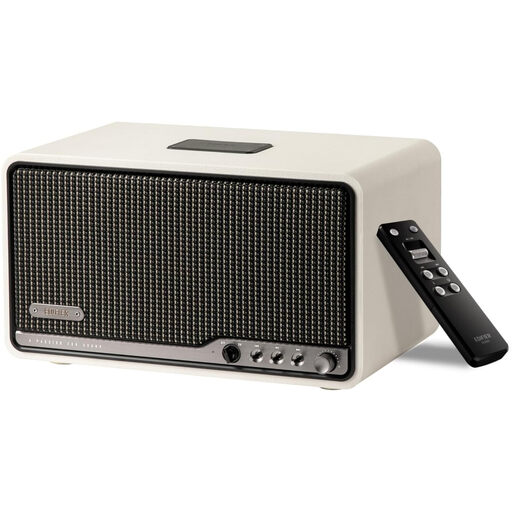
A wireless tabletop option for listeners considering a compact powered setup. Confirm its connections and how many S300 units are included: a left/right stereo arrangement may require another speaker.
Measure the intended shelf or tabletop position before choosing it for the living room.
 No image available
A desktop-focused option if a compact powered setup also fits your living-room listening position. The title specifies Bluetooth 5.3, LDAC, USB-C and AUX inputs, 66 W RMS, a 3-inch mid-bass driver and a 1-inch tweeter.
Confirm the included speaker quantity and whether the intended bookshelf position works for this desktop design.
Passive bookshelf speakers do; powered models have amplification built in. For example, KEF specifies a 10–150 W amplifier requirement for the passive Q1 Meta, while Q Acoustics describes its M-series speakers as having built-in amplification. Check the exact model before connecting a source.
They can be placed near a wall only if the model's guidance and the resulting sound work in your room; do not assume they will behave as they would farther away. KEF says rear-ported speakers are more sensitive to wall placement than front-ported designs, so measure your clearance and experiment with positioning.
Start with the speakers at similar distances from your listening position, then adjust both sides as the room allows. KEF suggests an approximately equilateral arrangement as a starting point; furniture, wall clearance and the individual speaker's instructions still matter.
You can if its output is suitable for the powered model's input. Q Acoustics specifies a turntable with a built-in preamp for its M20; if yours lacks one, check whether a separate phono stage is needed before connecting it.