Choose speakers around the loft’s layout and your playback setup, rather than driver size or quoted bass output alone. Passive standmounts give you a separate choice of amplifier, powered speakers simplify the system, and active monitors with response controls are worth considering when a fixed position near room boundaries makes bass balance difficult. Whichever route you take, check the space available for placement, source connections and whether the listing supplies a stereo pair.
Who these speakers suit
Bass-focused electronic-music listeners
If kick drums and bass lines matter most to you, leave room to adjust speaker placement. KEF’s placement guidance notes that rear-ported designs are particularly sensitive to the wall behind them, so a larger cabinet or deeper quoted bass response is not the whole decision.
Listeners working around a difficult loft layout
Hard surfaces, close walls, shelving or an irregular listening position can make flexibility more useful than maximum quoted output. Placement changes come first; Yamaha’s manual monitor controls and Genelec’s compatible calibration system offer different ways to adjust response.
Listeners who want fewer separate components
If you play music from a phone, computer, controller or turntable, check the actual inputs and cables before choosing a compact powered setup. Also establish whether the product is a stereo pair or a single speaker; studio monitors are commonly specified individually.
What matters when choosing
Passive standmounts
Choose when: You want a conventional stereo listening system and the freedom to choose or change the amplifier separately.
Allow for: A compatible amplifier, speaker cable and enough space to experiment with placement, especially for rear-ported models.
Powered bookshelf speakers
Choose when: Straightforward playback from your usual sources matters more than choosing a separate amplifier.
Allow for: Less flexibility to change amplification later, and check the supplied plug, voltage configuration and exact inputs.
Active studio monitors
Choose when: Your listening position is fairly fixed or you also use the speakers for DJing or music production.
Allow for: Individual-monitor listings, a suitable source connection and, for Genelec GLM calibration, compatible hardware.
For electronic music in a converted loft, start with the issue most likely to change your decision, then compare products using the corresponding checks.
| Concern | What to check | Who this matters to |
|---|
| Controlled bass |
Check cabinet depth, port position and space to vary the distance from walls. Treat quoted low-frequency response as a specification, not a prediction of sound in your loft. |
I want kick drums to have weight without bass becoming overfull where the speakers must stand; around 42% of consumers put controlled bass and placement first. |
| Room adjustment |
Check for manual low-frequency controls or compatible calibration, including any hardware needed to use it. |
With a fixed listening seat and awkward room boundaries, I need a way to adjust the balance after positioning the speakers; room response comes first for around 33% of consumers. |
| Connections and system simplicity |
Match each source to an input, then confirm cable needs, amplification and whether the listing supplies one speaker or a stereo pair. |
I want to play from my usual devices without assembling an unnecessarily complicated system; roughly 25% of consumers prioritise a straightforward, complete setup. |
Buying mistakes to avoid
-
Assuming a bookshelf speaker belongs inside a shelf
A tight shelf position can limit the placement changes that help balance bass and stereo imaging. KEF recommends beginning with a stereo triangle and experimenting with distance from the wall behind the speakers.
Measure usable width, depth and rear clearance before ordering. Plan for a stable position that lets you move both speakers while keeping the listening arrangement reasonably even.
Stands, isolation supports or furniture rearrangement may be needed if the available shelf fixes the speakers too close to boundaries.
-
Treating the deepest quoted bass figure as the answer
A low-frequency specification does not describe the response at your listening seat. KEF notes that rear-ported speakers can be more sensitive to wall placement, which matters if a loft layout fixes their position.
Leave room to adjust placement, or check whether a suitable speaker offers response controls. Listen to familiar bass-heavy tracks at your normal listening level when assessing the result.
-
Comparing a passive pair with one active monitor
Those listings may represent different parts of a working stereo system. Passive speakers need separate amplification, while Yamaha specifies the HS5 as a single powered monitor.
Confirm the number of speakers supplied and what you need to connect your source before comparing setups.
A passive setup needs an amplifier and speaker cable; an active-monitor setup may require a second monitor and suitable connections.
-
Assuming daytime bass cannot disturb neighbours
In England and Wales, GOV.UK says councils must investigate noise complaints that could amount to a statutory nuisance. A converted loft’s shared walls or floors make your intended listening level worth considering before purchase.
Check any building or tenancy terms, consider how the speakers contact shared structures and choose a listening level you can maintain without causing a nuisance.
Brands to consider for these speaker setups
KEF
KEF offers passive bookshelf and standmount models, including the compact Q1 Meta and larger Q Concerto Meta.
- KEF’s placement guidance gives a stereo triangle as a starting point and recommends experimenting with distance from the front wall.
- KEF notes that rear-ported designs can be more sensitive to wall placement; the guidance does not guarantee a particular result in your room.
Q Acoustics
Q Acoustics offers larger passive standmount options, including the 3030i and 3030c.
- Q Acoustics specifies a 165 mm mid/bass driver and a quoted 46 Hz response for the 3030i.
- These passive models need a compatible amplifier; their quoted bass characteristics do not establish how they will sound in a particular loft position.
Yamaha
Yamaha’s powered HS-series studio monitors provide a route for nearfield listening and manual response adjustment.
- The HS5 has ROOM CONTROL and HIGH TRIM adjustments, alongside XLR and TRS inputs, according to Yamaha.
- The HS5 is specified as one monitor; check the quantity and how your source will connect for stereo playback.
Genelec
Genelec’s active 8330A monitor is an option for a fixed listening position where room-response calibration is a priority.
- Genelec says the 8330A works with its GLM software to configure and calibrate the monitor for the listening environment.
- GLM calibration requires compatible hardware, and the 8330A is sold as an individual monitor.
Audioengine
Audioengine’s A5+ Wireless is a powered bookshelf-speaker option for listeners who want wireless and analogue connections.
- Audioengine lists Bluetooth, RCA and 3.5 mm inputs for the A5+ Wireless.
- Check the supplied plug, voltage configuration and applicable warranty for the specific listing before ordering.
Joybuy products for these setups
These choices cover compact powered playback and a passive bookshelf setup. Check each listing’s speaker quantity and connections against the stereo system you intend to build; none of the quoted specifications determines bass balance in your loft.
 Image unavailable
Edifier M60 Bluetooth 5.3 desktop speakers, 66 W RMS
Consider the M60 if compact playback from a phone or computer matters more to you than choosing a separate amplifier.
The product title lists Bluetooth 5.3, USB-C and AUX inputs, 3-inch mid-bass drivers and 1-inch tweeters.
Confirm whether the listing includes both speakers. If bass balance is the deciding factor, also check the available placement space and response-adjustment options.
View on Joybuy
 Image unavailable
HiVi-Swans D3.1MKII passive bookshelf speakers, 6.5-inch
Consider the D3.1MKII if you want to choose a separate amplifier and can adjust the speakers’ distance from the wall.
The product title specifies a 6.5-inch mid-bass driver, 28 mm tweeter, rear bass reflex, 8-ohm impedance and a 10–120 W power range.
Allow for a compatible amplifier and speaker cable. Confirm how many speakers the listing supplies before planning a stereo setup.
View on Joybuy
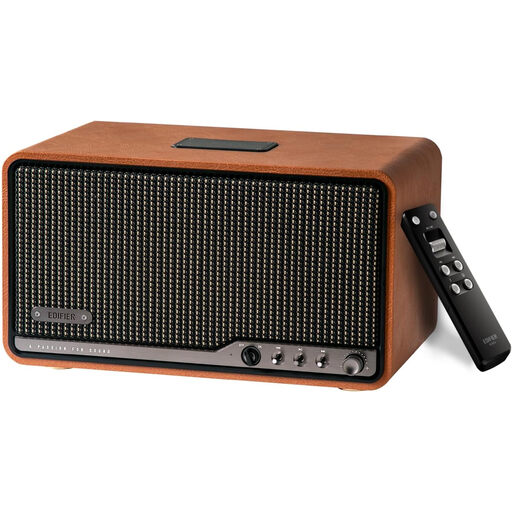 Image unavailable
Edifier S300 wireless multi-room tabletop speaker, brown
Consider the S300 for a powered tabletop setup if wireless playback and a compact arrangement are priorities.
The product title identifies a wireless multi-room speaker. Its description discusses configuring multiple S300 speakers as a left/right pair, so confirm the quantity required for stereo listening before ordering.
View on Joybuy
Common questions
How should I position bookshelf speakers in a converted loft?
Start with the speakers and listening position forming an equilateral triangle, then adjust their position to hear how the bass changes. KEF gives speaker spacing of 1,800–2,400 mm as a starting point, not a universal requirement; measure the space you actually have and try to keep the two speaker distances reasonably even.
Are rear-ported speakers unsuitable near a wall?
Not necessarily, but leave room to experiment if you choose them. KEF says rear-ported speakers can offer deeper bass while being more sensitive to their distance from the wall behind them, so a fixed shelf position makes placement flexibility particularly important.
Do I need two studio monitors for stereo listening?
Yes, stereo listening needs a left and a right speaker. Yamaha specifies the HS5 as a single powered monitor, and Genelec’s 8330A is also sold as one unit; confirm the listing quantity and source connections before treating either as a complete stereo setup.
Could loud electronic music cause a noise complaint?
Yes, loud music can prompt a council investigation in England and Wales if it may amount to a statutory nuisance. GOV.UK describes this as including noise that unreasonably and substantially interferes with the use or enjoyment of a home. Scotland and Northern Ireland have different reporting routes; wherever the loft is located, check local arrangements and any building or occupancy terms.


