For live-jazz listening, choose the system before trying to choose a speaker by genre: passive bookshelf speakers make sense if you have, or want to select, a suitable stereo amplifier; an active pair suits a setup with fewer separate components. Audition familiar recordings at your usual volume, then check amplifier matching, room placement and the connections or accessories your complete setup needs.
Who these speakers suit
Listeners focused on detail and stereo placement
If you want to follow horn lines, cymbals, vocals and the positions of players in a small ensemble, compare speakers using live recordings you know. KEF describes its passive LS50 Meta as detail-oriented, but that description cannot establish which presentation you will prefer.
Owners of a separate hi-fi system
If you already have a stereo amplifier, passive speakers let you keep that component in the system. Check its documented capability against the exact speakers you are considering, including their impedance guidance.
Listeners who want fewer separate components
If streamed albums, radio or TV are your main sources, an active pair avoids choosing a separate amplifier. KEF lists streaming, Bluetooth, HDMI ARC, USB-C and a subwoofer output for its LSX II; check the connections against your own sources.
What matters when choosing
Passive bookshelf speakers
Choose when: You own a suitable stereo amplifier or want to choose the amplifier separately.
Trade-off: Component choice comes with amplifier matching, speaker cabling and more equipment to accommodate.
Active stereo speakers
Choose when: Integrated amplification and direct access to your preferred sources matter more than choosing separate electronics.
Trade-off: The built-in amplification and available connections are part of the system you choose, so check them before committing.
| Concern | What to check | Who this matters to |
|---|
| Instrument separation and stereo image |
Audition a familiar live recording at your usual volume; listen for distinct instruments and stable placement. |
I want to follow the players in a small ensemble without losing quieter parts when the group plays together. Around 36% of consumers put this listening need first. |
| Room scale and bass |
Check dimensions and placement space, then compare bass and usable volume in your room or a comparable setting. |
In my listening room, double-bass lines need enough presence without becoming overwhelming. For around 29% of consumers, room scale and bass are the primary concern. |
| Amplifier matching |
For passive speakers, compare the exact amplifier’s documented load capability with the speaker’s power and impedance guidance. |
I want new passive speakers to work with the amplifier I own, rather than discover that the pairing needs changing. Around 21% of consumers prioritise system matching. |
| Sources and connections |
For an active system, check every source you intend to connect and the required input or streaming method. |
I would rather play live albums and connect my everyday sources without choosing a separate amplifier. That convenience comes first for around 14% of consumers. |
Buying pitfalls
-
Choosing passive speakers before checking the amplifier
Manufacturer guidance differs by model. KEF specifies a 40–100 W amplifier requirement for the LS50 Meta; Q Acoustics recommends 25–100 W for the 5020, which has a stated 3.3 Ω minimum impedance; and Bowers & Wilkins recommends 30–120 W into 8 Ω for the 606 S3, which has a stated 3.7 Ω minimum impedance.
Identify your exact amplifier and compare its documented speaker-load capability with the speaker manufacturer’s guidance. If the match remains uncertain, ask for a demonstration of the intended pairing.
A passive setup also needs a suitable amplifier and speaker cable if you do not already have them.
-
Assuming a bookshelf speaker belongs inside a crowded shelf
A suitable position depends on the particular speaker and its placement guidance. Bowers & Wilkins states that stands are not included with the 606 S3.
Measure the intended space, consult the exact model’s manual for clearance guidance and check that the speakers can be positioned securely at the listening height you want.
Your chosen position may require stands, brackets or a change to the furniture.
-
Reading bass performance from one specification
Published response figures use different stated conditions: Q Acoustics gives 53 Hz–30 kHz at −6 dB for the 5020, while Bowers & Wilkins gives 52 Hz–28 kHz at ±3 dB for the 606 S3. Those figures are not a like-for-like prediction of bass in your room.
Use specifications to narrow the models you audition, then compare familiar recordings at normal listening levels and consider the effect of placement.
-
Assuming an active system accepts every source
Built-in amplification does not mean every TV, computer or music source can connect in the way you expect.
List the sources you will use and check the exact active model’s physical inputs, supported streaming methods and any adapter or phono stage your setup requires.
Brands to consider for these speaker routes
KEF
The LS50 Meta represents a compact passive route, while the LSX II is an active wireless system. They require different supporting equipment.
- KEF specifies a 40–100 W amplifier requirement for the passive LS50 Meta and lists streaming, HDMI ARC, Bluetooth, USB-C and a subwoofer output for the LSX II.
- Choose between these models by system type and source requirements; neither is a direct substitute for the other.
Q Acoustics
The passive 5020 is an option to audition with a separate amplifier.
- Q Acoustics specifies a 125 mm bass unit, 25 mm tweeter and 25–100 W recommended amplifier power for the 5020.
- Its stated 6 Ω nominal and 3.3 Ω minimum impedance call for checking the intended amplifier. The brand’s imaging and bass-dynamics descriptions are design claims to assess by listening.
Bowers & Wilkins
The passive 606 S3 offers a 165 mm bass/midrange driver for listeners considering a larger-driver standmount.
- Bowers & Wilkins specifies 88 dB sensitivity and recommends 30–120 W amplifier power into 8 Ω for the 606 S3.
- The stated minimum impedance is 3.7 Ω, and stands are not included. Check amplifier capability and the planned position.
Wharfedale
Wharfedale positions the passive Diamond 12.2 for larger rooms and more powerful two-channel systems.
- The Diamond 12.2 has a stated 150 mm bass/mid driver and 25 mm dome tweeter.
- Wharfedale’s room positioning is not a room-size rule; audition the speaker with suitable electronics and assess its placement.
Joybuy product choices
These choices cover passive speakers for a separate-amplifier setup and a wireless tabletop option to consider if you want stereo from two units. Compare their format and placement needs before using live-jazz recordings to judge the sound for yourself.
 No image available
HiVi-Swans D3.1MKII passive bookshelf speakers
Consider this passive model if you are assembling a system around a separate stereo amplifier.
The stated two-way design has a 6.5-inch mid-bass driver, 28 mm soft-dome tweeter and rear bass-reflex port. The title states 8 Ω and a 10–120 W power range; check the intended amplifier and allow for the rear-port placement requirements.
View on Joybuy
 No image available
HiVi-Swans DIY3.1 passive bookshelf speakers, pair
This passive pair is another option if you want to use a separate stereo amplifier.
The product name specifies 6.5-inch speakers. Check the recommended amplifier requirements for this exact model and assess whether the pair fits your intended position before buying.
View on Joybuy
 No image available
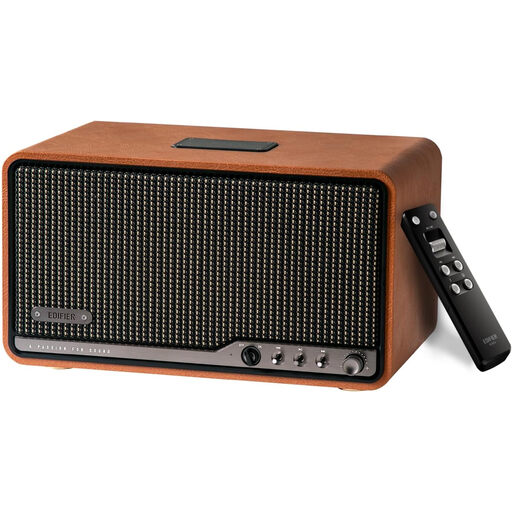
Edifier S300 wireless tabletop speaker, brown
Consider the S300 if a wireless tabletop arrangement suits your space better than passive bookshelf speakers.
The listing describes one speaker and says two S300 units can be configured as a left/right stereo pair. Check what is needed for the complete pair, along with its dimensions and connections, before choosing it for stereo listening.
View on Joybuy
Frequently asked questions
Should I choose passive or active speakers for live jazz?
Choose passive speakers if you have, or want to select, a suitable separate amplifier; choose an active system if integrated amplification and convenient access to your sources matter more. For a passive model, check its power and impedance guidance against the amplifier; for an active model, check its actual inputs and streaming methods.
Can bookshelf speakers sit on a shelf instead of stands?
A shelf may work if it accommodates the exact model securely and meets its placement guidance. Check the manual and available clearance rather than relying on the word “bookshelf”; Bowers & Wilkins states that stands are not included with its 606 S3.
What should I use to compare speakers for live jazz?
Use familiar live recordings that contain the instruments and ambience you care about, and compare speakers at your normal listening volume. If you are considering passive models, ask to hear them with your own amplifier or an appropriately comparable setup.
How should I dispose of unwanted active speakers?
Use an electrical-waste collection or take-back route rather than putting active speakers in general waste. UK government guidance describes waste electrical and electronic equipment rules intended to support recovery, reuse and recycling; check the available route with the retailer or your local authority.


