What matters when choosing
For children’s songs played near a wall, start with the space available and the device that will play the music. Then consider volume control and whether the speakers physically fit where they will be used.
| Concern |
What to check |
Who this matters to |
| Bass near a wall |
Check the exact model’s port position or room-response controls, and allow space for its cabinet and cables. |
If the speakers must sit close to a wall, I want songs to remain clear without excessive bass. Roughly 36% of consumers would put predictable close-wall sound first. |
| Simple playback |
Match the speaker’s inputs to your phone, tablet or computer; check whether a separate amplifier is needed. |
When I start songs from an everyday device, I want to do so without setting up extra components. Around 29% of consumers would make simple playback their main priority. |
| Comfortable volume |
Check how readily an adult can adjust the volume, including during routine playback. |
If a child reacts badly to sound, I need to lower or stop the music promptly. About 21% of consumers would prioritise comfortable, controllable volume. |
| Physical fit |
Measure shelf depth and cable space, or check mounting requirements if considering an on-wall model. |
Where a shelf is too shallow, I need a speaker arrangement that fits the intended spot without forcing an unsuitable installation. Roughly 14% of consumers would put installation fit first. |
Brands to consider
These brands illustrate different approaches to tight placement; check the specifications and installation instructions for the particular model you are considering.
ELAC
A reference point for a conventional passive bookshelf pair: ELAC describes the Debut 3.0 DB53 as a front-ported, two-way model.
- ELAC specifies a recommended amplifier range of 20–120 W for the DB53, which helps when checking an existing amplifier.
- The DB53 still needs a compatible amplifier and speaker cables; its front port does not guarantee balanced bass in every position.
Audioengine
An option to examine if a compact powered system and connections for everyday music sources matter more than assembling separate hi-fi components.
- Audioengine says its front-ported A2+ family is intended for bookshelf or close-wall placement; it lists USB-C, Bluetooth and analogue connections for the A2+ Gen 3.
- Check the exact model’s placement instructions, connections and local power requirements before choosing a listing.
Genelec
Relevant when wall or corner placement is fixed and room-response adjustment is a priority.
- Genelec describes room-response controls that can address increased low-frequency output near walls; the G One is a compact active home-audio model.
- The appropriate adjustment depends on the model and room, so its controls call for more setup attention than a basic powered pair.
DALI
Worth considering if the practical requirement is to mount speakers on a wall rather than place them on a shelf.
- DALI describes dedicated on-wall models with down-firing ports designed to work with the wall surface.
- That description does not apply to every DALI bookshelf model. Check the chosen model’s mounting requirements and whether it is passive or active.
Joybuy product choices
These Edifier options are relevant to compact everyday music playback. Before choosing either for a close-wall position, check its placement guidance and listen for excessive bass where it will actually stand.
 No image available
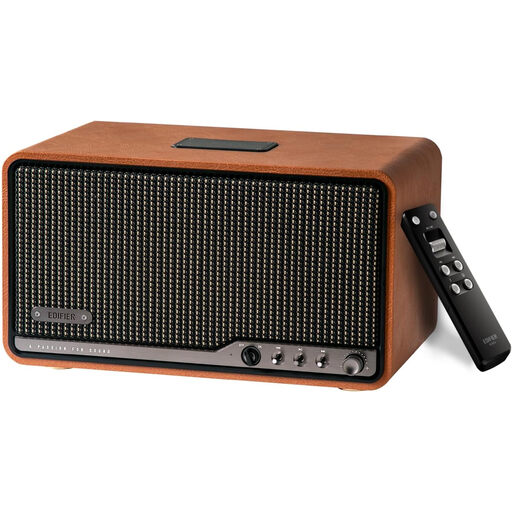
Edifier S300 Hi-Fi Wireless Multi-Room Tabletop Speaker – Brown
Consider the S300 if you want a compact tabletop speaker for everyday songs and prefer to check its listed Bluetooth, AirPlay 2, USB-C and AUX options against your source devices.
Confirm whether this listing supplies one speaker or a pair if you are planning stereo playback. Check the exact model’s wall-placement guidance, power arrangement and volume controls before setting it up for children’s music.
View on Joybuy
 No image available
Edifier M60 Bluetooth 5.3 Multimedia Speakers
For a compact desktop or shelf setup, the M60 offers Bluetooth 5.3, USB-C and AUX input options for compatible music sources.
The product title specifies 66 W RMS, a 3-inch mid-bass driver and a 1-inch tweeter. Check placement guidance for the intended wall distance, along with the power arrangement and how readily you can adjust the volume.
View on Joybuy
Common questions
Why can bookshelf speakers sound too bass-heavy near a wall?
Nearby walls can increase low-frequency output, as Genelec explains. Start with the speaker maker’s placement instructions, then listen at your normal song volume and adjust its position or available bass controls if the result sounds excessive.
Can a front-ported speaker go straight against a wall?
A front port alone does not guarantee that a speaker will sound balanced against a wall. Audioengine says front ports are less influenced by wall proximity than rear ports, but the shelf, room and listening position still matter; follow the exact model’s guidance and listen for excessive bass or rattles.
What else do I need to play songs through passive bookshelf speakers?
Passive bookshelf speakers need a compatible amplifier as well as a way to connect your music source. For example, ELAC specifies a recommended amplifier range of 20–120 W for the Debut 3.0 DB53; check the requirements of the exact pair you choose rather than applying that range to other models.
What if a child finds the music distressing?
Lower or stop the music and respond to the child’s reaction. East Kent Hospitals University NHS Foundation Trust notes that children with sound sensitivity may cover their ears, become distressed or try to leave; seek appropriate clinical advice if concerns persist or affect daily life.
What should I check when buying mains-powered speakers for Great Britain?
Check that the exact listing’s power requirements and supplied connection suit where the speakers will be used, and review its product safety information. The Office for Product Safety and Standards explains that the Electrical Equipment (Safety) Regulations 2016 set requirements for electrical equipment placed on the Great Britain market; Northern Ireland has different regulatory treatment. A product title or overseas listing alone does not establish the status of a particular speaker.


