Families planning school-holiday snacks
Compare sugar figures and biscuit portions if you want a familiar sweet snack without assuming that every bourbon cream meets a lower-sugar aim.


For a lower-sugar school-holiday snack, compare bourbon biscuits using the sugars figure per 100g, then check the amount per biscuit for the portion you plan to serve. A smaller biscuit or a gluten-free, milk-free or vegan label does not, on its own, establish that the biscuit is reduced in sugar. Food supplied by a school in England raises a separate question from snacks bought for home.
Compare sugar figures and biscuit portions if you want a familiar sweet snack without assuming that every bourbon cream meets a lower-sugar aim.
Check the current pack for the ingredients and allergen information you need. Tesco Free From Bourbon Creams are described as gluten free, milk free and suitable for vegans, but those claims answer a different question from sugar content.
Distinguish food provided as part of school lunch from food provided at other times. School-food requirements are separate from a family’s choice of snacks at home during the holidays.
Start with a like-for-like sugar comparison, then check the intended portion and any dietary requirements. If a school in England will provide the snack, assess the applicable school-food rules separately.
| Priority | What to check | Your needs |
|---|---|---|
| Sugar and labels | Compare sugars per 100g on the same basis. Where shown, traffic-light labelling also indicates the levels of sugars, fat, saturates and salt. | I want to compare the biscuits, not just their packaging claims. In the Food Standards Agency and Ipsos Northern Ireland’s 2024 survey, 49% of the 611 people interviewed in Northern Ireland between 16 September and 23 November said they actively used traffic-light labelling when shopping for food. |
| Biscuit portions | After checking per 100g, look at the stated serving size and sugars per biscuit. A smaller biscuit can have a lower per-biscuit figure without having less sugar per 100g. | How much sugar is in the portion I plan to offer? I need both figures to tell a smaller serving from a different recipe. |
| Dietary suitability | Check the current ingredients and allergen statement, as well as any gluten-free, milk-free or vegan declaration. Compare sugar separately. | Someone eating the biscuits needs a declared dietary alternative; I do not want to mistake that declaration for a reduced-sugar claim. |
| School provision | Establish whether a school covered by England’s school-food regulations is providing the food and whether it is part of lunch. Schedule 4 of the Requirements for School Food Regulations 2014 says cakes and biscuits must not be provided outside school lunch. | I am choosing food for a school, rather than buying snacks for home, and need to apply the rules for that setting. |
A gluten-free or milk-free declaration describes dietary suitability, not how the finished biscuit compares for sugar.
Check sugars per 100g against a comparable conventional biscuit, then use the per-biscuit figure for the portion you intend to serve.
Different biscuit sizes can make per-biscuit figures misleading when the aim is to compare recipes.
Compare sugars per 100g first, then check biscuit weight, serving size and sugars for the planned portion.
England’s rules on certain high-fat, salt or sugar retail promotions address a different setting from the Requirements for School Food Regulations 2014.
For snacks at home, use the nutrition and portion information. For food provided by a school in England, check the school-food requirements for lunch or non-lunch provision.
Cocoa sourcing information and descriptions of a richer filling do not tell you whether a finished biscuit has less sugar.
Compare the nutrition declarations before deciding whether those other attributes matter to your choice.
These product lines illustrate why a brand name or a front-of-pack description cannot replace a comparison of the finished biscuits’ labels.
Tesco lists both conventional Bourbon Creams and a separate Free From version.
Sainsbury's Bourbon is a conventional wheat-and-cocoa biscuit.
Waitrose Essential Bourbon Creams include information about Fairtrade cocoa sourcing.
M&S describes its Extra Cream Bourbon Creams as having extra chocolate cream.
These sandwich biscuits are alternatives to consider for school-holiday snacks, not bourbon creams. Compare their current sugars per 100g and intended servings with the bourbon biscuits you normally buy before deciding whether either meets a lower-sugar aim.
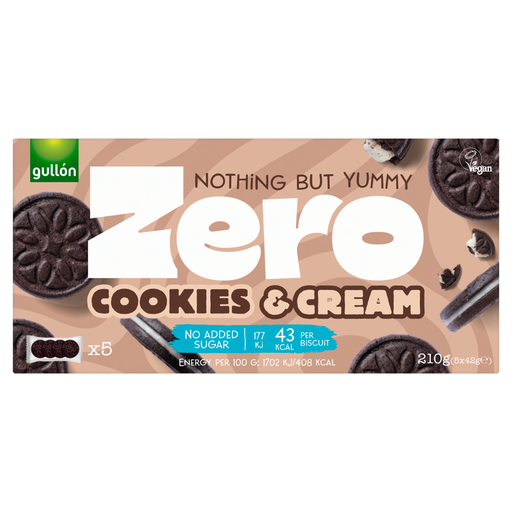 No image available
A cookies-and-cream sandwich biscuit rather than a bourbon cream. The pack is 210g; check its current sugars per 100g and per serving rather than treating “no added sugar” as a reduced-sugar comparison. The product warning says excessive consumption may produce a laxative effect.
 No image available
An Oreo sandwich biscuit rather than a bourbon cream, in a 97g pack. Check the current nutrition panel, ingredients and any sweetener warning when comparing it with a conventional bourbon biscuit for the portion you plan to serve.
No. Tesco Free From Bourbon Creams are described as gluten free, milk free and suitable for vegans, but those declarations do not compare their sugar content with another biscuit. Check the current sugars figures on the same per-100g basis.
Compare sugars per 100g first, then sugars per biscuit or planned serving. GOV.UK’s nutrition-labelling guidance says nutrition information is expressed per 100g or 100ml; the Food Standards Agency also explains that traffic-light labels indicate levels of fat, saturates, sugars and salt. A smaller per-biscuit figure alone does not establish less sugar per 100g.
No. The phrase describes an ingredient listed for Sainsbury's Bourbon, not a sugar comparison for the finished biscuit. Use the finished products’ nutrition declarations to assess sugar.
No. The Department of Health & Social Care’s guidance on high-fat, salt or sugar promotions addresses certain retail promotions and placements, not a family’s consumption at home. School-provided food is a separate setting governed by school-food requirements.
For schools covered by England’s Requirements for School Food Regulations 2014, Schedule 4 says cakes and biscuits must not be provided as food outside school lunch. Check the requirements applicable to the school and the type of provision before arranging snacks.