TV-night snackers looking for sugar-free biscuits
If the sugar-free claim is essential, check the individual biscuit pack rather than relying on the Bourbon format or a range name. A different biscuit style may suit that requirement.


If sugar-free is your requirement, look for an individually labelled sugar-free biscuit in another format rather than assuming a conventional or free-from Bourbon qualifies. Listings from Tesco, Asda and Sainsbury’s, including Tesco’s McVitie’s listing, give 18–28.5g sugars per 100g for the Bourbon products covered here; Gullón lists sugar-free biscuits in its Zero range, but in different formats. Choose a free-from Bourbon when its stated gluten or milk exclusions matter, and compare the nutrition panel and the portion you plan to eat separately.
The choice changes depending on whether sugar-free labelling, the Bourbon format or a stated ingredient exclusion matters most.
If the sugar-free claim is essential, check the individual biscuit pack rather than relying on the Bourbon format or a range name. A different biscuit style may suit that requirement.
A free-from Bourbon keeps the cocoa-sandwich format while addressing the exclusions stated on its label. Check sugar separately: free-from does not mean sugar-free.
The sugars figure alone does not show total carbohydrate. Diabetes UK points readers to the carbohydrate information on the nutrition label; compare it with the number of biscuits you expect to eat.
Settle the biscuit format first, then check the exact claim and nutrition information on the individual product.
Choose when: Sugar-free labelling matters more to you than the traditional Bourbon format.
Trade-off: Gullón’s Zero range includes sugar-free digestive biscuits, which are a different format from a Bourbon.
Choose when: You want the familiar cocoa biscuit and cream filling rather than a sugar-free claim.
Trade-off: The conventional Bourbons listed by Tesco and Sainsbury’s contain sugars and do not meet a sugar-free requirement.
Choose when: You want a Bourbon-style biscuit with the gluten and milk exclusions stated on its pack.
Trade-off: Tesco and Asda list sugars in their free-from Bourbons, so the free-from label does not answer a sugar-free need.
| Priority | What to check | Your needs |
|---|---|---|
| Sugar claim | Read the exact claim on the individual pack: “sugar-free” and “no added sugar” are different claims. Compare sugars per 100g on the nutrition panel. | I’m looking for a biscuit labelled sugar-free, not simply a Bourbon with a smaller per-biscuit sugars figure. |
| Carbohydrate and portion | Compare total carbohydrate and sugars per 100g, then check the stated serving against the number of biscuits you plan to eat. Diabetes UK advises using total carbohydrate information when comparing foods. | For a TV night, I want to compare the amount I’m likely to eat, not just the manufacturer’s single-biscuit serving. |
| Gluten and milk exclusions | Check the individual product’s gluten-free and milk-free statements and allergen information. Check its sugars figure separately. | I’d like a Bourbon-style biscuit that meets my stated ingredient exclusions; I won’t assume its free-from label also means sugar-free. |
Tesco lists 19.5g sugars per 100g for its Free From Bourbon Creams, while Asda lists 18g per 100g for its Free From Bourbon Biscuits. Their gluten and milk exclusions answer a different question.
Check the ingredient exclusions you need, then read the sugars figure and exact sugar claim on that same product.
A per-biscuit figure describes the stated serving, which may not match the portion eaten during a TV night.
Use per-100g values for a like-for-like comparison, then check the figures against your intended portion.
A sugar-free claim does not state how much total carbohydrate a biscuit contains. Diabetes UK notes that polyols, used in some products, contain carbohydrates and calories.
Read the carbohydrate figure, serving size and ingredients on the individual pack when those details matter to your choice.
These examples show why a brand or range name is less useful than the claim and nutrition information for the specific biscuit.
An option for shoppers willing to switch from a Bourbon to a different biscuit format.
Its conventional and Free From Bourbon Creams address different buying needs.
Its Bourbon is an example of the conventional biscuit format.
Its Free From Bourbon Biscuits are relevant when the stated gluten and milk exclusions matter.
Its Bourbon Creams are another conventional cocoa-sandwich option.
These products are alternatives for someone willing to move away from an exact Bourbon biscuit: one is a sandwich cookie, while the other is a digestive. Check each individual pack’s nutrition and allergen information before choosing.
 No image available
A sandwich-cookie format to consider if you want a sugar-free-labelled alternative rather than an exact Bourbon. The pack is 97g; compare its full nutrition and ingredient information with your intended portion.
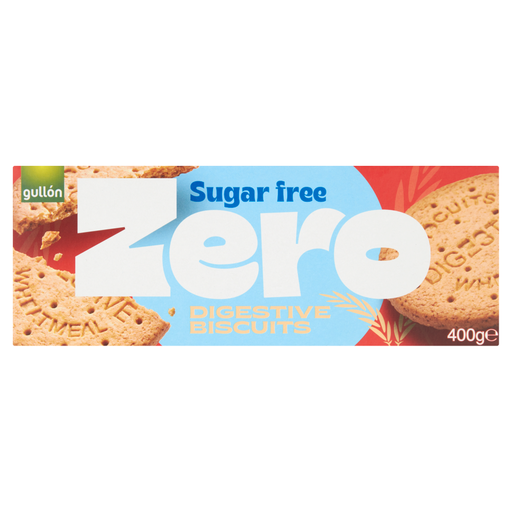 No image available
A sugar-free-labelled digestive for TV-night snacking if you do not need the Bourbon sandwich format. The pack is 400g; check the individual product’s carbohydrate, ingredients and allergen information as well as its sugar claim.
No. A relative difference between two products is not a sugar-free claim. The Bourbon listings from Tesco, Asda and Sainsbury’s, including Tesco’s McVitie’s listing, give sugars figures ranging from 18g to 28.5g per 100g; read the exact claim on any biscuit you are considering instead.
No. Gullón’s UK Zero range uses these descriptions for different products. Check the wording and nutrition panel on the individual pack rather than assuming every biscuit in the range has the same claim.
Not on the basis of its gluten-free label. Tesco lists 19.5g sugars per 100g for its Free From Bourbon Creams, and Asda lists 18g per 100g for its Free From Bourbon Biscuits. Choose these products for their stated exclusions if those match your needs, and assess sugars separately.
Compare total carbohydrate, the stated serving and the ingredients as well as the sugar claim. Diabetes UK advises checking total carbohydrate on food labels and notes that polyols contain carbohydrates and calories; the claim alone does not describe those figures.