Small-cottage pudding bakers
You want oven-style baking for your pudding dish, but worktop room is limited or the cottage’s main oven is inconvenient to use.


Choose a dedicated countertop convection oven if baking is the main task and it has room for your pudding dish and the servings you need. A combination microwave-convection oven makes more sense when worktop space is tight and you also need microwave reheating or grilling. Before buying either, check dish clearance, the appliance’s position and power requirements against the cottage kitchen.
The right format depends on whether you mainly need a place to bake, extra capacity for guests or several cooking functions in one appliance.
You want oven-style baking for your pudding dish, but worktop room is limited or the cottage’s main oven is inconvenient to use.
You need enough room for the intended servings, or an additional oven that can help with the meal while dessert is being prepared.
You want to bake bread pudding but would also use microwave reheating and grilling in the same countertop appliance.
Choose when: Bread pudding and other oven-style dishes are the main reason for adding an appliance, particularly if you need room for several servings.
Trade-off: A larger oven can occupy substantial worktop space and needs a suitable electrical supply; for example, SharkNinja UK lists the Ninja DT200UK at H33.5 × W43.5 × D50.5 cm and 2400 W.
Choose when: The cottage also needs microwave reheating and grilling, and one appliance must cover those jobs alongside occasional baking.
Trade-off: Check the exact model’s convection mode and usable cavity: the intended dish still has to pass through the door and fit in its baking position.
Choose when: The supplied oven has a usable baking setting and holds the dish comfortably, especially if you are making only one pudding.
Trade-off: You will not gain a second cooking space, but you avoid finding worktop and storage room for another appliance.
If you do need a countertop appliance, establish how it will bake first; then measure the dish, plan its position and check the power supply.
| Concern | What to check | Who this matters to |
|---|---|---|
| Oven-style baking | Confirm a Bake or convection mode and check the manual for temperature and timing controls. | If I am following a bread-pudding recipe, I need an oven-style setting rather than microwave reheating alone; around 30% of consumers put baking control first. |
| Dish and serving capacity | Measure the dish, including handles, against the door opening and usable rack space; check exterior depth too. | When I am feeding several guests, my dish must fit and hold enough portions; roughly 30% of consumers make dish and batch fit their primary concern. |
| Everyday functions | Decide whether microwave reheating and grilling are useful enough to justify a combination model. | In a small kitchen, I would use the appliance between baking sessions, not just for dessert; about 20% of consumers prioritise that multifunction use. |
| Power and placement | Check the rating and manufacturer’s clearances against a suitable socket and available worktop position. | Before bringing an oven into the cottage, I need somewhere it can stand and be plugged in safely; around 20% of consumers place power and positioning first. |
Capacity does not tell you whether a pudding dish, including its handles, will pass through the door or sit on the rack.
Measure your dish and compare it with the exact model’s door opening, usable cavity and rack position before buying.
A grill or air-fry label alone does not establish that an appliance has the oven-style mode you intend to use for bread pudding.
Look for an explicit Bake or convection function and read the model’s instructions for that mode.
Electrical Safety First warns that ovens and grills can overload an extension lead when they are used alongside other large appliances.
Use a suitable wall socket where available. If an extension lead is necessary, check its marked current rating, do not exceed it and do not connect extension leads together.
Requirements for hosts depend on where the cottage is located. Scottish Fire and Rescue Service states that short-term-let licensing is mandatory for holiday cottages in Scotland; GOV.UK says a national registration scheme for short-term lets in England is expected to begin in March 2027.
If you are supplying the appliance for guests, check the requirements applicable to the property’s nation and local authority.
These examples illustrate different appliance formats; compare the exact model’s baking controls, dimensions and instructions rather than treating a brand name as a fit guarantee.
A reference point for a larger dedicated countertop oven when baking space and cooking on two levels matter.
A reference point for the combination route when reheating, grilling and fan-assisted oven cooking are all useful.
A reference point for comparing countertop electric-oven formats and cavity sizes.
These combination microwave models are options to compare if the cottage needs reheating and other cooking functions alongside oven-style baking. Measure your pudding dish and check the exact model’s convection or Bake instructions before deciding.
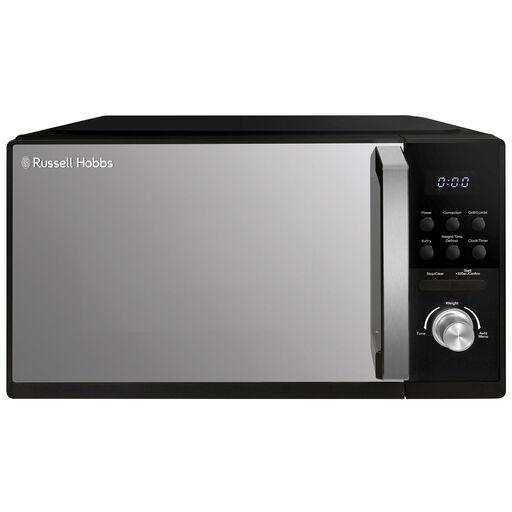 No image available
Consider this countertop model if you need microwave, grill and convection-oven modes in one appliance.
Its listed 95-minute timer helps with cooking-time planning. Check the door opening and rack clearance against your dish, and confirm the baking-temperature controls and electrical requirements before use.
 No image available
Consider this model if a Bake function alongside microwave use is more useful to you than a dedicated countertop oven.
The listing describes a digital timer and names 2400 W in the product title. Check usable dish space, the baking-temperature controls and the appliance’s full electrical requirements against the cottage setup.
 No image available
Consider this model if you want microwave, grill and convection modes in the same countertop appliance.
Its listing specifies a timer of up to 95 minutes and a 288 mm turntable. Check that your dish fits through the opening and in the usable cavity, then confirm the baking controls, worktop clearances and electrical rating.
 No image available
Consider this model if you need convection cooking as well as microwave and grill functions.
The listing describes a turntable on/off option, though that does not establish whether your pudding dish will fit. Check the door opening, usable cavity, temperature and timing controls, and installation requirements.
Use a suitable wall socket where available. Electrical Safety First warns that ovens and grills can overload an extension lead when used with other large appliances; if an extension lead is necessary, check its marked current rating, keep the combined load within that rating and do not connect extension leads together.
For a plug-in oven or grill used in the UK, Electrical Safety First says it must have a UK three-pin plug and fuse. Check the supplied plug, cable and model instructions before use.
Holiday-let requirements differ by nation. Scottish Fire and Rescue Service states that licensing is mandatory for holiday cottages in Scotland; GOV.UK says a national short-term-let registration scheme in England is expected to begin in March 2027. Check the rules applicable to the property’s nation and local authority.
Let the appliance cool fully, then follow its model-specific instructions for cleaning racks, trays and internal surfaces. Keep the plug, cable and electrical parts dry.