Breakfast shoppers reducing fat
If milk goes into your cereal, coffee or tea, semi-skimmed offers a step away from whole milk. Consider 1% or skimmed milk when reducing fat is the stronger priority.


If reducing fat is the priority, choose semi-skimmed milk for a middle ground between whole and skimmed, or consider 1% or skimmed milk when reducing fat matters more than a rich texture. Filtered semi-skimmed milk is worth considering if you use milk slowly, but its stated storage life depends on the particular product and its label instructions.
If milk goes into your cereal, coffee or tea, semi-skimmed offers a step away from whole milk. Consider 1% or skimmed milk when reducing fat is the stronger priority.
If you only open milk for occasional breakfasts or hot drinks, compare pack size and the opened-life instruction. A filtered product’s stated longer life may be useful if you can follow its storage conditions.
If texture matters in cereal or coffee, try a lower-fat type before committing to a larger pack. Arla describes its B.O.B semi-skimmed milk as having a whole-milk-style taste; that product-specific claim cannot predict your preference.
Choose the milk type first, then compare the nutrition panel, pack size and storage instructions for the bottles you are considering.
| Priority | What to check | Your needs |
|---|---|---|
| Milk type | Compare whole, semi-skimmed, 1% and skimmed milk. Read fat and saturates on the same per 100ml basis rather than relying on pack colour. | I want milk for breakfast while reducing fat, so I need to decide how far from whole milk to move. |
| Nutrition panel | Check the exact bottle. Tesco and Sainsbury’s semi-skimmed examples each list 1.8g fat, 1.1g saturates, 3.6g protein and 124mg calcium per 100ml. | Milk goes into my cereal and drinks, and I want to compare what each option contains on a like-for-like basis. |
| Flavour and texture | Choose between the milk types with your usual cereal or coffee in mind. Treat a whole-milk-style taste description as specific to the product making that claim. | I would like to move away from whole milk without choosing a texture I do not enjoy at breakfast. |
| Pack size and opened life | Check how much you will use before the bottle’s opened-life limit. Sainsbury’s standard semi-skimmed example says three days after opening; Waitrose’s filtered example states seven days when refrigerated below 5°C. | Some weeks I use little milk, so a smaller pack or a suitable filtered product could be more practical. |
| Storage and date | Read the refrigeration instructions and identify whether the pack has a use-by or best-before date. GOV.UK distinguishes use-by dates, which concern safety, from best-before dates, which concern quality. | I need to know how to store an opened bottle and which date instruction applies to it. |
Whole milk does not meet the same fat-reduction aim as a lower-fat milk type.
Compare semi-skimmed, 1% and skimmed milk first, then decide which texture you prefer for breakfast.
A longer stated life is most useful when you would otherwise struggle to finish an opened bottle within its instructions.
Match the pack size and opened-life instruction to how often you use milk for cereal and drinks.
The Sainsbury’s standard semi-skimmed listing says to consume it within three days of opening, while the Waitrose filtered listing states seven days when refrigerated below 5°C.
Follow the instruction on the bottle you buy, including its refrigeration conditions.
GOV.UK explains that a use-by date concerns food safety, while a best-before date concerns quality.
Check which date appears on the pack and follow its storage instructions; do not use a smell test to override a use-by date.
These product-line examples show why the exact nutrition panel and storage instructions matter more than the name on the bottle.
A filtered semi-skimmed option for shoppers who use chilled milk gradually.
An own-label standard semi-skimmed milk reference.
An own-label standard semi-skimmed milk reference in a two-pint pack.
A retailer reference for standard semi-skimmed and Cravendale filtered semi-skimmed milk.
Marks & Spencer describes a milk range that includes skimmed, semi-skimmed and whole milk.
A retailer reference for filtered semi-skimmed milk.
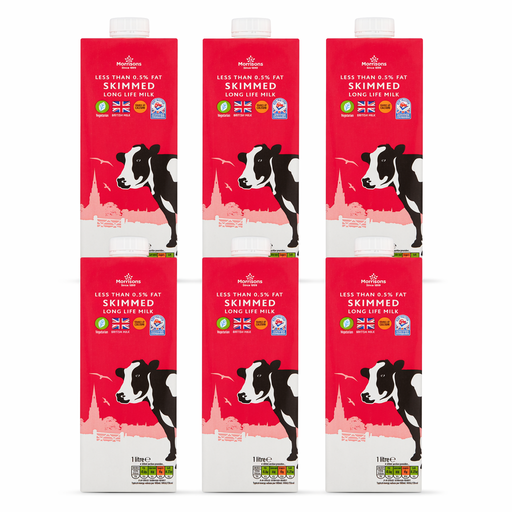
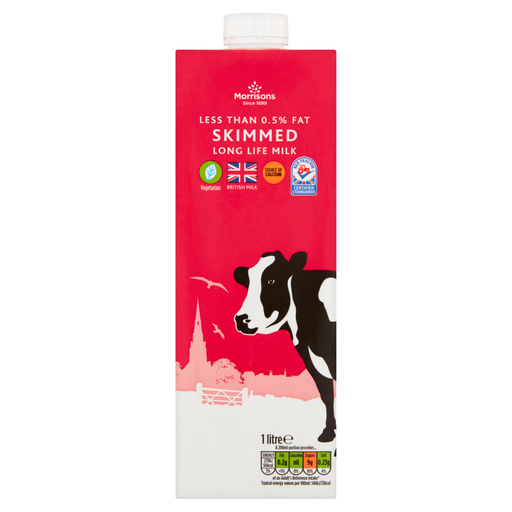
These Morrisons UHT skimmed milk options suit the skimmed-milk route for a continental breakfast. Choose between a single 1-litre carton and six 1-litre cartons according to how much milk you expect to use.
 No image available
A six-carton option if you regularly use skimmed milk for breakfast cereal or hot drinks. The product information says the UHT milk can be stored without refrigeration before opening; refrigerate each opened carton and use it within three days. Check the cartons’ dates when planning to use the full pack. The product information says it is not suitable for children under five.
 No image available
A single-carton option if you use less skimmed milk for breakfast cereal or hot drinks. The product information says the UHT milk can be stored without refrigeration before opening; refrigerate the opened carton and use it within three days. Check its date when planning when to open it. The product information says it is not suitable for children under five.
No. If reducing fat is the aim, compare semi-skimmed, 1% and skimmed milk instead. NHS guidance advises older children and adults choosing lower-fat milk to consider those alternatives.
Semi-skimmed milk offers a middle route if you want to move away from whole milk without choosing skimmed. Tesco and Sainsbury’s examples each list 1.8g fat and 1.1g saturates per 100ml; check the label of the bottle you buy and decide whether you like its texture in your usual breakfast.
Consider it if you use milk slowly enough to benefit from the particular product’s stated storage life. ASDA’s Cravendale listing states up to three weeks unopened and seven days opened; Waitrose’s filtered listing states up to one month unopened and seven days opened when refrigerated below 5°C. Follow the label conditions for the bottle you choose.
Follow the opened-life and refrigeration instructions on your bottle. The Sainsbury’s standard semi-skimmed listing says to consume it within three days of opening and keep it below 5°C, while the Waitrose filtered listing states seven days when refrigerated below 5°C.
Check the type of date first. GOV.UK says use-by dates concern safety and best-before dates concern quality; do not use a smell test to override a use-by date. Follow the pack’s storage instructions as well.