What to check before choosing
Decide whether reach, low-light control or carrying size is your main constraint, then compare complete camera-and-lens combinations rather than camera bodies alone.
Compact camera
Choose it when: A small, fixed-lens camera is the condition for taking it with you regularly.
Trade-off: Its built-in lens cannot be exchanged if you later need a different focal range.
Bridge camera
Choose it when: You want long optical reach in one camera without lens changes.
Trade-off: The fixed lens cannot be replaced with one suited to a different aperture or focal range.
Mirrorless camera
Choose it when: You are prepared to select lenses for different scenes or expand your kit later.
Trade-off: Telephoto reach depends on the lens you bring, which adds carrying and lens-changing decisions.
| Concern |
What to check |
Who this matters to |
| Reach for distant subjects |
Compare optical focal ranges, including whether figures are stated as 35 mm equivalents, and check stabilisation. |
When wildlife or sport is too far away to approach, I need optical reach before I worry about a smaller bag. About 33% of consumers put that reach first. |
| Low-light control |
Check the intended lens’s maximum aperture, the camera’s controls and independent results for the scenes you shoot. |
For dusk or indoor photographs, I want control over exposure and focus without assuming a camera body alone will solve the problem. Roughly 27% of consumers prioritise that low-light control. |
| Portability |
Compare the size of the complete kit with your day bag and, when flying, your cabin-bag allowance. |
If a larger kit would stay behind during a holiday, I would accept a fixed lens to keep the camera with me. Around 20% of consumers make ease of carrying their primary concern. |
| Lens flexibility |
Confirm the mount, the lenses you would use and any adapter needed for lenses you already own. |
I want to change lenses as my subjects change, even if that means packing more equipment. About 20% of consumers put system flexibility first. |
Joybuy camera selection
This compact digital camera is a fixed-lens option to consider if you want optical zoom for travel without carrying interchangeable lenses. Check its actual focal-length range against the distant subjects you plan to photograph.
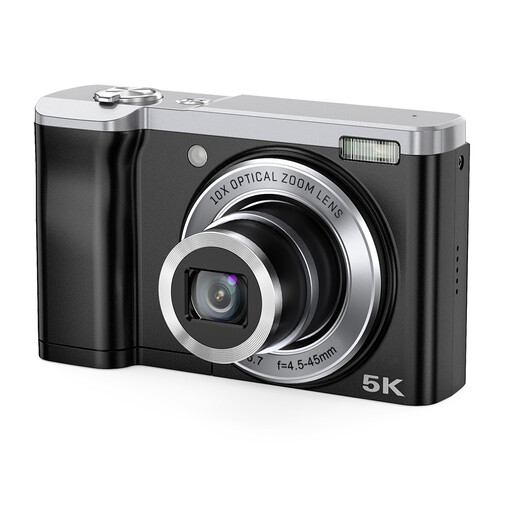 Image unavailable
Songdian 5K 56MP digital camera, 10x optical zoom, black
Consider this fixed-lens camera if you want optical zoom for travel without packing separate lenses. Its listing states 10x optical zoom and front and rear cameras; confirm the actual focal-length range for your intended distant subjects. If low-light scenes, moving subjects or bag space drive your choice, check the camera’s autofocus behaviour, dimensions and weight before ordering.
View on Joybuy
Frequently asked questions
Will a dedicated camera improve my low-light travel photos?
Not automatically: the result depends on the camera, lens, focus, subject movement and settings. Which? identifies low light as a reason to consider a dedicated camera, but compare the exact camera-and-lens combination for the scenes you shoot rather than assuming every dedicated camera will outperform your phone.
Should I choose a bridge or mirrorless camera for wildlife?
Choose a bridge camera if long built-in optical reach and no lens changes are your priorities; Panasonic specifies a 20–1200 mm equivalent lens for the DC-FZ82D. Choose mirrorless if you want interchangeable lenses and are willing to carry the one needed for wildlife. Nikon’s listed Z50II kit includes a separate 50–250 mm lens. Check handling and focus performance for the subjects you expect to photograph.
Can I use Canon EF or EF-S lenses on an EOS R50?
Yes, with a compatible Mount Adapter EF-EOS R, according to Canon. RF and RF-S lenses mount natively on the EOS R50, but EF-M lenses are incompatible. Confirm your specific lens and adapter before choosing a body-only kit.
Where should I pack spare camera batteries when flying?
Keep spare batteries in cabin baggage and check your airline’s current requirements, as the UK Civil Aviation Authority advises. Protect them during travel, and measure your loaded camera bag against the allowance for your flight; easyJet’s standard small under-seat bag limit is 45 × 36 × 20 cm.


