Hosts wanting an alcohol-free fizz
If a sparkling apple drink is part of the occasion, check whether the ingredients specify 100% carbonated apple juice. A product labelled ‘sparkling apple juice drink’ may have a different composition.


For a brunch where guests want a fizzy, alcohol-free apple drink, choose a product whose ingredients confirm 100% carbonated apple juice rather than relying on the word ‘sparkling’ alone. Individual cans suit help-yourself serving, while a bottle suits pouring shared glasses; still pressed apple juice makes sense when fizz is not important. Compare the juice percentage, sugars per 100ml and storage instructions on the pack you buy.
If a sparkling apple drink is part of the occasion, check whether the ingredients specify 100% carbonated apple juice. A product labelled ‘sparkling apple juice drink’ may have a different composition.
Guests who want fizz and guests who prefer a familiar still breakfast juice need not be offered the same drink. A sparkling option and a still pressed juice serve those preferences separately.
Look at the juice percentage, full ingredients, sugars per 100ml, pack size and after-opening instructions. The product name alone will not tell you all of these.
Decide whether fizz and 100% juice both matter, then choose a pack that fits how guests will be served.
| Priority | What to check | Your needs |
|---|---|---|
| Juice content | Read the stated juice percentage and ingredients. Coca-Cola Great Britain describes Appletiser as 100% carbonated apple juice from concentrate; the White Pearl listing at Tesco specifies 25% apple juice, carbonated water and glucose-fructose syrup. | If I want a 100% sparkling apple juice, I need the ingredients to confirm it—not just a sparkling apple name on the front. |
| Serving format | Compare individual 250ml cans with a 750ml bottle. Cans avoid opening a shared bottle; a bottle allows you to pour glasses at the table. | Guests helping themselves may find cans simpler. If I am serving everyone together, I may prefer to pour from a bottle. |
| Sugars and portions | Compare sugars per 100ml on the current labels rather than treating carbonation as a sugar measure. For unsweetened 100% fruit juice, the NHS says a maximum of 150ml counts as one 5 A Day portion, once a day. | I want to choose the glass size myself: a 250ml can is larger than the NHS amount that counts as one juice portion. |
| Storage | Check whether the drink needs chilling before serving and follow its own after-opening refrigeration and use-by instructions. Match the pack size to the amount guests are likely to drink. | If I expect leftovers, I would rather check the bottle’s storage instructions before opening it. |
| Bottle opening | Read any pressurised-contents warning on a corked bottle. Tesco’s White Pearl listing warns that its cork can pop abruptly. | At a crowded table, I want to open a corked sparkling bottle away from other people and follow its label. |
The Tesco listing for White Pearl specifies 25% apple juice alongside carbonated water and glucose-fructose syrup. Coca-Cola Great Britain lists Appletiser as 100% carbonated apple juice from concentrate; the two formulations are not interchangeable if juice percentage matters to you.
Check the percentage and complete ingredient list before choosing a sparkling drink.
Carbonation does not tell you the sugar content. The product information in this comparison lists sugars for both sparkling and still apple juices.
Compare the nutrition panels on the same per-100ml basis, using the current pack labels.
The NHS says a maximum of 150ml of unsweetened 100% fruit juice counts as one 5 A Day portion, once a day. A 250ml can is a pack size, not that counting amount.
Choose a serving size separately from the size of the can.
Tesco’s White Pearl listing warns that pressurised contents can cause the cork to pop abruptly.
Keep the cork pointed away from people and follow the bottle’s opening instructions.
These examples illustrate sparkling and still apple-juice formats; the ingredient and storage details apply to the products described, not every drink from each brand.
Coca-Cola Great Britain describes Appletiser as a lightly sparkling drink made from 100% carbonated apple juice from concentrate. Tesco lists both 6 x 250ml cans and a 750ml bottle.
The Copella Cloudy Apple Juice listed by Tesco is a still, not-from-concentrate apple juice in a 1.35L chilled bottle.
Tropicana describes Orchard Apple as 100% pressed apple juice, not from concentrate. The 900ml pressed-apple product listed by ASDA is a still juice.
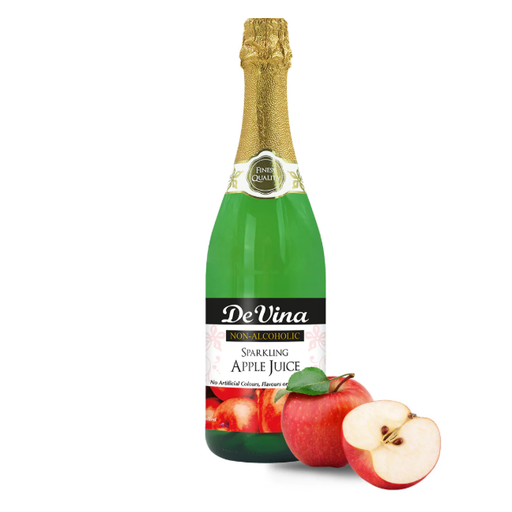
These two sparkling apple drinks offer different brunch-serving formats: individual Appletiser cans and a shared De Vina bottle. Check the De Vina label if 100% juice is essential to your choice.
 No image available
Six individual cans suit a brunch where guests will help themselves rather than share an open bottle. The stated ingredients are 100% carbonated apple juice from concentrate.
Check sugars per 100ml on the current pack. Each 250ml can is larger than the NHS maximum 150ml of unsweetened 100% fruit juice that counts as one 5 A Day portion once a day.
 No image available
The 750ml bottle offers a pourable sparkling apple drink for guests sharing glasses at the table.
If 100% apple juice matters, check the juice percentage on the current label. Check its nutrition panel and follow its after-opening storage and serving warnings, particularly if children under four will attend.
The NHS says a maximum of 150ml of unsweetened 100% fruit juice counts as one 5 A Day portion, once a day. Check that the sparkling product is unsweetened 100% juice rather than assuming the name confirms it; a larger can does not increase the amount counted.
Not necessarily. The supplied product information lists 10.2g sugars per 100ml for Appletiser and 10g per 100ml for the referenced Tropicana and Copella still juices. Compare the current nutrition panels per 100ml, as carbonation itself is not a measure of sugar content.
Choose individual 250ml cans if guests will help themselves without pouring from a shared bottle. A 750ml bottle suits serving glasses at the table; check how it should be stored after opening.
No. Tesco’s White Pearl listing specifies 25% apple juice from concentrate, carbonated water and glucose-fructose syrup, whereas Coca-Cola Great Britain lists Appletiser’s ingredients as 100% carbonated apple juice from concentrate. Read the juice percentage and ingredients on the product you choose.
Follow that bottle’s opening instructions and keep the cork pointed away from people. Tesco’s White Pearl listing specifically warns that its pressurised contents can make the cork pop abruptly.