Brunch cooks making hot dishes
If butter will go into eggs, pancakes or baking, compare the ingredient list and salt level of the particular block or tub. A spreadable blend is a different formulation, even when its name includes butter.


Choose a butter block or pure-butter tub when you want the butter-led ingredient lists shown on the cited labels for cooking or melting. If guests need to spread something straight from the fridge, a spreadable blend may be more convenient, but check its ingredients: the cited blends contain rapeseed oil and water. The cited butter and blends also contain milk, so check the label before serving anyone with a milk allergy.
If butter will go into eggs, pancakes or baking, compare the ingredient list and salt level of the particular block or tub. A spreadable blend is a different formulation, even when its name includes butter.
If guests will spread a product straight from the fridge, look for that use stated on its label. Sainsbury’s describes the cited Kerrygold spreadable as suitable for spreading straight from the fridge; it contains butter, rapeseed oil and water.
The cited butter blocks, pure-butter tub and spreadable blends contain milk. Check the individual pack before serving a guest with a milk allergy; the NHS distinguishes food allergy from lactose intolerance.
Start with how the butter will be used, then compare the ingredients and label information for the exact product you plan to serve.
| Priority | What to check | Your needs |
|---|---|---|
| Ingredients for cooking | Read the ingredient list to distinguish butter from a blend containing oil and water. Tesco Groceries lists butter, lactic culture and salt for its cited Lurpak block; Sainsbury’s lists butter and salt for its cited Kerrygold pure-butter tub. | For eggs, pancakes or baking, I want to know which formulation I am putting into the dish. |
| Cold-bread spreading | Look for an explicit fridge-ready spreading statement, then check the blend’s ingredients. Sainsbury’s makes that use claim for the cited Kerrygold spreadable, which lists 40% milk fat and 20% rapeseed oil. | Guests will be serving themselves cold toast, crumpets or bagels, so I do not want to wait for a block to soften. |
| Salt and saturates | Compare the same measure, preferably per 100g, on the exact packs. Tesco Groceries lists 1.2g salt and 52g saturates per 100g for its cited Lurpak block; Sainsbury’s lists 1.8% salt for its cited Kerrygold pure-butter tub. | I want to compare the products I might actually buy, rather than assume that all salted butters have the same figures. |
| Milk allergens | Check the current ingredient and allergen information for every product, including spreadable blends. The cited butter and blends contain milk. | Someone at brunch has a milk allergy, so a butter blend must not be mistaken for a dairy-free option. |
| Storage | Read the pack’s refrigeration, freezing and defrosting directions before buying more than you expect to use. The cited Anchor Salted Butter listing says to keep it refrigerated or freeze it for up to three months. | If there will be butter left after brunch, I need storage directions for that particular pack. |
The cited spreadable products include rapeseed oil and water, unlike the cited butter blocks and pure-butter tub. That difference matters if you are choosing by ingredients as well as by how easily a product spreads.
Read the ingredient list rather than relying on the word “butter” on the front of the pack.
Salt figures differ between the cited salted products. A per-serving figure also describes a different quantity from a per-100g figure.
Compare salt and saturates per 100g for the exact products, then check the stated serving size if you use per-serving figures.
The NHS distinguishes lactose intolerance from food allergy. The cited butter and spreadable products contain milk, so a spreadable formulation does not remove the milk-allergy concern.
For a guest with a milk allergy, do not serve these dairy products; check the allergen label of an alternative before serving it.
A brand name alone does not identify the formulation: compare the particular block, tub or spreadable product.
The cited Tesco Groceries listings include a slightly salted butter block and a separate spreadable blend.
The cited Sainsbury’s listings distinguish a pure-butter tub from a fridge-ready spreadable blend.
The cited Sainsbury’s listing describes a 200g salted butter block made with British milk.
The cited own-label products include a British salted butter block and a Taste the Difference spreadable blend.
Tesco Groceries lists its British Salted Block Butter 250g alongside branded blocks and spreadable products.
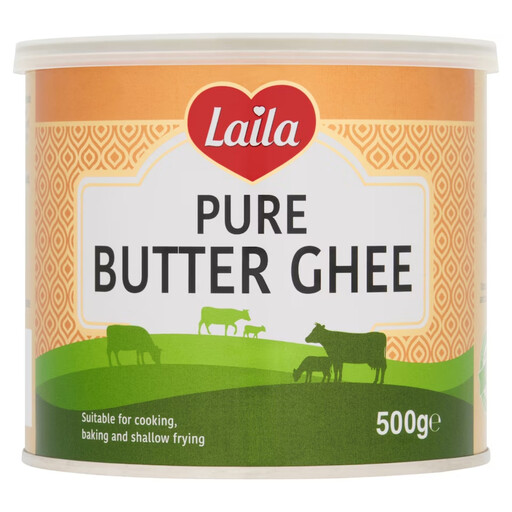
This ghee is an option to consider for hot brunch cooking, rather than a butter block or a spread labelled for use straight from the fridge.
 No image available
For a brunch menu involving cooking, this 500G butter ghee is a different format from the blocks and spreadable blends above. Check the pack’s milk-allergen and storage directions, and confirm whether its serving texture suits you if you also need something for cold toast.
Choose according to how you will serve it: a block or pure-butter tub has the butter-led ingredient lists shown on the cited cooking options, while the cited Kerrygold spreadable is labelled for spreading straight from the fridge. Check its ingredients if an oil-and-water blend would change your choice.
Not necessarily. Sainsbury’s lists its cited Kerrygold spreadable as a 60% fat blend with rapeseed oil and water, while its cited Taste the Difference spreadable is a 78% blend containing butter, rapeseed oil and water. Read the exact product’s ingredient list.
No: the cited products contain milk. Check the current allergen label of any alternative before serving it to a guest with a milk allergy.
No. The NHS distinguishes lactose intolerance from food allergy and includes butter among dairy products. Do not assume an individual’s suitability from the word “butter” or “spreadable”; check the label and follow advice relevant to that person’s circumstances.
Follow the directions on the specific pack. The cited Anchor Salted Butter listing says to keep it refrigerated or freeze it for up to three months; check that pack for its full freezing and defrosting instructions.