Hosts serving mixed preferences
Offer a regular and a zero-sugar choice if both are wanted. Choose the number and size of containers for the group rather than relying on brand alone.


For brunch with friends, offer regular cola if guests want it, and consider a separate zero-sugar option rather than assuming one formulation suits everyone. Coca-Cola Great Britain lists 10.6g sugars per 100ml for Original Taste and 0g for Coca-Cola Zero Sugar; Pepsi UK lists 4.5g for Pepsi and 0g for Pepsi MAX. If someone wants to avoid caffeine, choose a product explicitly labelled caffeine-free: standard Coca-Cola Zero Sugar and Pepsi MAX contain caffeine.
The useful starting point is what guests will actually drink, especially when the group has different preferences about sugar or caffeine.
Offer a regular and a zero-sugar choice if both are wanted. Choose the number and size of containers for the group rather than relying on brand alone.
Look for an explicitly caffeine-free cola. A zero-sugar label does not establish that the drink is caffeine-free.
Read the ingredient list and any phenylalanine statement on the exact pack, particularly if a guest needs to check whether it contains aspartame.
Decide which formulations to serve before choosing a pack format. Compare sugar figures on the same per-100ml basis, then check caffeine and ingredient labels on each option.
| Priority | What to check | Your needs |
|---|---|---|
| Sugar | Compare sugars per 100ml on the exact products. Coca-Cola Great Britain lists Original Taste at 10.6g and Zero Sugar at 0g; Pepsi UK lists Pepsi at 4.5g and Pepsi MAX at 0g. | I want guests to be able to choose between regular and zero-sugar cola, rather than having one option chosen for the whole group. |
| Caffeine | Check for explicit No Caffeine or Zero Caffeine wording and read the ingredients. Standard Coca-Cola Zero Sugar and Pepsi MAX list caffeine or caffeine flavouring, according to their UK brand labels. | Someone coming to brunch wants to avoid caffeine, so I need a separately labelled caffeine-free drink. |
| Sweeteners | Read the current ingredients and phenylalanine statement. Coca-Cola Great Britain and Pepsi UK list aspartame in their standard zero-sugar colas; GOV.UK explains the warning wording for foods containing aspartame. | I want guests who check sweeteners to be able to see the label for the drink they are served. |
| Pack format | Check the container size, pack count and how many different colas the group wants. Confirm the supplied quantity if a listing's title and description disagree. | Individual cans would let guests take different options; if everyone wants the same cola, a sharing format may be simpler. |
Standard Coca-Cola Zero Sugar and Pepsi MAX contain caffeine or caffeine flavouring, according to their UK ingredient lists. Their caffeine-free alternatives are separately labelled.
If a guest wants to avoid caffeine, check that the specific drink says No Caffeine or Zero Caffeine before serving it.
Regular colas do not all have the same sugar figure: Coca-Cola Great Britain lists 10.6g sugars per 100ml for Original Taste, while Pepsi UK lists 4.5g for Pepsi.
Decide whether to offer regular cola, zero-sugar cola or both, then compare the products' per-100ml labels.
Coca-Cola Zero Sugar and Pepsi MAX list sweeteners including aspartame and carry a phenylalanine statement. A guest checking ingredients needs the information for the particular drink on the table.
Keep the current pack available to read, and check its ingredients and warnings before serving.
These examples show why the full product name matters: regular, zero-sugar and caffeine-free variants can sit within the same range.
Its UK range includes Original Taste, Zero Sugar and a separately identified Zero Sugar Zero Caffeine option.
Pepsi UK identifies regular Pepsi, Pepsi MAX and a separate Pepsi MAX No Caffeine product.
Tesco's UK cola listings include branded and own-label products across regular, sugar-free and caffeine-free categories.
These multipacks cover regular cola, zero-sugar cola with caffeine, and a caffeine-free zero-sugar option for serving individual cans at brunch. Check each pack's label against your guests' preferences.
 No image available
A zero-sugar, caffeine-free choice in individually served cans. The product information lists 0g sugars per 100ml; it also lists sweeteners and a source-of-phenylalanine statement, so check the current pack if those ingredients matter to a guest.
 No image available
A 24-can zero-sugar option when caffeine is acceptable to the guests choosing it. Pepsi UK lists 0g sugars per 100ml for Pepsi MAX; its ingredients include caffeine and sweeteners, and its label states that it contains a source of phenylalanine.
 No image available
A regular-sugar option for guests who want Original Taste. Coca-Cola Great Britain lists 10.6g sugars per 100ml and caffeine flavouring. The listing title says 24 x 330ml, but its description says 2 x 18 x 330ml; confirm the supplied quantity before buying.
 No image available
A 24-can zero-sugar choice for guests who do not need a caffeine-free drink. Coca-Cola Great Britain lists 0g sugars per 100ml; standard Coca-Cola Zero Sugar contains caffeine flavouring and sweeteners and carries a source-of-phenylalanine statement.
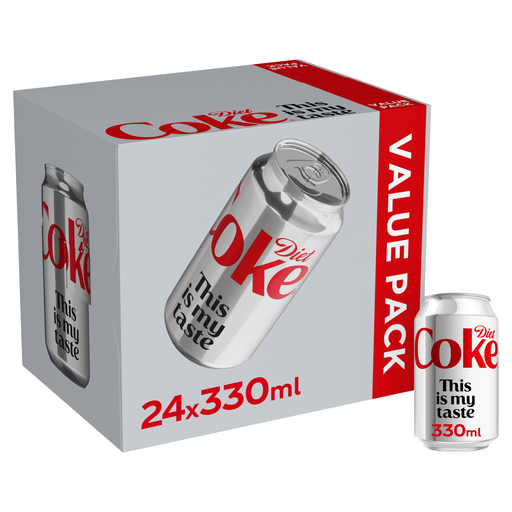 No image available
Another zero-sugar cola offered as 24 individual cans. The product information lists 0g sugars per 100ml, along with caffeine, sweeteners and a source-of-phenylalanine statement; it is not the choice for someone seeking caffeine-free cola.
No. Coca-Cola Great Britain lists caffeine flavouring in standard Coca-Cola Zero Sugar, and Pepsi UK lists caffeine in Pepsi MAX. For a caffeine-free choice, check that the specific product is explicitly labelled Zero Caffeine or No Caffeine.
Coca-Cola Zero Sugar and Pepsi MAX list aspartame and state that they contain a source of phenylalanine. GOV.UK sets out the warning wording for foods containing aspartame; read the statement on the exact pack if it matters to a guest.
Use the current product page when shopping and check the pack before serving. The pack identifies the ingredients and warnings for the drink you actually have, which matters when choosing between similarly named variants.
Read the ingredient list on the specific pack. GOV.UK guidance says manufacturers must provide information about food additives in ingredient lists; a zero-sugar description alone does not identify the drink's complete formula.