Shoppers seeking a fuller-tasting cup
You want to distinguish a pure green tea from a green-and-black blend before choosing on the basis of flavour descriptions.


Start with a smaller pack if you want to try pure green tea without committing to a larger box, but do not assume it will taste strong: Tesco Groceries describes the reviewed Clipper tea as light and delicate and Twinings Pure Green as mellow. If by “stronger” you mean a richer, more black-tea-like flavour, Twinings describes its green-and-black blend as rich; it contains 70% green tea and 30% black tea, so it is not a pure green tea or a measured strength winner.
You want to distinguish a pure green tea from a green-and-black blend before choosing on the basis of flavour descriptions.
You want to compare bag counts and ingredients before moving from a small trial box to an 80-bag pack.
You want to check whether a product is labelled decaffeinated rather than assuming ordinary green tea is caffeine-free.
Decide what “stronger” means to you, then check the tea type and pack directions before choosing a box size.
| Priority | What to check | Your needs |
|---|---|---|
| Pack size | Compare the number of bags and the stated pack weight. Consider a smaller box before committing to a larger one. | I would rather try a smaller pack before buying tea whose flavour I have not tasted. |
| Tea type and flavour | Read the ingredients as well as the flavour description. Twinings says its rich-tasting blend contains 70% green tea and 30% black tea; descriptions are not comparable strength measurements. | If I require pure green tea, a green-and-black blend will not meet that requirement, even if its flavour sounds fuller. |
| Brewing directions | Follow the pack’s infusion time. The UK Tea & Infusions Association advises water at around 80°C for green tea and says to read the pack instructions. | Before changing teas, I want to prepare the one I have consistently and see whether its flavour suits me. |
| Caffeine labelling | Check whether the pack is ordinary or decaffeinated green tea. Do not use flavour intensity as a guide to caffeine content. | When caffeine matters to me, I need the product’s caffeine or decaffeinated labelling, not just a stronger-tasting cup. |
Tesco Groceries describes the reviewed Clipper pure green tea as light and delicate, while its Twinings Pure Green listing says smooth, earthy and mellow. Neither description establishes an extra-bold flavour.
Check the flavour description and try a smaller pack if taste is your deciding factor.
Twinings Green Tea & Black Tea Blend contains 70% green tea and 30% black tea. Twinings describes it as rich, but it does not meet a pure-green-tea requirement.
Read the ingredient breakdown rather than relying on the product name alone.
Ordinary green tea contains caffeine; a fuller flavour does not tell you how much a cup contains.
Look for a clearly labelled decaffeinated product if avoiding caffeine is important to your choice.
These examples show why pack size, ingredients and flavour descriptions deserve separate checks; they do not establish which tea tastes strongest.
Tesco Groceries lists an own-label Green Tea 20 Pack 50g.
Tesco Groceries lists Clipper Organic Fairtrade Green Tea in an 80-bag pack.
The reviewed products include an 80-bag pure green tea and an 80-bag green-and-black blend.
Its green-tea range includes Mao Feng, jasmine pearls, popcorn tea and green tea with mint.
Pukka’s Mint Matcha Green combines sencha and matcha with mint.
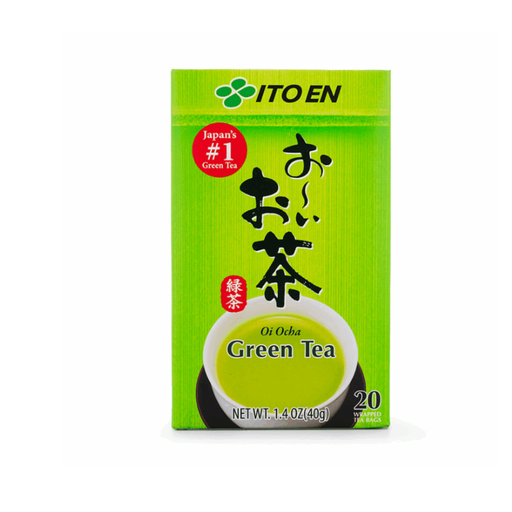
This 20-bag pure-green-tea option suits someone considering a smaller box before choosing a larger pack. Its flavour description is not an independent comparison with other teas.
 No image available
The 20-bag pack is an option if you want to try a smaller box of pure green tea. The product description lists green tea as the ingredient and describes the flavour as “rich, bold”; that wording does not establish how strongly it tastes compared with other teas. Check the pack’s brewing directions and caffeine information if either affects your choice.
Start with the pack directions so you can judge the tea as intended. The UK Tea & Infusions Association advises water at around 80°C for green tea and following the pack’s infusion time; a longer steep is not a reliable way to turn a light tea into an extra-bold one.
No. Twinings says its green tea contains around 30–40mg of caffeine per 200ml cup, with the amount varying by tea and brewing. Check for explicit decaffeinated labelling if caffeine is a deciding factor.
Check the ingredient list to distinguish pure green tea from a blend, then read the brewing directions and any caffeine or decaffeinated labelling. If you need to avoid a particular ingredient, check the physical pack before use rather than relying on a flavour description.