Multi-tray home bakers
You want to bake several trays of rolls in one session. Check the exact model’s supported shelf levels rather than assuming every fan oven handles the same batch.


If rolls are the main buffet item, start with a single fan oven whose exact model specification supports baking on several levels. Choose a double oven when other dishes need a separate cooking space or schedule; consider steam assistance only if its bread-baking method suits you. Check tray fit, cabinet dimensions and electrical requirements before choosing either format.
You want to bake several trays of rolls in one session. Check the exact model’s supported shelf levels rather than assuming every fan oven handles the same batch.
You need rolls and other buffet food on different timings or settings. Separate oven cavities may make that schedule easier to organise.
You care about crust and colour enough to consider a model-specific steam-baking process, including its preparation and cleaning steps.
Decide whether you need several trays in one cavity or separate spaces for other dishes. Then assess any steam feature and check whether the exact oven fits your kitchen and electrical setup.
| Concern | What to check | Who this matters to |
|---|---|---|
| Multi-tray baking | Check the stated baking levels, shelf positions and tray dimensions for the exact model. Bosch Home UK and NEFF Home Appliances GB each specify up to three levels for their cited hot-air models. | If I need to bake several trays of rolls together, even baking across the intended shelf levels comes before a large capacity figure. Around 31% of consumers would put multi-tray baking first. |
| Separate cooking schedules | Compare the two cavities’ usable space and controls with the dishes you plan to make; check the taller cabinet space a built-in double oven needs. | When other buffet dishes need different timings or settings, I want to keep the rolls on their own schedule. For around 31% of consumers, separate cooking space is the primary concern. |
| Bread finish | Confirm the exact model has a bread-suitable steam mode and read its water, preheating and cleaning instructions. | I may accept an extra preparation step if controlling the rolls’ crust and colour matters more to me than oven format. Bread finish would come first for around 19% of consumers. |
| Fit and installation | Compare the installation drawing with your cabinet opening and check the model’s connection and power requirements before ordering. | If my kitchen opening or electrical connection limits the choice, I need an oven that can be fitted appropriately before I weigh its baking features. Around 19% of consumers would prioritise fit and installation. |
A capacity figure does not tell you whether your trays fit or how many levels the model supports for baking rolls at once.
Check internal shelf positions, tray dimensions, supplied accessories and the manufacturer’s guidance for the baking mode you intend to use.
Connection and power requirements vary by model. Electrical Safety First advises checking an oven’s power requirements before choosing it.
Read the exact installation instructions and seek qualified electrical advice if the existing circuit or connection is uncertain. Do not plan to power a high-load oven through an extension lead.
Depending on the oven and existing installation, fitting it may involve electrical work.
A steam-baking feature does not establish how many trays will fit, and its operating steps can add work during buffet preparation.
Consider it for the bread finish you want, then check the selected model’s steam procedure and multi-level baking guidance separately.
Selling or serving rolls as a food business brings obligations that an oven feature cannot address. The Food Standards Agency says a new food business should register with its local authority at least 28 days before trading or food operations begin.
If the buffet is commercial, address registration and food-safety procedures separately from the oven purchase.
Relevant if you are comparing a single oven for several trays with a double oven for dishes on separate schedules.
Relevant if multi-level hot-air baking and access to the oven cavity are priorities.
Relevant when comparing double-oven scheduling with steam-assisted bread baking; these are model-specific options.
These built-in single and double ovens offer choices for baking roll batches or cooking other buffet dishes separately. Check the exact model’s tray guidance and installation requirements against your plans.
 No image available
The double-oven format may suit rolls and other buffet dishes that need separate cooking spaces.
Check the appliance and cabinet dimensions carefully: the 90 cm designation and a listed height of 885 mm need to be reconciled before fitting. Confirm the electrical connection, tray fit and supported baking levels for your planned batch.
 No image available
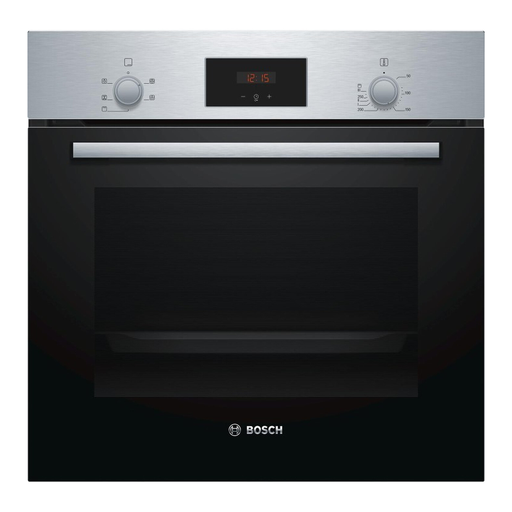
Consider this single oven when rolls are the main batch and you want a stated multi-level baking mode: Bosch Home UK specifies 3D Hotair for up to three levels on the HHF113BR0B.
One cavity cannot run another dish independently at a different setting. Check tray fit, cabinet dimensions and the exact installation instructions before buying.
 No image available
The two-cavity format may help when rolls and other buffet dishes need different cooking schedules.
Before planning a multi-tray roll batch, check this model’s shelf-level guidance and tray fit. Match its installation dimensions and electrical requirements to your kitchen.
A single oven with a stated multi-level baking mode suits rolls cooked as one batch; a double oven becomes useful when other dishes need a separate setting or schedule. Compare usable tray space and cabinet dimensions before deciding, rather than relying on the number of cavities alone.
No multi-level result should be assumed from the fan-oven label alone. Bosch Home UK specifies up to three levels for the HHF113BR0B’s 3D Hotair mode, and NEFF Home Appliances GB specifies up to three for the B54CR71N0B’s CircoTherm mode; follow the selected oven’s guidance for shelf positions, trays and settings.
Check the exact oven’s connection and power requirements against the existing installation before ordering. Electrical Safety First advises reviewing power requirements and having an oven fitted by a qualified electrician; do not assume that two built-in models use the same connection.
Yes, operating a food business involves requirements beyond choosing an oven. The Food Standards Agency says a new food business should register with its local authority at least 28 days before trading or food operations begin; address food-safety procedures separately from appliance features.