Buffet operators managing salt
Hotel teams comparing sauce labels and setting a consistent serving size so they can assess the salt in the portion offered to guests.


For a hotel breakfast buffet, choose between a ready-made pasta sauce and a passata base according to preparation capacity, then compare salt per 100g and in the portion you plan to serve. Passata lets the kitchen control added seasoning but needs a consistent recipe; a ready-made sauce reduces preparation, but its salt and allergen information must be checked for the exact product.
Hotel teams comparing sauce labels and setting a consistent serving size so they can assess the salt in the portion offered to guests.
Teams weighing the convenience of a finished sauce against the recipe work involved in turning passata into a buffet sauce. A low-fat label does not answer their salt question.
Teams keeping the sauce recipe and guest information aligned. GOV.UK guidance says food businesses must provide allergen information for non-prepacked food as well as prepacked food.
Choose when: The kitchen can make and follow a standard sauce recipe while controlling what it adds.
Trade-off: Passata is an ingredient, not a finished sauce, so preparation and recipe control remain with the kitchen.
Choose when: Reducing preparation steps is more important than controlling the sauce recipe from a tomato base.
Trade-off: Its finished recipe leaves less room to control ingredients; assess the exact sauce rather than relying on a front-of-pack claim about another nutrient.
| Concern | What to check | Who this matters to |
|---|---|---|
| Salt in the served portion | Compare salt per 100g on the same prepared or as-sold basis, then work out the amount in the planned serving, including any salt added to a house recipe. | If I need to control salt across buffet servings, the ladle size matters as well as the pack label; about 40% of consumers put portion-level salt control first. |
| Preparation and service | Confirm whether the product is a finished sauce or a base, and check its preparation and storage instructions against the intended service. | When breakfast preparation time is tight, I need a repeatable sauce without more recipe work than the team can manage; roughly 30% of consumers prioritise preparation and service speed. |
| Ingredient and allergen information | Keep the current pack or supplier specification, recipe and guest information aligned whenever the product or recipe changes. | If a supplier changes the sauce, I need the allergen information available to guests to match what is served; about 30% of consumers place accurate ingredient and allergen information first. |
The Dolmio Low Fat Bolognese listing on Tesco Groceries declares 0.67g salt per 100g and 0.75g per listed portion. Its low-fat positioning does not establish that it is a reduced-salt pasta sauce.
Read the salt line and calculate the amount in the buffet portion before approving the sauce.
Sainsbury's lists reduced-salt ketchup and reduced-sugar-and-salt baked beans, but their product claims do not describe a pasta sauce or establish how one would work in a buffet recipe.
Check the ingredients and nutrition of the exact pasta sauce or tomato base you intend to serve.
Tesco Groceries cautions that reformulation can change ingredients, nutrition and allergens. A changed sauce or base can leave a buffet recipe record out of step with the food served.
Check the current pack or supplier specification and update the recipe and allergen information when the product changes.
A tomato-base option for kitchens preparing their own pasta sauce.
A ready-made sauce route represented here by the Low Fat Bolognese product listed by Tesco Groceries.
A retailer whose product listings can help with an initial comparison of exact sauces.
A retailer with reduced-salt products in other tomato-based food categories.
For a kitchen preparing its own breakfast-buffet pasta sauce, this selection is a passata base, not a ready-made sauce. Check the planned recipe and serving size before assessing the finished dish.
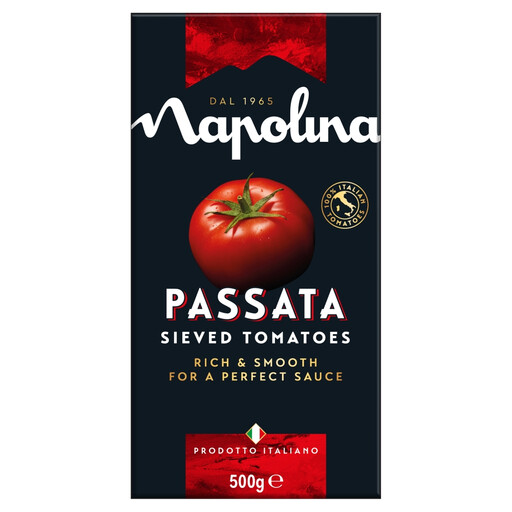 Image unavailable
A 500g passata for a kitchen-made pasta sauce when staff can prepare and follow a consistent recipe. It is a tomato base rather than a finished sauce; check the current pack's salt and allergen information, then account for added ingredients and the portion served.
Bristol City Council's catering guidance describes a product with no more than 0.3g salt per 100g as low in salt. Compare the per-100g declarations on a like-for-like basis, then calculate salt for the amount of finished sauce the buffet will serve.
No. Low fat describes a different nutrient. The Dolmio Low Fat Bolognese listing on Tesco Groceries declares 0.67g salt per 100g and 0.75g per listed portion, so check a sauce's own salt declaration rather than its low-fat name.
Food businesses must provide allergen information for non-prepacked food: GOV.UK guidance covers England, Wales and Northern Ireland, while Food Standards Scotland gives guidance for Scotland. Keep the information given to guests aligned with the exact sauce and the full recipe served.
Use it for an initial comparison, then check the current pack or supplier specification before service. Tesco Groceries cautions that reformulation can change ingredients, nutrition and allergens.