
24/7 Customer Support

Free returns

Same-day & Next-day Delivery

Quality Guaranteed

Unlock Your Welcome Offers: FREE Delivery | Up to 80% OFF | Free 30-day JoyPlus trial
Download the APP
A new built-in hob is the centrepiece of a modern kitchen, promising a sleek look and enhanced cooking performance. Yet, many UK homeowners find their exciting purchase quickly leads to frustration. Marketing claims often obscure practical flaws, from surfaces that are impossible to keep clean to power demands that your home's wiring simply can't handle. Before you invest, it's crucial to understand the key differences that separate a reliable workhorse from a costly countertop ornament.
As a Joybuy Product Recommendation Officer, my role is to help you see past the hype. This guide focuses on the essential, non-negotiable factors to consider, ensuring you select an integrated hob that genuinely fits your cooking style, kitchen design and budget.
Many hobs look great in the showroom but fail in a real-world kitchen. Here are the most common issues we see and how to sidestep them:
induction hob or ceramic hob. However, many of these high-performance models require a dedicated 32A hardwired electrical circuit. If your kitchen is only equipped with standard 13A sockets, you will face an unexpected and potentially expensive bill from an electrician to upgrade your wiring. Always check the "rated fuse" or "total connected load" specification before you buy.5 burner gas hob sounds ideal for large families or keen cooks, but the promise of versatility can be misleading. On a standard 60cm hob, five burners are often crammed so tightly that you can't physically fit more than two or three pans on at once, rendering the extra burners useless. Pay close attention to the hob's width (e.g., 75cm or 90cm) and the layout of the burners to ensure there is practical space for your cookware.To make a smart choice, focus on these three fundamental specifications.
This is the most important decision and dictates your daily cooking experience.
gas on glass hob models combine this control with a sleek, easier-to-clean surface. A crucial safety feature to look for is a Flame Failure Device (FFD), which cuts the gas supply if the flame is extinguished.electric hob that provides a sleek, modern look for a lower initial cost than induction. It works with any type of flat-bottomed pan. The main drawback is that it's slower to heat up and cool down and the glass surface retains a lot of heat, which is indicated by a residual heat indicator.While hobs are categorised by width (e.g., 60cm hob, 75cm, 90cm), the most critical measurement is the cut-out dimension. This is the exact size of the hole required in your worktop. A standard 60cm hob typically requires a cut-out of around 560mm x 490mm. Always measure your existing space or confirm the dimensions with your kitchen fitter before purchasing to avoid costly mistakes.
Your choice of controls affects both aesthetics and daily use.
Based on these practical considerations, we've matched several models to different UK household needs.
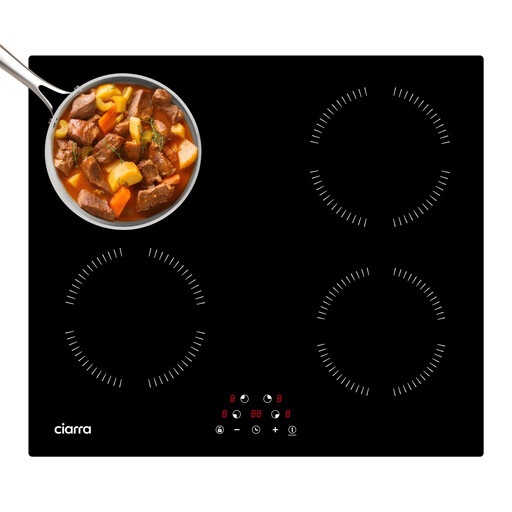
Why This Fits Their Persona: For those who prioritise speed, safety and a clean aesthetic, this induction hob is an ideal choice. Its responsive touch controls and flat glass surface fit perfectly into a contemporary kitchen design, while the efficiency of induction cooking appeals to the tech-savvy and energy-conscious user.
The specifications clearly state it requires a 32A rated fuse, making the electrical requirements transparent from the start. As an induction hob, spills don't burn on, making it genuinely easy to clean.
Features 9 power levels for precise temperature control and includes essential safety functions like a child lock and residual heat indicators. The 4 zone hob layout is practical for a standard 60cm space.

Why This Fits Their Persona: Perfect for those who love the control of gas cooking but want a modern look. This hob is ideal for busy family kitchens where multiple dishes are prepared at once, from a quick stir-fry on the powerful wok burner to simmering sauces.
Its 75cm width provides ample space between the five burners, avoiding the "crowded cooking" trap. The sleek gas on glass hob surface is significantly easier to wipe down than traditional stainless steel gas hobs.
Features a powerful 5kW double-ring wok burner for high-heat cooking and robust, dishwasher-safe cast iron supports for stability. The Preci Flame technology offers 9 distinct power levels for more precise control than standard gas hobs.

Why This Fits Their Persona: This hob is for the user who wants a modern, reliable electric hob but prefers the familiar, tactile feel of physical dials. It's a straightforward, no-fuss appliance from a trusted brand, making it a solid choice for kitchen upgrades or rental properties.
While it has knobs, their side-mounted position keeps them away from the main cooking zones, reducing grime build-up. The frameless design ensures there's no metal rim to trap dirt, making it easier to clean than many other knob-controlled models.
It combines the sleek look of a black glass ceramic hob with the intuitive feel of a hob with knobs. The 4 HighSpeed cooking zones heat up quickly and the 9 power levels offer precise control.
We have compiled a complete, real-time list of products that fully satisfy these strict selection criteria and UK safety regulations.
1. Do I need a special electrician to install a built-in hob? For any gas hob, UK law requires that installation is carried out by a Gas Safe registered engineer. For most electric hob models, including powerful induction and ceramic types, a qualified electrician is necessary for safe hardwiring into the mains. The only exception is for "Plug & Play" models specifically designed with a standard 13A plug, which can be installed without an electrician.
2. How much does it cost to run an induction hob vs a gas hob in the UK? Induction hobs are significantly more energy-efficient, converting around 85-90% of their energy into heat for the pan. Gas hobs are much less efficient, at around 40-55%. While energy tariffs fluctuate, the superior efficiency of an induction hob generally makes it cheaper to run over the long term compared to gas.
3. What is the average lifespan of a built-in hob? With proper care, a quality built-in hob can be expected to last for 10 to 15 years. Gas hobs, with their simpler mechanical components, can sometimes have a longer operational life. The lifespan of induction and ceramic hobs is often dependent on the durability of their internal electronic components. Choosing a model from a manufacturer with a good reputation for reliability can contribute to a longer service life.